

This bill requires the President to impose visa- and property-blocking sanctions on the Supreme Leader of the Islamic Republic of Iran, Ayatollah Ali Khameini, and the Iranian president elected in 2021, Sayyid Ebrahim Raisol-Sadati.
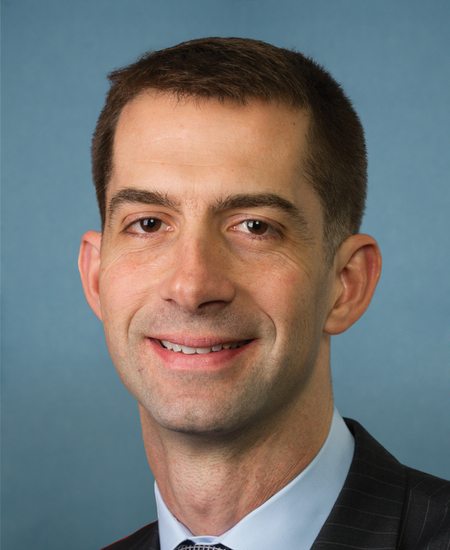
Sen. Tom Cotton
Sponsored bills
This resolution recognizes the 75th anniversary of the Fulbright Program, which promotes international goodwill through the exchange of students in the fields of education, culture, and science.
Stop CRT Act This bill grants Executive Order 13950 the force and effect of law, except with respect to elementary schools, secondary schools, or institutions of higher education. That order prohibits federal agencies and contractors from advancing specified policies or training related to race or sex. The bill further prohibits the allocation of federal funds to an elementary school, secondary school, or institution of higher education that compels teachers or students to affirm certain race-based theories.
Intelligence Community Workforce Agility Protection Act of 2021 This bill allows a current tax deduction for the moving expenses of an employee or new appointee of the intelligence community who moves due to a change in assignment that requires relocation. It also allows a current tax exclusion for such employees or appointees for moving expense reimbursements. Under current law, the tax deduction and exclusion for the moving expenses of other taxpayers are suspended for the period beginning in 2018 through 2025.
Travel Mask Mandate Repeal Act of 2021 This bill prohibits federal agencies from mandating the use of masks or face coverings on planes, trains, buses, and other public conveyances and at transportation hubs to prevent the transmission of COVID-19. Specifically, the bill nullifies (1) the rule issued by the Centers for Disease Control and Prevention (CDC) on January 29, 2021, that mandates such use of masks or face coverings; and (2) orders and directives of the Transportation Security Administration that relate to the CDC rule.
This resolution commemorates the 50th anniversary of the National Center for Toxicological Research.
Securing the Homeland from International Entrants with Life-threatening Diseases Act or the SHIELD Act This bill suspends for one year the admission and parole into the United States of certain categories of individuals who are from or were recently in a country that fails to meet certain criteria related to COVID-19. This restriction applies to certain individuals entering the United States from Mexico or Canada through a port of entry or U.S. Border Patrol station and (1) whose country of origin has not been categorized by the Centers for Disease Control and Prevention as a low-risk country for COVID-19, or (2) who was in such a country at any time in the 30 days before arriving in the United States. The bill exempts certain individuals from this restriction, including U.S. citizens and lawful permanent residents, members of the Armed Forces, and persons from a foreign country who arrive at a designated port of entry with valid travel documents. The Department of Homeland Security shall transport barred individuals to a foreign location, such as an individual's country of origin, to the extent practicable.
This resolution urges the Biden Administration to ensure that the military has all the necessary resources to build and sustain the country's military strength.
Unnecessary Agency Regulations Reduction Act of 2021 This bill requires the Office of Information and Regulatory Affairs to annually report a list of major rules (i.e., rules with a significant economic impact, cost to consumers, or adverse effects on competition) that it recommends should be consolidated or repealed because they are outdated, duplicative, or incur excessive compliance costs. Congress must review the list to determine, and recommend by joint resolution, any such rules to consolidate or repeal.
Protect American Power Infrastructure Act This bill prohibits certain transactions that involve using bulk-power equipment to provide power for defense critical electric infrastructure in the United States if a foreign adversary owns or exercises influence over the equipment, including transactions that (1) involve equipment designed, developed, manufactured, or supplied by persons owned by, controlled by, or subject to the direction of a foreign adversary; and (2) pose an undue risk of catastrophic effects on the security or resiliency of such infrastructure. However, the Department of Energy may approve transactions if it designs or negotiates measures to mitigate such risks.