

Freedom from Mandates Act This bill nullifies certain executive orders regarding COVID-19 safety and prohibits the Departments of Labor and Health and Human Services (HHS) from taking specified actions with respect to vaccination against COVID-19. Specifically, the bill nullifies Executive Order 14042 (relating to ensuring adequate COVID-19 safety protocols for federal contractors) and Executive Order 14043 (requiring COVID-19 vaccination for federal employees). Labor may not issue any rule requiring employers to mandate vaccination of employees against COVID-19 or requiring testing of employees who are unvaccinated. HHS may not (1) require a health care provider, as a condition of participation in the Medicare or Medicaid program, to mandate vaccination of employees against COVID-19 or require testing of employees who are unvaccinated; or (2) otherwise penalize such a provider for failure to mandate such vaccination or require such testing.
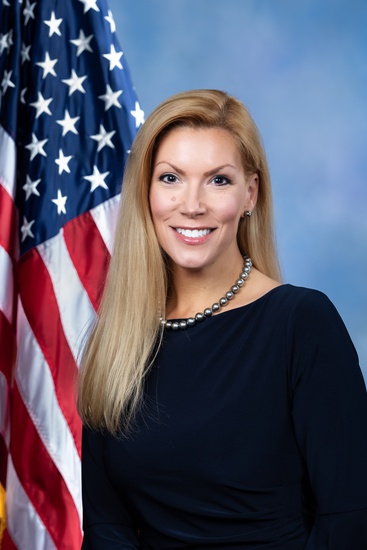
Rep. Beth Van Duyne
Sponsored bills
Permanently Preserving America's Investment in Manufacturing Act This bill makes permanent the allowance for depreciation, amortization, or depletion for purposes of determining the income limitation on the tax deduction for business interest.
Unruly Passenger Restraint Review Act This bill requires the Government Accountability Office to review and recommend ways to improve passenger air carriers' policies, training, and related procedures concerning unruly passengers. It also requires the Federal Aviation Administration to develop, taking into account the review's findings and recommendations, best practices for such procedures.
This resolution expresses the sense of the House of Representatives that the United States shall recognize kind actions in our country, encourage kindness, spread love, and foster a culture of being kind to one another.
This resolution celebrates the contributions of small businesses in every U.S. community and supports the designation of National Small Business Week. Further, it supports efforts to provide small businesses with aid and assistance through certain programs and initiatives.
This bill requires the Internal Revenue Service (IRS) to report to Congress on projections of the estimated tax gap (i.e., the difference between tax liabilities owed to the IRS and those liabilities that the IRS actually collects). The IRS may use artificial intelligence and related data analysis tools to calculate a tax gap projection. The bill also requires the Joint Committee on Taxation to issue periodic reports to the congressional tax committees on the tax gap projection. The bill restricts IRS funding to FY2021 levels for audits and enforcement until it publishes an updated tax gap projection. Funding is also restricted for certain purposes, including (1) targeting U.S. citizens who exercise their First Amendment rights, (2) targeting a group for regulatory scrutiny based on its ideological beliefs, and (3) auditing individual taxpayers with an adjusted gross income of less than $400,000. The bill directs the IRS to establish a fellowship program to recruit private sector tax experts to join the IRS to create and participate in the audit task force. The purposes of the tax force include performing audit case selection, educating IRS employees on emerging issues, auditing selected taxpayers, addressing offshore tax evasion, and identifying, mentoring, and training IRS junior employees with respect to audits.
This bill designates the community-based outpatient clinic of the Department of Veterans Affairs in San Angelo, Texas, as the Colonel Charles and JoAnne Powell VA Clinic.
Countering Communist China Act This bill addresses issues related to China, tax incentives, and other topics. The bill imposes visa- and property-blocking sanctions on certain entities and individuals that (1) are involved in acts of malign disinformation on behalf of a foreign government or political party, or (2) have engaged in a pattern of significant infringement of intellectual property belonging to a U.S. entity or individual. It also authorizes sanctions on developers and owners of software that makes unauthorized transmissions of user data to servers that are located in China and are accessible by China's government. The bill also provides tax incentives for relocating pharmaceutical, medical supply, or medical device manufacturing to the United States, including by allowing accelerated depreciation of nonresidential real property acquired in connection with such relocation; eliminates the five-year amortization requirement for research and experimental expenditures scheduled to begin in 2022, thus allowing continued expensing of such expenditures in the taxable years in which they are incurred; prohibits an institution of higher education from receiving certain federal funds if the institution has a contractual partnership with an entity controlled by China's government or organized under China's laws; modifies presumptions and evidentiary standards in administrative patent validity challenges; bars China from asserting sovereign immunity in certain instances; requires U.S. representatives to the International Monetary Fund (IMF) to take certain actions, such as opposing any increase to the weight given to China's currency when determining the value of IMF Special Drawing Rights; and permanently rescinds unobligated funds previously made available for certain economic relief programs related to COVID-19.
Combating Predatory Lending in Higher Education Act of 2021 This bill includes Direct PLUS Loans that are made to graduate students and parents on behalf of dependent students in an institution of higher education's (IHE's) cohort default rate. This rate is the percentage of an IHE's borrowers who enter repayment and default on certain student loans. Further, the Department of Education must include this information in its annual report on cohort default rates.
This resolution condemns the President's failure to heed military and intelligence advisors about the speed and nature of the Taliban offense in Afghanistan and urges the President to commit to maintaining the evacuation operation as long as necessary to evacuate any U.S. citizen, lawful permanent resident, or Afghan partner who requests evacuation assistance .