

Maddy summaryThis resolution (HRES 583) condemns the July 7, 2025, attack on a U.S. Border Patrol facility in McAllen, Texas, where Ryan Louis Mosqueda injured agents and police. It expresses support for the affected personnel, wishes them a full recovery, and reaffirms the House’s backing of Border Patrol officers in their border security mission. The resolution directly addresses the McAllen community and Border Patrol staff impacted by the violence, serving as a symbolic statement of solidarity without creating new laws or policies.
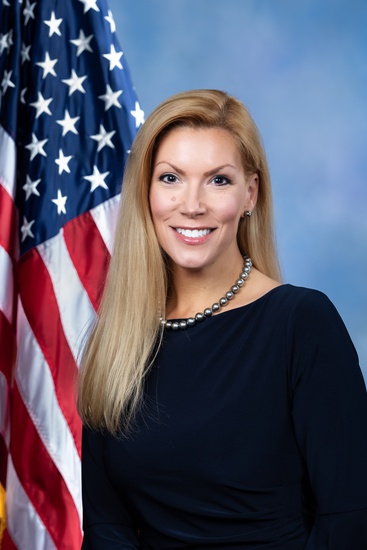
Rep. Beth Van Duyne
Sponsored bills
Maddy summaryHR 4382 authorizes the U.S. Mint to produce commemorative coins for the 2028 Los Angeles Olympics/Paralympics and 2034 Salt Lake City Winter Olympics/Paralympics. It specifies gold, silver, and half-dollar coin designs with defined mintage limits (e.g., up to 100,000 $5 gold coins for each event), all bearing inscriptions like "2028" or "2034" and standard coin features. A surcharge ($5-$50 per coin) is added to sales, with all funds directed to the respective Olympic committees to support event hosting and legacy programs like youth sports. The bill ensures no net cost to the government by requiring surcharge revenues to cover all design, production, and marketing expenses before funds are disbursed.
Maddy summaryHR 4363, the Defend Girls Athletics Act, requires public K-12 schools and colleges to certify annually that they comply with Executive Order 14201, which mandates keeping men out of women's sports. Schools must submit written compliance certifications by August 15 each year (for K-12) or July 1 (for colleges), with states reporting non-compliant agencies to the federal government. Schools or colleges failing to certify or violating the rule risk losing federal education funding, including returning unobligated funds and becoming ineligible for future federal support. The bill directly affects all public schools and colleges receiving federal education funds by tying their eligibility to adherence to this sports participation requirement.
Maddy summaryHR 4370, the SAMS Act of 2025, codifies five existing executive orders into law to strengthen U.S. mineral supply chains. It gives legal force to orders focused on securing critical minerals (like lithium and rare earths) for national security and economic resilience, directly affecting federal agencies implementing these strategies. Key provisions require agencies to follow these established policies - addressing reliance on foreign mineral sources, supporting domestic mining, and prioritizing national security in mineral processing - without creating new regulations. The bill does not alter current mineral policies but formally enshrines them as binding federal requirements.
Maddy summaryHR 3179 proposes renaming the Anahuac National Wildlife Refuge in Texas to the "Jocelyn Nungaray National Wildlife Refuge." The bill directly affects the refuge's official name and all federal references to it, including documents and maps. It cites findings about 12-year-old Jocelyn Nungaray's murder in Houston and states the renaming honors her, given her love of animals and local connection. The key mechanism is a straightforward name change for all federal records, with no new policies or funding impacts.
Maddy summaryThis bill requires drug manufacturers to pay rebates to Medicare when their "selected drugs" (cancer and complex therapies subject to negotiated maximum fair prices) are used. Manufacturers must calculate rebates based on the difference between current Medicare payment rates (ASP+6) and new negotiated rates (MFP+6), covering the gap for beneficiaries. This lowers patient coinsurance from the current 20% of ASP+6 to 20% of MFP+6 for these specific drugs during the negotiated price period. The rebates are paid to the Medicare trust fund and apply to Medicare Part B beneficiaries using these drugs, directly affecting drug manufacturers and patients covered under Medicare Part B.
Maddy summaryHR 4148 disapproves a Department of Labor regulation (88 Fed. Reg. 57526) that would have updated wage requirements under the Davis-Bacon Act for federal construction projects. The bill states this regulation "shall have no force or effect," preventing federal contractors from being subject to the proposed changes. This is a procedural measure targeting a specific regulatory update, directly affecting contractors working on federally funded construction projects.
Maddy summaryHR 4053, the "Stop Funding Rioters Act," blocks individuals convicted of specific offenses from accessing Small Business Administration (SBA) programs. It directly affects people convicted of assaulting police officers (as a misdemeanor or felony) or committing a felony during a riot that destroyed a small business. The bill's key provision denies eligibility for any SBA assistance, loans, or programs to these individuals. This policy change modifies SBA program access based solely on prior criminal convictions related to violence against law enforcement or riot-related property damage.
Patient Access to Higher Quality Health Care Act of 2025 This bill repeals provisions under the Stark law (i.e., the Physician Self-Referral Law) that limit, for purposes of Medicare participation, self-referrals by newly constructed or expanded physician-owned hospitals.
Maddy summaryThis resolution (HRES 503) is a non-binding expression of support for designating June 11, 2025, as "World Franchise Day." It does not create new laws or directly affect any individuals or businesses; instead, it symbolically recognizes franchising's economic role. The resolution cites franchising's history (tracing to Benjamin Franklin and Isaac Singer), its current scale (830,876 U.S. establishments supporting 8.8 million jobs), and its contribution to the economy (nearly 3% of GDP). It is a procedural resolution, not a policy change, meant to acknowledge franchising's significance as a business model.