

Robust International Response to Pandemic Act This bill requires the Department of the Treasury and each U.S. Executive Director at an international financial institution to take certain actions in support of the global response to COVID-19 (i.e., coronavirus disease 2019). Specifically, each U.S. Executive Director at an international financial institution (e.g., the International Bank for Reconstruction and Development or the International Finance Corporation) must seek the suspension of debt service payments to the institution and the relaxation of fiscal targets for certain programs, oppose programs or loan agreements that would reduce countries' health care spending or other spending related to their responses to COVID-19, and require approval of all Special Drawing Rights (a currency support tool) allocation transfers from wealthier member countries to countries that are emerging or developing to ensure the allocations are used for the public good and in response to the global pandemic. Further, the U.S. Governor at the International Monetary Fund (IMF) must advocate for the issuance of Special Drawing Rights so that governments may access additional resources to finance their responses to COVID-19. Of these Special Drawing Rights allocated to the United States, Treasury must lend a specified amount to the Poverty Reduction and Growth Trust or other special purpose vehicle of the IMF to help eligible low-income countries respond to COVID-19. Treasury must also advocate for an extension of the current moratorium on debt service payments to official bilateral creditors by the world's poorest countries.
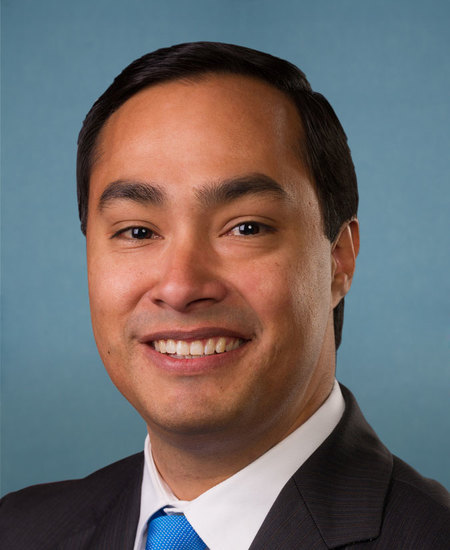
Rep. Joaquin Castro
Sponsored bills
"Six Triple Eight" Congressional Gold Medal Act of 2021 This bill directs the Speaker of the House of Representatives and the President pro tempore of the Senate to arrange for the award of a Congressional Gold Medal in honor of the women of the 6888th Central Postal Directory Battalion (commonly known as the Six Triple Eight) in recognition of their pioneering military service, devotion to duty, and contributions to increase the morale of personnel stationed in the European theater of operations during World War II. The medal shall be given to the Smithsonian Institution and made available for display and research.
High Speed Rail Corridor Development Act of 2021 This bill revises and reauthorizes through FY2025 the high-speed rail corridor development competitive grant program of the Department of Transportation (DOT). In awarding grants, the bill requires DOT to prioritize (1) projects that involve the purchase of electrified next generation passenger rail equipment, and (2) applications for projects that provide for a greater non-federal share of the cost of such projects. DOT must also for each fiscal year set aside 50% of funds for projects with a federal share that does not exceed 50% of the project net capital cost.
Gym Mitigation and Survival Act of 2021 or the GYMS Act of 2021 This bill establishes a grant program to provide economic support to eligible fitness facilities in response to the COVID-19 (i.e., coronavirus disease 2019) pandemic. Specifically, the bill authorizes the Small Business Administration to make initial and supplemental grants to privately owned fitness facilities that primarily provide health or fitness services and that do not offer golf, hunting, sailing, or riding facilities. The total amount of grant funds for a recipient may not exceed $25 million, and the recipient must use these funds for payroll costs, rent or mortgage obligations, and other ordinary and necessary business expenses.
Family and Medical Insurance Leave Act or the FAMILY Act This bill entitles every employee to a family and medical leave insurance (FMLI) monthly benefit payment of two-thirds of the employee's regular pay, limited to a maximum of $4,000, for not more than 60 days of qualified caregiving. The bill establishes the Office of Paid Family and Medical Leave within the Social Security Administration to administer the FMLI program. An FMLI benefit payment must be coordinated with any periodic benefits received under a state or local temporary disability insurance or family leave program. The bill imposes a tax on employers, employees, and self-employed individuals to fund FMLI benefits. It also establishes the Federal Family and Medical Leave Insurance Trust Fund to hold tax revenues.
This resolution recognizes the contributions of frontline workers and other essential personnel and reaffirms the responsibility of Congress to meet the needs of those workers and the elderly during the COVID-19 (i.e., coronavirus disease 2019) pandemic.
Homeownership for DREAMers Act This bill prohibits federal mortgage providers from limiting insurance eligibility on the basis of the mortgagor's participation in the Deferred Action for Childhood Arrivals Program.
Keep Our Promise to America's Children and Teachers Act or the Keep Our PACT Act This bill provides funding through FY2031 for grant programs operated by local educational agencies to provide supplementary educational and related services to low-achieving students and other students who attend elementary and secondary schools with relatively high concentrations of students from low-income families. Additionally, the bill permanently reauthorizes the grant program to assist states and outlying areas in providing special education and related services to children with disabilities.
USPS Fairness Act This bill repeals the requirement that the U.S. Postal Service annually prepay future retirement health benefits.
Ensuring Coverage in Public Health Emergencies Act of 2021 This bill requires private health insurance plans to provide a 30-day special enrollment period for eligible individuals after a public health emergency is declared. An employee who is eligible but not enrolled may enroll in an employer-provided group health plan during the special enrollment period.