

Hack Your State Department Act This bill requires the Department of State to design, establish, and make publicly known a Vulnerability Disclosure Process to improve cybersecurity. In establishing the process, the State Department must identify which information technology should be included, determine whether the process should differentiate among and specify the types of security vulnerabilities that may be targeted, and provide a readily available form and means of reporting, among other requirements. The bill also requires the State Department to establish a bug bounty pilot program, under which an approved individual, organization, or company is temporarily authorized to identify and report vulnerabilities of internet-facing information technology of the State Department in exchange for compensation.
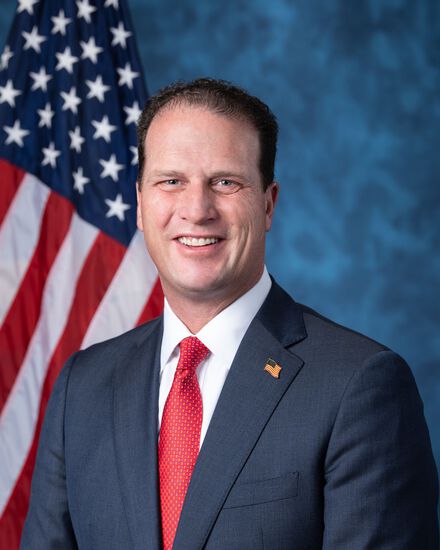
Rep. August Pfluger
Sponsored bills
Regulations from the Executive in Need of Scrutiny Act of 20 21 This bill revises provisions relating to congressional review of agency rulemaking. Specifically, the bill establishes a congressional approval process for a major rule. A major rule may only take effect if Congress approves of the rule. A major rule is a rule that results in (1) an annual effect on the economy of $100 million or more; (2) a major increase in costs or prices for consumers, individual industries, government agencies, or geographic regions; or (3) significant adverse effects on competition, employment, investment, productivity, innovation, or the ability of U.S.-based enterprises to compete with foreign-based enterprises. In addition, the bill establishes a congressional disapproval process for a nonmajor rule. A nonmajor rule may only take effect if Congress does not disapprove of the rule.
Iran Sanctions Relief Review Act of 2021 This bill restricts the President's authority to unilaterally undertake certain actions with respect to Iran and increases congressional oversight of those actions. Specifically, the President must report to Congress before terminating or waiving sanctions related to Iran or taking a licensing action that significantly alters U.S. foreign policy with respect to Iran. Each report must (1) describe the proposed action and its rationale, and (2) indicate whether or not the action is intended to significantly alter foreign policy concerning Iran. If the intention is to alter that policy, the report must provide additional information about the policy objectives and anticipated effects of the action. After the President submits a report, the bill provides Congress with a 30-day period to review it; this period is extended to 60 days for reports submitted between July 10 and September 7. During this period, Congress may enact a joint resolution approving or disapproving the action. During the review period, the President may not take the action unless Congress passes a joint resolution of approval; if Congress enacts a joint resolution of disapproval, the bill prohibits the President from taking the action. The bill also outlines procedures for the introduction and consideration of these types of joint resolutions.
State Border Security Reimbursement Act of 2021 This bill requires the federal government to reimburse eligible states for their border security expenses. To be eligible, a state must have expended more than $2.5 billion on border security and enforcement in the 10 years before this bill's enactment. If such a state provides an accounting of all of its nonfederally funded border security expenses any time up to 180 days after this bill's enactment, the federal government shall reimburse the full amount.
This concurrent resolution expresses the sense of Congress that a carbon tax would be detrimental to American families and businesses and is not in the best interest of the United States.
Defund the Wuhan Institute of Virology Act This bill prohibits making federal funds available to the Wuhan Institute of Virology in China. The Government Accountability Office must report to Congress on federal funds given to the institute over the past 15 years. The report must list any such funds that the institute provided to the Chinese government, the Chinese Communist Party, or affiliates of these entities.
COVID-19 Origin Act of 2021 This bill requires the Office of the Director of National Intelligence (ODNI) to declassify all information relating to potential links between the Wuhan Institute of Virology and the origin of COVID-19. The ODNI shall submit to Congress an unclassified report containing such information, with redactions only as necessary to protect sources and methods.
Operation Stonegarden Authorization Act This bill provides statutory authorization for the Operation Stonegarden grant program within the Department of Homeland Security. Through the program, the Federal Emergency Management Agency shall provide grants for enhancing border security to law enforcement agencies that are (1) in a state with an international land or maritime border, and (2) involved in an active U.S. Customs and Border Protection operation coordinated through the Border Patrol.
Get Americans Back To Work Act This bill makes an individual ineligible for federal pandemic unemployment compensation (FPUC) after June 30, 2021. It also reduces the amount of FPUC to $150.00 for weeks of unemployment ending after May 31, 2021, and ending on or before June 30, 2021. Under current law, an individual is eligible for FPUC for weeks of employment ending on or before September 6, 2021 in the amount of $300.
Repealing Illegal Freedom and Liberty Excises Act or the RIFLE Act This bill repeals the excise tax on the transfer of firearms. The bill shall not be construed as placing any regulated firearms under the jurisdiction of the U.S. Consumer Product Safety Commission.