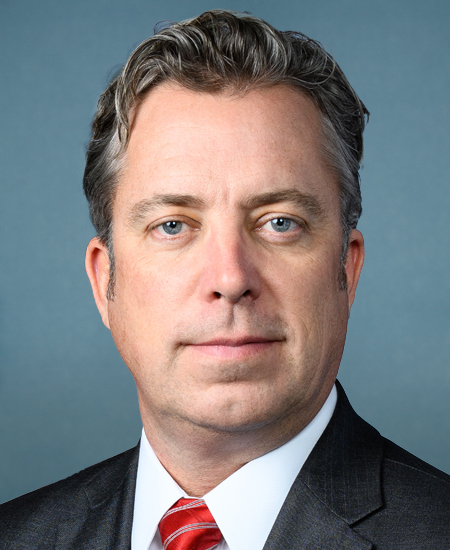
No Federal Funds for Abortion Travel Expenses Act of 2023 This bill prohibits the use of federal funds to support interstate travel to obtain an abortion.
Rep. Andrew Ogles
Sponsored bills
Mayorkas Must Fly Coach Until We Secure the Border Act This bill prohibits any officer or official of the Office of the Secretary of the Department of Homeland Security (DHS), including the Secretary of DHS, from using any federal executive aircraft until certain conditions relating to the border have been met. Specifically, the prohibition shall apply until the number of encounters and apprehensions of non-U.S. nationals ( aliens under federal law) who have unlawfully crossed the border have been reduced to FY2020 numbers; DHS reports to Congress a plan to place 90% of deployed U.S. Border Patrol agents in duties in the field; and DHS reports to Congress a plan to offer resources, including financial support, to local communities and governments.
Restoring Energy Market Freedom Act This bill repeals specified business tax credits related to electricity produced from certain renewable resources and alternative energy and investment credits related to energy projects. Specifically, the bill repeals tax credits (i.e., money that can be offset against a tax liability) for businesses for (1) electricity produced from certain renewable resources (e.g., solar energy); (2) production of electricity from advanced nuclear power facilities; (3) carbon dioxide sequestration; (4) zero-emission nuclear power production; (5) production of clean hydrogen; (6) production and sale of specified components, such as solar energy components; and (7) production of clean electricity. The bill also repeals tax credits for investments related to certain energy projects, including credits for (1) geothermal energy property placed in service, (2) qualifying coal projects, (3) qualifying advanced energy projects, (4) advanced manufacturing investments, and (5) clean electricity investments.
Maddy summaryThis bill requires the U.S. State Department to officially designate four specific Mexican drug cartels (Gulf Cartel, Cartel Del Noreste, Cartel de Sinaloa, and Cartel de Jalisco Nueva Generacion) as foreign terrorist organizations under existing law. It mandates a 30-day report explaining why these groups meet the legal criteria for such designation, including justification if they don't. The report must be submitted to specified congressional committees and may lead to additional cartels being designated based on the findings. The bill also clarifies that this designation won't affect asylum eligibility for individuals fleeing these groups.
No taxpayer funding for United Nations Human Rights Council Act This bill requires the Department of State to withhold from the U.S. contribution to the United Nations (U.N.) the amount that would be allocated to the U.N. Human Rights Council. Such withheld funds must be rescinded and must not be considered arrears to be repaid to the United Nations. The bill also prohibits the State Department from making voluntary contributions to the U.N. Human Rights Council.
Maddy summaryHR 1492, the CBO Show Your Work Act, requires the Congressional Budget Office (CBO) to publicly publish its fiscal models, data, and detailed methodologies used when estimating the costs and effects of legislation. Specifically, the bill mandates that the CBO make available all models, data preparation routines, and the specific assumptions and computations behind its cost estimates - enabling independent verification by non-CBO staff. This applies to all estimates prepared under the law, with limited exceptions for data protected by other statutes (requiring only descriptive statistics and access details for such data). The changes take effect six months after the bill becomes law. The bill directly affects the CBO’s internal processes and transparency practices, not the legislative content itself.

Maddy summaryThe POWER Act of 2023 prevents the President from blocking or delaying new oil, gas, coal, or mineral leases on federal lands without explicit Congressional approval. It specifically stops executive actions that would delay or cancel permits for energy development on National Forests, public lands, the outer continental shelf, or energy-managed lands. The bill requires Congress to pass new laws if it wants to restrict energy leasing or withdraw land from development under existing federal land laws. This directly affects energy companies seeking to develop resources on federal property by limiting executive authority over lease approvals.
Maddy summaryHJRES 41 disapproves a Department of Homeland Security (DHS) rule that expanded the "public charge" standard, which previously allowed officials to deny visas or green cards to immigrants likely to use public benefits like Medicaid or housing assistance. This resolution would nullify the rule (published in the Federal Register as 87 Fed. Reg. 5547), meaning it could no longer be enforced against immigrants applying for U.S. entry or residency. The bill directly affects noncitizens seeking visas, green cards, or adjustment of status who might use public benefits, as the rule had broadened the criteria for denying their applications. As a disapproval resolution under the Congressional Review Act, it stops the rule from taking effect without creating new immigration law.
Maddy summaryThis bill amends U.S. financial sanctions law to require the Treasury Secretary to specifically consider whether foreign banks knowingly provide banking services (including personal accounts) to entities designated under the Taylor Force Act, which targets groups that murder U.S. citizens. It directs Treasury to designate as "of primary money laundering concern" foreign banks that facilitate terrorism payments, particularly those using U.S. correspondent accounts. The law adds two new factors for Treasury to evaluate: (1) whether a bank knowingly serves entities listed in the Taylor Force Act regulations, and (2) whether the bank’s accounts or transactions help fund acts of terrorism. This directly affects foreign financial institutions operating in the U.S. financial system that may inadvertently or intentionally support terrorist organizations.
Maddy summaryHR 1313, the Transparency in CFPB Cost-Benefit Analysis Act, requires the Consumer Financial Protection Bureau (CFPB) to include detailed cost-benefit analyses in all proposed financial regulations. The bill mandates that the CFPB explain the need for a regulation, assess costs and benefits for small businesses and the economy, evaluate alternatives, and justify decisions where benefits don't outweigh costs. It also requires consultation with the Small Business Administration if a rule increases costs for small businesses and a distribution analysis of burdens. This bill directly affects the CFPB's rulemaking process by increasing transparency in how financial regulations are developed.