

Affordable Housing Credit Improvement Act of 2021 This bill revises provisions of the low-income housing tax credit and renames it as the affordable housing credit . The bill increases the per capita dollar amount of the credit and its minimum ceiling amount beginning in 2021 and extends the inflation adjustment for such amounts. The bill modifies tenant income eligibility requirements and the average income formula for determining such income. It also revises rules for student occupancy of rental units and tenant voucher payments, and prohibits any refusal to rent to victims of domestic abuse. The bill further modifies the credit to increase state allocations of the credit; repeal the qualified census tract population cap; prohibit local approval and contribution requirements; increase the credit for certain projects designated to serve extremely low-income households; increase the credit for certain bond-financed projects designated by state agencies; eliminate the basis reduction for properties that receive certain energy-related tax benefits; and increase the population cap for difficult development areas (i.e., areas with high construction, land, and utility costs relative to area median gross income). The bill also includes Indian and rural areas as difficult development areas and modifies other requirements relating to casualty losses, acquisition credits, and foreclosures.
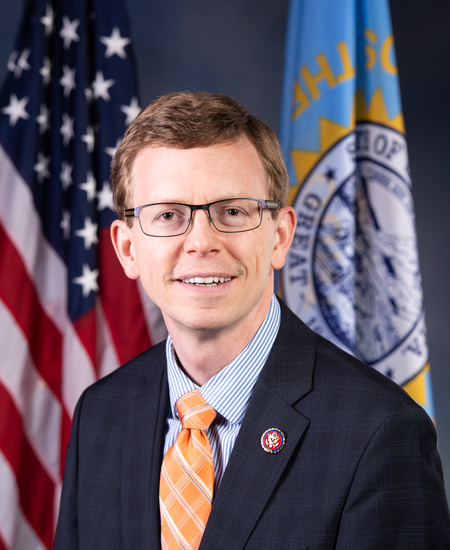
Rep. Dusty Johnson
Sponsored bills
Accelerate Long-term Investment Growth Now Act or the ALIGN Act This bill makes permanent the expensing of certain new business equipment. Expensing allows the deduction of the full amount of an expense item in the same taxable year.
Comprehensive Care for Alzheimer's Act This bill allows the Center for Medicare and Medicaid Innovation (CMMI) to test a Dementia Care Management Model that provides comprehensive care to Medicare beneficiaries with Alzheimer's disease or a related dementia. Under the model, participating health care providers receive payment under Medicare for comprehensive care management services that are provided to individuals with diagnosed dementia, excluding Medicare Advantage enrollees, hospice care recipients, and nursing home residents. Required services include medication management, care coordination, and health, financial, and environmental monitoring, as well as trainings and other support services for unpaid caregivers. Providers must furnish services through interdisciplinary teams and must ensure access to a team member or primary care provider 24-7. The CMMI must set payments and determine quality measures for the model in accordance with specified requirements. The bill also allows the CMMI to design a similar model under Medicaid.
Selective Service Repeal Act This bill repeals the requirement for males between the ages of 18 and 26 to register with the Selective Service. The bill also specifies that an individual shall not be penalized for prior failure to register with the Selective Service.
Kids In-Person Determines School Success Act or the KIDS Success Act This bill requires each local educational agency (LEA) that received federal COVID-19 relief funds to, within 60 days, submit a report to the Department of Education (ED). The bill also requires ED to assess the impact of school closures due to COVID-19. Specifically, the LEA must report on each elementary or secondary school that did not reopen for full-time, in-person learning as of April 5, 2021. The report must include the reasons why the school did not reopen in accordance with specified guidance from the Centers for Disease Control and Prevention and the expected date for return to full-time, in-person learning. In addition, the report must include the total amount of federal COVID-19 relief funds received by the LEA. Upon receiving the information from LEAs, ED must assess and report on the effects of school closures due to COVID-19. The assessment must include (1) the long-term effects of extended e-learning and hybrid learning on students, and (2) the effect of closures on student absenteeism and disciplinary changes.
Veterinary Medicine Loan Repayment Program Enhancement Act This bill modifies the requirements for calculating taxable income to exclude from gross income payments under the federal veterinary medicine loan repayment program or any state loan repayment or forgiveness program that is intended to provide for increased access to veterinary services in such state.
Voluntary Protection Program Act This bill provides statutory authority for the voluntary protection program within the Occupational Safety and Health Administration. Under the program, workplaces that implement comprehensive safety and health management systems are exempt from certain paperwork and inspection requirements.
Feed Emergency Enhancement During Disasters with Cover Crops Act of 2021 or the FEEDD Act of 2021 This bill expands relief under the federal crop insurance program for agricultural producers that harvest second crops as a result of a prevented planting. Specifically, a producer may collect 100% of the prevented planting guarantee for the acreage of the first crop if (1) the acres planted are in an area with low hay or forage supplies due to widespread excessive moisture, flood, or drought; (2) the second crop will be planted with an intended use of animal feed that is hayed, gazed, or chopped; and (3) the second crop will be donated or used by the producer. Additionally, the Department of Agriculture may not reduce the amount of a payment collected by a producer that hays, grazes, or chops over crops on prevented planting acres after the harvest date that it establishes for each region of the United States.
This resolution condemns Iranian state-sponsored terrorist attacks against U.S. citizens and officials and Iranian dissidents and expresses support for the people of Iran who are engaged in legitimate and peaceful protests against the Iranian regime.
Reinforcing Utility Restoration After Losses (RURAL) Act This bill provides authority and funding for the Department of Agriculture to establish a loan program for certain rural utility service providers (e.g., electric, telecommunications, or waste disposal service providers) to replace specified losses during a federally declared disaster or emergency. During such a disaster or emergency, interest on the loan shall not accrue, and repayment of principal shall not be required. Borrowers may qualify for partial loan forgiveness if certain requirements are met. The bill also establishes and provides funding for a Rural Utility Bridge Loan Fund to implement the program.