

Maddy summaryHR 277 would require Congress to approve major federal regulations before they take effect. Major rules are defined as those with significant economic impact ($100 million+ annually), major cost increases for consumers or industries, or significant adverse effects on competition, employment, or innovation. Agencies must submit detailed information about these rules to Congress, including cost-benefit analyses, before they can take effect. Congress would have 70 session days to approve the rule with a joint resolution; if they don't act within that timeframe, the rule would not take effect. This would increase congressional oversight of federal regulations and require more detailed information about proposed rules before they become law.
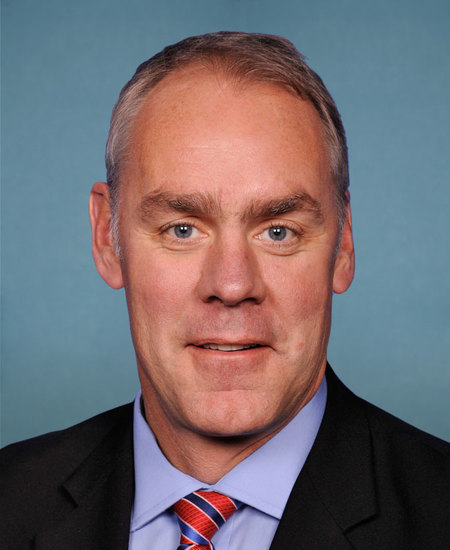
Rep. Ryan K. Zinke
Sponsored bills
Maddy summaryThis bill redesignates a specific street area in Washington, D.C. (between International Drive, Van Ness Street, and International Place, NW) and the address 3505 International Place, NW as "Tiananmen Square Memorial Boulevard." It requires the General Services Administrator to install new street signs matching DC's Metro station style at designated locations. The bill has no policy impact beyond administrative naming changes and does not affect any legislation, regulations, or residents.
Tribal HUD-VASH Act of 2023 This bill provides statutory authority for the Tribal HUD-VASH program, which provides rental assistance and supportive services to Indian veterans who are homeless or at risk of homelessness and living in or near an area where a tribe or tribally designated housing entity provides assistance for affordable housing. The Department of Housing and Urban Development (HUD) may use up to 5% of rental assistance amounts under the HUD-VASH program, which provides housing assistance to homeless veterans, for the Tribal HUD-VASH program. The Tribal HUD-VASH program must be carried out by HUD in conjunction with the Department of Veterans Affairs. Under the program, grants must be made to entities eligible for housing assistance block grants. HUD may make renewal grants to entities that have received prior program grants.
Maddy summaryHR 1640, the Save Our Gas Stoves Act, prevents the Department of Energy from implementing energy efficiency standards for gas stoves that would make them unavailable in the U.S. market. It amends federal law to require that any new standard for gas stoves must not result in the unavailability of gas stove types, directly affecting gas stove manufacturers and consumers who rely on these appliances. The bill specifically blocks the implementation of the 2023 proposed rule (Energy Conservation Program: Energy Conservation Standards for Consumer Conventional Cooking Products) and any similar rule. This is a policy change focused on maintaining the availability of gas stoves by altering the criteria for energy standard approval.
Maddy summaryThis proposed constitutional amendment would give Congress the authority to ban physical acts that desecrate the U.S. flag, such as burning or trampling. If ratified by 38 states (three-fourths of all states), it would allow federal laws prohibiting such acts. The amendment does not currently prohibit flag desecration but seeks to change the Constitution to permit it. It would directly affect individuals engaging in physical flag desecration. The bill is pending in the House Judiciary Committee and requires state ratification to become part of the Constitution.
Maddy summaryThe Protecting Veteran Community Care Act expands access to mental health and substance-use services through the Veterans Community Care Program for veterans who cannot get timely care in VA residential treatment facilities. It requires community providers to meet state licensing and accreditation standards and prohibits the VA from denying community care solely because community providers cannot meet the same wait time standards as VA facilities. The bill also mandates the VA to track and report on requests for mental health care, including approvals, denials, and appeals. This applies directly to veterans facing delays in accessing VA residential mental health programs.
Maddy summaryThis bill approves a 2000 treaty between the San Juan Southern Paiute Tribe and the Navajo Nation, establishing a 5,400-acre reservation within the existing Navajo Indian Reservation boundaries in northern Arizona and southern Utah. The San Juan Southern Paiute Tribe (federally recognized since 1989) will gain exclusive jurisdiction over this land, including water rights, resolving long-standing disputes that previously prevented the Tribe from providing essential services like housing and healthcare on their ancestral lands. Key provisions include transferring all land and water rights within the designated Northern and Southern Areas to the Tribe, with the U.S. holding them in trust, and ending Navajo Nation jurisdiction over these areas once boundaries are finalized. The bill also resolves pending litigation and requires the Secretary of the Interior to survey and fence the reservation boundaries within 18 months.
Maddy summaryHJRES 46 is a congressional resolution rejecting a specific rule issued by the National Marine Fisheries Service (NMFS) under federal environmental regulations. The resolution seeks to block the NMFS rule (published June 2022) that updated procedures for listing endangered/threatened species and designating critical habitats. If passed, this resolution would make the NMFS rule legally ineffective under federal law. The bill directly affects how the NMFS manages species protection programs but does not change the underlying environmental laws. This is a procedural disapproval resolution, not a new policy.
Maddy summaryHJRES 49 is a congressional disapproval resolution targeting a specific rule by the U.S. Fish and Wildlife Service that would have listed the northern long-eared bat as an endangered species under the Endangered Species Act. The rule, published in the Federal Register in November 2022 (87 Fed. Reg. 73488), would have imposed federal protections and restrictions on activities affecting the bat's habitat. This resolution, if passed, would nullify that rule, preventing the bat from receiving federal endangered species status and associated legal safeguards. It directly affects the regulatory status of the northern long-eared bat and activities regulated under the Endangered Species Act.
Maddy summaryThis bill prohibits the use of Department of Defense funds for adult cabaret performances. It bans the Defense Department from hosting, advertising, or supporting such events, which are defined as performances featuring topless dancers, strippers, exotic dances, or male/female impersonators appealing to prurient interest. The restriction applies to all Defense Department funds and facilities, preventing their use for these specific types of entertainment.