

Pharmacy DIR Reform To Reduce Senior Drug Costs Act This bill establishes certain requirements for prescription drug plans and the prices of covered drugs under the Medicare prescription drug benefit. Specifically, the bill requires price concessions, payments, and fees that are negotiated with a pharmacy to be included in a drug's negotiated price, excluding incentive payments, and for this price to be provided at the point of sale. Additionally, prescription drug plans must report price concessions or incentive payments that are made after payment for covered drugs at the point of sale, including by contracted intermediaries, to the pharmacy at least annually. The Centers for Medicare & Medicaid Services must establish standardized pharmacy performance measures with respect to incentive payments and price concessions; such measures must account for all pharmacy types, including specialty pharmacies, and focus on patient health outcomes and other targeted areas.
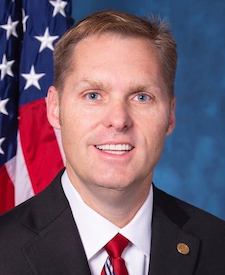
Rep. Michael Guest
Sponsored bills
Biodiesel Tax Credit Extension Act of 2021 This bill extends the income and excise tax credits for biodiesel and renewable diesel used as fuel through 2025.
Contact Lens Prescription Verification Modernization Act This bill revises the requirements for the verification of prescriptions related to the purchase of contact lenses. Specifically, online sellers of prescription contact lenses must provide consumers with a method to transmit a digital copy of their prescriptions to such sellers. Online sellers also must encrypt protected health information they send by email. Additionally, the bill prohibits any seller of prescription contact lenses from using telephone calls with an artificial or prerecorded voice (i.e., robocalls) to verify a consumer's prescription.
Surface Transportation Advanced through Reform, Technology, and Efficient Review Act 2.0 or the STARTER Act 2.0 This bill addresses provisions related to federal-aid highway, transit, highway safety, motor carrier, innovation, and resiliency programs of the Department of Transportation (DOT). It also sets forth requirements for the operation of railroad freight cars in the United States. For example, the bill extends FY2020 enacted levels through FY2026 for federal-aid highway, transit, and safety programs. DOT must provide competitive grants for projects to provide parking for commercial motor vehicles on the federal-aid highway system; establish a discretionary program to award competitive grants for eligible projects that encourage economic viability of the nation, a metropolitan area, or a region; create a public awareness campaign to reduce instances of driving while under the influence of prescription and over-the-counter medications; and promulgate regulations to implement an apprenticeship program for licensed commercial motor vehicle drivers under the age of 21. The bill also establishes new competitive grant programs to spur innovation of connected vehicle applications into operational deployments and to test the safe integration of automated driving system technologies into the on-road transportation system. Additionally, the bill addresses projects to improve the resiliency of federal-aid highways and bridges on and off the National Highway System. Further, the bill prohibits the operation of railroad freight cars in the United States that have been manufactured or assembled by certain foreign countries or that contain sensitive technology from such countries.
Ghost Army Congressional Gold Medal Act This bill directs the Speaker of the House of Representatives and the President pro tempore of the Senate to award a Congressional Gold Medal to the 23rd Headquarters Special Troops and the 3133d Signal Service Company, known as the Ghost Army , collectively, in recognition of its service during World War II.
This resolution expresses support for the designation of DIPG Awareness Day. DIPG is diffuse intrinsic pontine glioma, a terminal childhood brain cancer.
Gun Owner Registration Information Protection Act This bill prohibits federal funding of, or support for, state databases that list (1) firearms lawfully owned or possessed by individuals, or (2) individuals who lawfully own or possess firearms.
Home Defense and Competitive Shooting Act of 2021 This bill removes short-barreled rifles (barrels of less than 16 inches in length) from the definition of firearms for purposes of the National Firearms Act. It also eliminates the prohibition on the transportation of such rifles in interstate commerce and treats persons who acquire or possess a short-barreled rifle as meeting the registration or licensing requirements for such rifle where such requirements are determined by reference to the National Firearms Act. The bill preempts state or local laws that impose a tax or recordkeeping requirements on short-barreled rifles. The Department of Justice must destroy records relating to the registration of certain rifles within one year after the enactment of this bill.
Lawful Interstate Transportation of Firearms Act This bill revises criminal provisions related to the interstate transportation of firearms and ammunition. An individual may transport a firearm between two places (e.g., states) where it is legal to possess, carry, or transport the firearm. During transport, the firearm must be unloaded and secured or securely stored. Additionally, an individual may transport ammunition, or a detachable magazine or feeding device, between two places where it is legal to possess, carry, or transport the ammunition, magazine, or feeding device. During transport, the ammunition, magazine, or feeding device must not be loaded into a firearm and must be securely stored. The term transport includes staying in temporary lodging; stopping for food, fuel, vehicle maintenance, an emergency, or medical treatment; or any other activity incidental to the transport. The bill prohibits the arrest or detention of an individual for a state or local firearm or ammunition violation unless there is probable cause to believe the individual failed to comply with the provisions of this bill, and there is probable cause to believe the individual committed another crime.
Defending Our Defenders Act This bill establishes federal criminal offenses involving the murder of federal, state, or local law enforcement officers. Violators are subject to life in prison or death. The bill sets forth aggravating factors (e.g., intent to ambush or prior history of promoting violence against a law enforcement officer) to be considered in determining whether to impose the death penalty.