

Robust International Response to Pandemic Act This bill requires the Department of the Treasury and each U.S. Executive Director at an international financial institution to take certain actions in support of the global response to COVID-19 (i.e., coronavirus disease 2019). Specifically, each U.S. Executive Director at an international financial institution (e.g., the International Bank for Reconstruction and Development or the International Finance Corporation) must seek the suspension of debt service payments to the institution and the relaxation of fiscal targets for certain programs, oppose programs or loan agreements that would reduce countries' health care spending or other spending related to their responses to COVID-19, and require approval of all Special Drawing Rights (a currency support tool) allocation transfers from wealthier member countries to countries that are emerging or developing to ensure the allocations are used for the public good and in response to the global pandemic. Further, the U.S. Governor at the International Monetary Fund (IMF) must advocate for the issuance of Special Drawing Rights so that governments may access additional resources to finance their responses to COVID-19. Of these Special Drawing Rights allocated to the United States, Treasury must lend a specified amount to the Poverty Reduction and Growth Trust or other special purpose vehicle of the IMF to help eligible low-income countries respond to COVID-19. Treasury must also advocate for an extension of the current moratorium on debt service payments to official bilateral creditors by the world's poorest countries.
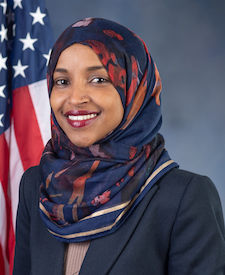
Rep. Ilhan Omar
Sponsored bills
"Six Triple Eight" Congressional Gold Medal Act of 2021 This bill directs the Speaker of the House of Representatives and the President pro tempore of the Senate to arrange for the award of a Congressional Gold Medal in honor of the women of the 6888th Central Postal Directory Battalion (commonly known as the Six Triple Eight) in recognition of their pioneering military service, devotion to duty, and contributions to increase the morale of personnel stationed in the European theater of operations during World War II. The medal shall be given to the Smithsonian Institution and made available for display and research.
Automatic Boost to Communities Act This bill creates the Boost Communities Program to provide monthly aid during and after the COVID-19 (i.e., coronavirus disease 2019) emergency. Specifically, the bill provides $2,000 a month to individuals until the COVID-19 emergency declaration is terminated, or the national unemployment rate meets specified criteria, whichever is later. Furthermore, the bill provides $1,000 a month to individuals during the following year. The program also provides targeted supplemental assistance for at-risk populations. The bill provides for the distribution of these funds through direct deposit, debit cards, and the establishment of digital dollar wallets. The Department of the Treasury is directed to mint and issue two $1 trillion platinum coins and additional coins as needed to fund the program. The Federal Reserve is directed to purchase the coins.
American Family Act of 2021 This bill modifies the child tax credit to (1) make the credit fully refundable, (2) increase the amount of the credit and allow an additional credit for children who are under six years of age, (3) require the amount of the credit to be adjusted annually for inflation, and (4) require the Department of the Treasury to establish a program for making advance payments of the credit on a monthly basis.
National Climate Emergency Act of 2021 or the Climate Emergency Act of 2021 This bill directs the President to declare a national emergency with respect to climate change. The President, in responding to the emergency, must ensure that the government invests in large scale mitigation and resiliency projects; makes investments that enable a racially and socially just transition to a clean energy economy by ensuring that at least 40% of investments flow to historically disadvantaged communities; avoids solutions that increase inequality or violate human rights; creates jobs that conform to labor standards that provide family sustaining wages and benefits and ensure safe workplaces; prioritizes local and equitable hiring and contracting that creates opportunities for marginalized communities; combats environmental injustice; and reinvests in existing public sector institutions and creates new public sector institutions to strategically mobilize and channel investments at the scale and pace required by the national emergency. The President shall report annually on actions taken in response to the national emergency.
This resolution calls on the President to take executive action to cancel up to $50,000 in federal student loan debt for borrowers. Further, it encourages the President to (1) ensure that borrowers have no tax liability from the debt cancellation, (2) ensure that the debt cancellation helps close racial wealth gaps, and (3) pause student loan payments and interest accumulation on federal student loans for the duration of the COVID-19 (i.e., coronavirus disease 2019) pandemic.
Family and Medical Insurance Leave Act or the FAMILY Act This bill entitles every employee to a family and medical leave insurance (FMLI) monthly benefit payment of two-thirds of the employee's regular pay, limited to a maximum of $4,000, for not more than 60 days of qualified caregiving. The bill establishes the Office of Paid Family and Medical Leave within the Social Security Administration to administer the FMLI program. An FMLI benefit payment must be coordinated with any periodic benefits received under a state or local temporary disability insurance or family leave program. The bill imposes a tax on employers, employees, and self-employed individuals to fund FMLI benefits. It also establishes the Federal Family and Medical Leave Insurance Trust Fund to hold tax revenues.
American Opportunity Accounts Act This bill establishes tax-exempt American Opportunity Accounts to provide children at birth with a $1,000 savings account with annual contributions up to $2,000 depending on family income. The accounts are available to children at age 18 for specified purposes, including educational expenses, home ownership, and investment that provides long-term returns.
Scientific Integrity Act This bill revises provisions regarding the release of scientific research results by federal agencies. Each agency that funds, conducts, or oversees scientific research must (1) adopt and enforce a scientific integrity policy that includes requirements such as that scientific conclusions are not based on political considerations, and (2) submit such policy to the Office of Science and Technology Policy (OSTP) for approval. Each agency must make such policy available to the public and submit such policy to Congress. Agencies and the OSTP must periodically review the policies. The Government Accountability Office shall review implementation of the policies. Each agency shall (1) appoint a Scientific Integrity Officer, (2) establish a process for dispute resolution consistent with the scientific integrity policy, and (3) establish a specified training program for current and new employees.
Restoring Communities Left Behind Act This bill directs the Department of Housing and Urban Development to establish a grant program for local partnerships to carry out neighborhood revitalization support activities in economically distressed areas. Eligible activities include weatherization and energy efficiency improvements; housing accessibility improvements for seniors and persons with disabilities; purchasing delinquent mortgages; purchasing and developing vacant or distressed properties to create affordable rental housing and for other purposes; and improving parks, sidewalks, and street lighting.