

Maddy summaryThis resolution expresses support for designating July 10th as Journeyman Lineworkers Recognition Day to honor the workers who maintain the nation's electrical grid. The bill specifically recognizes the dangerous conditions these employees face, such as working at heights near live power lines and responding to disasters like hurricanes and wildfires. It also commemorates Henry Miller, the first president of the International Brotherhood of Electrical Workers, who died on July 10, 1896, while performing his duties. Ultimately, the measure encourages the public to observe this day with reflection on the contributions of lineworkers.
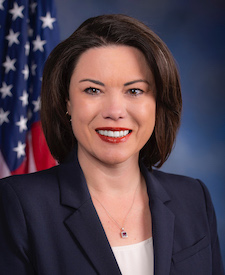
Rep. Angie Craig
Sponsored bills
Maddy summaryThe Voter Choice Act establishes a federal program to assist states and local governments in transitioning to ranked choice voting systems for elections. Under this bill, the Election Assistance Commission would provide technical support and financial grants to help jurisdictions acquire necessary equipment, design ballots, and create educational materials for voters. Grants awarded through this program are capped at 50 percent of project costs and must be distributed across a diverse range of geographic areas and population types. The legislation authorizes $40 million in funding for fiscal year 2027 to support these transition efforts.
Maddy summaryThe Find Our Families Act of 2026 requires the Department of Homeland Security to create a public online system that allows families to locate individuals detained by Customs and Border Protection or Immigration and Customs Enforcement. This system must provide search results within eight hours of detention, display information in multiple languages, and include specific details such as names, dates of birth, and facility locations, while excluding data for minors. The bill also mandates that families be notified within five hours if a detainee is transferred for medical care and establishes new reporting requirements for CBP arrests, including details on the circumstances of the arrest and the number of agents involved. Additionally, the legislation creates a process for families to report errors in detainee information and imposes penalties on employees or contractors who fail to comply with these data-sharing and reporting obligations.
Maddy summaryThe Federal Jobs for STARs Act of 2026 aims to increase hiring opportunities for individuals in the federal workforce who have gained skills through alternative routes like military service, apprenticeships, or community colleges rather than traditional four-year degrees. It requires the Office of Personnel Management to restrict agencies from mandating bachelor's degrees unless absolutely necessary and to create a specific section on federal job websites dedicated to these candidates. Additionally, the bill mandates a study to explore funding options, such as scholarships and tuition assistance, to help current federal employees with these backgrounds pursue further education.
Maddy summaryHRES 1405 is a non-binding resolution that encourages the U.S. House of Representatives to recognize June as LGBTQIA+ Pride Month. The document acknowledges the historical significance of events like the Stonewall Inn uprising and highlights the ongoing struggle for equality faced by lesbian, gay, bisexual, transgender, queer, intersex, and asexual individuals. It includes a detailed list of historical milestones and legislative achievements related to LGBTQIA+ rights to provide context for the celebration. Because this measure is a resolution of recognition rather than a law, it does not create new legal obligations or change federal policy.
Maddy summaryThis bill authorizes Congress to award a Congressional Gold Medal to individuals who fought for or with the United States in the Pacific theater during World War II and subsequently became prisoners of war. The legislation specifically recognizes the service and sacrifice of those who defended locations such as Bataan and Corregidor, including Filipino soldiers and civilians who served alongside U.S. forces. To implement this award, the Speaker of the House and the President pro tempore of the Senate will arrange for the creation of a gold medal by the Secretary of the Treasury, which will be presented to the Smithsonian Institution for display. The act also allows for the production of duplicate bronze medals to cover the costs of the original gold medals, with any proceeds from these sales deposited into the United States Mint Public Enterprise Fund.
Maddy summaryThe Data Infrastructure Energy Measurement and Standards Act directs the National Institute of Standards and Technology to develop better methods for measuring energy and water use in data centers, including those running artificial intelligence models. This research program aims to create standardized definitions and reporting guidelines that account for different power systems, cooling setups, and varying workload demands. The bill also requires the agency to coordinate with industry experts and international partners to establish global standards while sharing data to improve future energy demand forecasts. To support these efforts, the legislation authorizes $10 million in funding for each of the fiscal years 2027 through 2029.
Maddy summaryThe Workforce for AI Trust Act directs the National Science Foundation and the National Institute of Standards and Technology to expand the American workforce capable of developing and governing artificial intelligence. It establishes new fellowship programs to train graduate and postdoctoral researchers from diverse fields, including the humanities and social sciences, to focus on the trustworthy design and evaluation of AI systems. Additionally, the bill requires NIST to create a standardized framework that defines the skills and roles needed for AI work, aiming to help industries and government agencies better identify and fill talent gaps. These provisions also mandate that peer review panels for AI research include experts from multiple disciplines to ensure broad perspectives are considered during the evaluation process.
Maddy summaryThe READ AI Models Act directs the National Institute of Standards and Technology (NIST) to develop a free, flexible template for documenting artificial intelligence (AI) models. The template would require basic details like developer information, training data cutoff dates, supported languages, and terms of service for both public and private sector AI models. NIST must gather public input through a 60-day comment period before finalizing the template and technical guidelines. If the pilot program proves effective, NIST would publish the template publicly and report to Congress within one year.
Maddy summaryThe Federal Workforce Reproductive Rights Protection Act prevents federal agencies from relocating headquarters or major operations to states with laws restricting or banning abortion, while also barring the use of funds to build or lease facilities in those locations. To support federal employees who need to access reproductive health care, the bill allows workers to decline transfers to restrictive states, grants up to 21 days of paid leave for travel to obtain such services, and provides reimbursement for travel costs without requiring disclosure of the specific medical procedure. Additionally, the legislation prohibits government agencies from investigating an employee's use of abortion services when reviewing security clearances or making personnel decisions and protects workers from retaliation if they exercise these new rights.