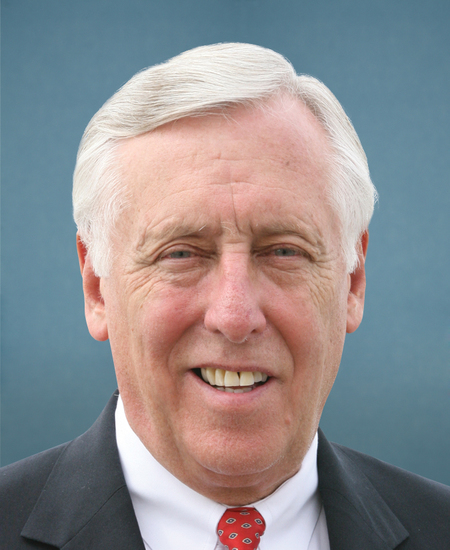
Photo of Steny H. Hoyer
D United States House · District 5 · Maryland

Rep. Steny H. Hoyer

Compare
Total votes
2,818
all sessions
Attendance
96%
117 missed
Near the chamber average
With party
98%
of cast votes
Near the chamber average
Bipartisan score
1%
crosses aisle rarely
Near the chamber average
Sponsored
293
bills & resolutions
Lower than 89% of chamber peers
Committees
4
assignments
293 bills and resolutions

Sponsored bills

Total
293
Primary
14
Co-sponsor
279
This page
293
matching current filters
Co-sponsor HR 5724
In committee · Delaware House · Co-sponsor
FAST Justice Act

Maddy summaryHR 5724, the FAST Justice Act, creates a 120-day deadline for the Merit Systems Protection Board (MSPB) to act on most federal employee appeals. If the MSPB fails to take action within this period, affected federal employees or job applicants can file a civil lawsuit in federal court. The bill specifies where these lawsuits can be filed (based on where the personnel action occurred or where the employee would have worked) and clarifies that courts must use standard review procedures for MSPB decisions. This directly affects federal workers facing delays in employment-related appeals.

In committee Oct 8, 2025 1 co-sponsor
Co-sponsor HR 5657
In committee · Delaware House · Co-sponsor
Fair Pay for Federal Contractors Act of 2025

Fair Pay for Federal Contractors Act of 2025 This bill provides back pay to employees of federal contractors who lost pay due to a lapse in appropriations (i.e., government shutdown) in FY2026. Specifically, the bill provides appropriations for federal agencies that are subject to a lapse in appropriations in FY2026 to adjust the price of contracts to compensate federal contractors for providing back pay to employees who were affected by the lapse in appropriations.  The agencies must adjust the price of any contract for which the contractor stopped, suspended, delayed, or interrupted all or part of the work under the contract due to the lapse in appropriations. The price adjustment must compensate the contractor for reasonable costs incurred to (1) compensate employees who were furloughed or laid off, were not working, or experienced a reduction of hours or compensation due to the lapse in appropriations; or (2) restore paid leave taken by employees during the lapse in appropriations if the contractor required or permitted employees to use paid leave as a result of the lapse in appropriations. The maximum amount of weekly compensation of an employee for which an adjustment may be made under this bill may not exceed the lesser of (1) the employee's actual weekly compensation, or (2) $1,442 (or a lesser amount pro-rated for an employee who works less than 40 hours per week). The bill also requires the Office of Federal Procurement Policy to submit a report to Congress on the adjustments made under this bill.

In committee Sep 30, 2025 1 co-sponsor
Co-sponsor HR 5572
In committee · Delaware House · Co-sponsor
Help FEDS Act

Maddy summaryHR 5572, the Help FEDS Act, ensures federal employees who must work during government shutdowns (but aren't paid due to the shutdown) can access unemployment benefits through their state's program. The bill requires states to allow these "excepted" employees to apply for and receive unemployment compensation during fiscal years 2026-2027, while also mandating repayment if they later receive pay under a separate federal provision. The federal government will reimburse states 100% of the unemployment benefits paid to these employees plus related administrative costs, funded from the Unemployment Trust Fund. This directly affects federal workers performing emergency work during shutdowns and state unemployment systems managing these claims.

In committee Sep 26, 2025 1 co-sponsor
Co-sponsor HR 5599
In committee · Delaware House · Co-sponsor
To prohibit the removal of Federal employees during any lapse in discretionary appropriations, and for other purposes.

Maddy summaryThis bill prevents federal agencies from terminating employees during a government shutdown caused by a lapse in discretionary funding. It prohibits removals of civil service employees at any agency affected by a funding gap, and if an employee is wrongfully removed, they can return to their job with back pay once funding resumes. The law directly protects all federal employees covered by the civil service system during shutdowns. It applies automatically to any funding lapse, requiring automatic reinstatement without needing separate legal action.

In committee Sep 26, 2025 1 co-sponsor
Co-sponsor HR 5390
In committee · Delaware House · Co-sponsor
FAMILY Act

Maddy summaryThe FAMILY Act would establish a national paid family and medical leave insurance program that provides wage replacement benefits for workers needing time off for caregiving or medical reasons. It defines "qualified caregiving" to include caring for a family member with a serious health condition, personal medical needs, or recovery from violence (including domestic violence, sexual assault, or stalking). Benefits would be calculated based on earnings, with a minimum monthly benefit of $580 and maximum of $4,000, administered by a new Office of Paid Family and Medical Leave within the Social Security Administration. Eligible individuals would need to have worked for at least 8 quarters in the previous year and file an application with required documentation, while existing state paid leave programs would continue to operate alongside this federal program.

In committee Sep 16, 2025 1 co-sponsor
Co-sponsor HR 492
In committee · Delaware House · Co-sponsor
Saving the Civil Service Act

Saving the Civil Service Act This bill generally prohibits changes to the classification of positions in the competitive service and excepted service unless certain conditions are met. (Competitive service positions are subject to competitive examination while excepted service positions are appointed under one of five schedules. Competitive service positions have notice and appeal requirements for adverse actions that are not applicable to most excepted positions, including those of a confidential, policy-determining, policy-making, or policy-advocating character under Schedule C.) On October 21, 2020, President Donald Trump issued an executive order that placed executive agency positions that are of a confidential, policy-determining, policy-making, or policy-advocating character, and that are not normally subject to change as a result of a presidential transition, under a new Schedule F in the excepted service. The order was subsequently revoked by President Joe Biden. The bill prohibits executive agency positions in the competitive service from being placed in the excepted service, unless such positions are placed in a schedule in the excepted service as in effect on September 30, 2020. The bill also prohibits positions in the excepted service from being placed in any schedule other than the aforementioned schedules. Additionally, agencies may not (1) transfer occupied positions from the competitive or excepted service into Schedule C without the consent of the Office of Personnel Management, or (2) transfer employees in the excepted service to another schedule or transfer employees in the competitive service to the excepted service without employee consent.


In committee Sep 16, 2025 1 co-sponsor
Co-sponsor HR 493
In committee · Delaware House · Co-sponsor
FAIR Act

Federal Adjustment of Income Rates Act or the FAIR Act This bill modifies pay rates for federal employees in 2026. Specifically, the bill increases rates under the statutory pay systems and for prevailing rate employees by 3.3% and increases locality pay by 1%.

In committee Sep 16, 2025 1 co-sponsor
Co-sponsor HR 5361
In committee · Delaware House · Co-sponsor
George Floyd Justice in Policing Act of 2025

Maddy summaryThe George Floyd Justice in Policing Act of 2025 would establish a National Police Misconduct Registry to track officer complaints, disciplinary actions, and misconduct records across all law enforcement agencies. It would require law enforcement agencies to implement body-worn camera programs with specific recording and retention policies, ban chokeholds and no-knock warrants in drug cases, and reform qualified immunity to make it easier to hold officers accountable for misconduct. The bill mandates comprehensive data collection on use of force incidents, requiring agencies to report detailed information about stops, searches, and force used, disaggregated by race, ethnicity, gender, and other demographics. These provisions would directly affect all Federal, State, and local law enforcement agencies that receive federal grant funding, with requirements for policy changes, training, and data reporting.

In committee Sep 15, 2025 1 co-sponsor
Co-sponsor HR 5309
In committee · Delaware House · Co-sponsor
Congressional Tribute to Constance Baker Motley Act of 2025

Maddy summaryHR 5309, the Congressional Tribute to Constance Baker Motley Act of 2025, authorizes a posthumous Congressional gold medal for Constance Baker Motley, a pioneering civil rights attorney and judge. The bill directs the Treasury Secretary to strike the medal with her image and name, to be presented to her son, Joel W. Motley III, and her niece, Constance Royster. It also permits the sale of bronze duplicates at cost to cover expenses, with proceeds going to the U.S. Mint fund. This is a commemorative measure with no substantive policy changes, honoring Motley’s legacy as the first African-American woman appointed to a federal judgeship.

In committee Sep 11, 2025 1 co-sponsor
Co-sponsor HR 5326
In committee · Delaware House · Co-sponsor
FLAME Act

Maddy summaryThe FLAME Act requires the U.S. Fire Administration to provide Congress 60 days' notice before canceling 25% or more of the National Academy’s annual courses, including details on affected departments and justifications. It mandates notifying enrolled firefighters and fire chiefs at least 45 days before cancellations, with reimbursement for fire departments’ travel and staffing costs (like overtime) unless cancellations are due to "good cause" (e.g., facility closures or national emergencies). The bill also directs a GAO study by March 2026 to analyze how large-scale cancellations impact fire department readiness, interoperability, and the Academy’s role in training. This directly affects fire departments nationwide that send personnel to the Academy for in-person or virtual training.

In committee Sep 11, 2025 1 co-sponsor
Showing 51 to 60 of 293 bills
Previous 1 5 6 7 30 Next