This joint resolution proposes a constitutional amendment authorizing Congress and the states to set reasonable limits on the raising and spending of money by candidates and others to influence elections. The amendment grants Congress and the states the power to implement and enforce this amendment by legislation. They are allowed to distinguish between natural persons and corporations or other artificial entities created by law, including by prohibiting such entities from spending money to influence elections.
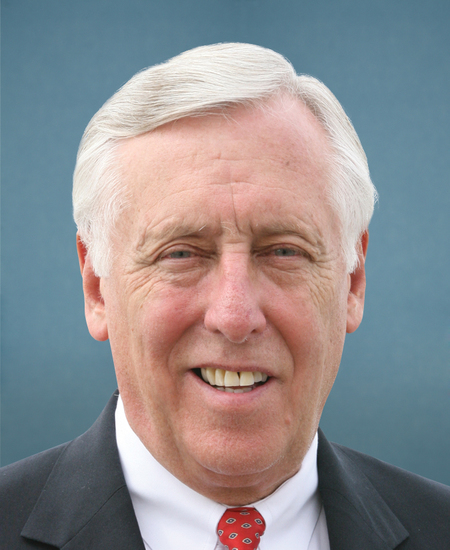
Rep. Steny H. Hoyer
Sponsored bills
"Six Triple Eight" Congressional Gold Medal Act of 2021 This bill directs the Speaker of the House of Representatives and the President pro tempore of the Senate to arrange for the award of a Congressional Gold Medal in honor of the women of the 6888th Central Postal Directory Battalion (commonly known as the Six Triple Eight) in recognition of their pioneering military service, devotion to duty, and contributions to increase the morale of personnel stationed in the European theater of operations during World War II. The medal shall be given to the Smithsonian Institution and made available for display and research.
American Family Act of 2021 This bill modifies the child tax credit to (1) make the credit fully refundable, (2) increase the amount of the credit and allow an additional credit for children who are under six years of age, (3) require the amount of the credit to be adjusted annually for inflation, and (4) require the Department of the Treasury to establish a program for making advance payments of the credit on a monthly basis.
Family and Medical Insurance Leave Act or the FAMILY Act This bill entitles every employee to a family and medical leave insurance (FMLI) monthly benefit payment of two-thirds of the employee's regular pay, limited to a maximum of $4,000, for not more than 60 days of qualified caregiving. The bill establishes the Office of Paid Family and Medical Leave within the Social Security Administration to administer the FMLI program. An FMLI benefit payment must be coordinated with any periodic benefits received under a state or local temporary disability insurance or family leave program. The bill imposes a tax on employers, employees, and self-employed individuals to fund FMLI benefits. It also establishes the Federal Family and Medical Leave Insurance Trust Fund to hold tax revenues.
Metro Accountability and Investment Act This bill reauthorizes for FY2022-FY2031 authority for the Department of Transportation (DOT) to provide grants to the Washington Metropolitan Area Transit Authority (WMATA) to finance in part the capital and preventive maintenance projects included in its Capital Improvement Program. It conditions the availability of funds, in part, on the WMATA Board of Directors certifying to DOT that it has adopted and will keep certain resolutions in effect for the entire funding period, including (1) establishing an independent budget authority, procurement authority, and hiring authority for its Office of the General Inspector; (2) ensuring its Inspector General (IG) can obtain legal advice from a counsel reporting directly to the IG; (3) requiring the IG to submit recommendations for corrective action to the General Manager and the Board of Directors of WMATA; (4) requiring the IG to publish such recommendations on its website; (5) requiring the WMATA Board of Directors to provide written notification to Congress at least 30 days in advance of the removal of an IG; and (6) prohibiting the WMATA Board of Directors from removing its Inspector General without a 30-day written notification that documents specific reasons for removal, including an abuse of authority.
Transformational Reforms and Updates to Ensure Educational Quality and Urgent Investments in Today's Youth Act of 2021 or the TRUE EQUITY Act This bill establishes various grant programs to address educational inequities in elementary and secondary schools. Specifically, the bill creates grant programs related to (1) early childhood education, (2) high-quality and diverse teachers and leaders, (3) college and career readiness pathways, and (4) additional resources for at-risk students. For each grant program, the Department of Education (ED) must award a single grant to an eligible state. To be eligible for a grant, a state must establish an independent state oversight board. The oversight board must, among other duties (1) determine whether the state and its local educational agencies (LEAs) have met state educational equity goals, and (2) hold them accountable for failing to meet those goals. ED may renew a grant if the oversight board determines the state has met its goals. In addition, for each grant program, the bill outlines the activities authorized under the program, maintenance-of-effort requirements, and matching fund requirements. Finally, the bill permits ED to enter into a local flexibility demonstration agreement, through which a state educational agency may use funds to develop and implement a school funding system based on weighted per-pupil allocations for low-income and disadvantaged students. (Currently, ED may enter into these agreements with LEAs.)
Raise the Wage Act of 2021 This bill increases the federal minimum wage for regular employees over a 5-year period, for tipped employees, and for newly hired employees who are less than 20 years old. The bill sets forth a schedule of annual increases in the federal minimum wage for individuals with disabilities. The Department of Labor shall no longer issue special certificates for the payment of subminimum wages to such individuals after the final wage increase under this bill for such individuals takes effect. Labor shall provide, upon request, technical assistance and information to employers to (1) help them transition their practices to comply with wage increases and other requirements under this bill for individuals with disabilities, and (2) ensure continuing employment opportunities for such individuals. The bill eliminates the separate minimum wage requirements for tipped, newly hired, and disabled employees. After a specified period, these employees shall be paid the same minimum wage as regular employees. Labor must publish any increase in the minimum wage in the Federal Register and on its website 60 days before it takes effect.
Saving the Civil Service Act This bill nullifies the executive order titled Creating Schedule F in the Excepted Service , which was issued on October 21, 2020. The order places executive agency positions that are of a confidential, policy-determining, policy-making, or policy-advocating character, and that are not normally subject to change as a result of a presidential transition, under a new schedule in the excepted service (Schedule F) instead of the competitive service. The order also requires any such positions in the excepted service to be reclassified to Schedule F. The bill also specifically prohibits positions or appointments in the competitive service or the Senior Executive Service from being converted to the excepted service, and prohibits certain noncompetitive appointments that were reclassified or made under the executive order from subsequently acquiring competitive status.
This resolution establishes the rules of the House of Representatives for the 117th Congress by adopting and modifying the House rules from the 116th Congress. Changes from the rules for the previous Congress include measures to facilitate the operation of Congress during the ongoing COVID-19 (i.e., coronavirus disease 2019) pandemic. The resolution makes the Office of Diversity and Inclusion permanent, revises language in the rules to be gender-inclusive, and continues requirements to protect congressional employees from harassment and discrimination. The resolution also implements measures to protect whistle-blowers and increase congressional transparency. The resolution authorizes necessary amounts for the Committee on House Administration to resolve contested elections. Additionally, the Clerk of the House of Representative must establish a process for House Members to indicate their support for Senate-passed measures that have been received by the House, including maintaining a publicly available list of Members supporting each measure. The chair of the Committee on the Budget may adjust an estimate concerning the fiscal impact of legislation to exempt the budgetary effects of measures to prevent, prepare for, or respond to economic or public health consequences resulting from the COVID-19 pandemic, as well as measures to prevent, prepare for, or respond to economic, environmental, or public health consequences resulting from climate change. Until the Committee on Oversight and Reform has adopted rules, the chair of the Select Subcommittee on the Coronavirus Crisis may issue subpoenas related to its investigation into political interference in the response to the coronavirus pandemic at the Department of Health and Human Services and the Centers for Disease Control and Prevention. The resolution also reauthorizes specified commissions, offices, and committees, and establishes a Select Committee on Economic Disparity and Fairness in Growth.

This resolution authorizes the Speaker of the House of Representatives to appoint a committee, joined with a corresponding Senate committee, which shall notify the President that a quorum of each chamber has assembled.