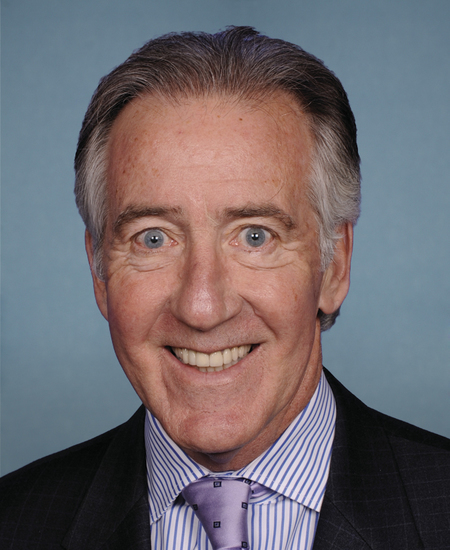
Photo of Richard E. Neal
D United States House · District 1 · Massachusetts On the 2026 ballot

Rep. Richard E. Neal

Compare
Total votes
2,818
all sessions
Attendance
97%
85 missed
Lower than 86% of chamber peers
With party
98%
of cast votes
Higher than 93% of chamber peers
Bipartisan score
1%
crosses aisle rarely
Lower than 93% of chamber peers
Sponsored
378
bills & resolutions
Lower than 89% of chamber peers
Committees
2
assignments
378 bills and resolutions

Sponsored bills

Total
378
Primary
22
Co-sponsor
356
This page
378
matching current filters
Co-sponsor HR 1631
In committee · Delaware House · Co-sponsor
Community Broadband Act of 2021

Community Broadband Act of 2021 This bill prohibits states from blocking the provision of broadband by public providers, public-private partnership providers, or cooperatively organized providers. Further, public providers and state or local entities participating in a partnership must administer applicable ordinances and rules without discrimination against competing private providers.

In committee May 11, 2021 1 co-sponsor
Co-sponsor HR 2991
In committee · Delaware House · Co-sponsor
Connecting America’s Active Transportation System Act

Connecting America's Active Transportation System Act This bill directs the Department of Transportation (DOT) to carry out an active transportation investment program to provide competitive grants to state, local, and regional government entities, and Indian tribes to construct projects that connect walking and bicycling infrastructure within and between communities, metropolitan regions, or states. The bill sets forth various limitations on the use of funds by DOT, including that it must obligate at least 30% of funds to projects that connect people with public transportation, businesses, workplaces, schools, residences, recreation areas, and other community activity centers; set aside at least $3 million to provide planning grants for eligible entities; and set aside at least $2 million to cover the costs of administration, research, technical assistance, communications, and training activities under the program. The federal share of grants must not exceed 80% of the total project cost. However, DOT may increase the federal share to 100% for disadvantaged communities with a poverty rate of over 40%.

In committee May 5, 2021 1 co-sponsor
Co-sponsor HR 234
In committee · Delaware House · Co-sponsor
Korean American VALOR Act

Korean American Vietnam Allies Long Overdue for Relief Act or the Korean American VALOR Act This bill entitles certain veterans who served in the armed forces of the Republic of Korea to hospital and domiciliary care and medical services through the Department of Veterans Affairs (VA). Specifically, the bill entitles those veterans who served in the armed forces of the Republic of Korea in Vietnam between January 9, 1962, and May 7, 1975, or during a time period determined by the VA, and became U.S. citizens after such service.

In committee May 4, 2021 1 co-sponsor
Co-sponsor HRES 169
In committee · Delaware House · Co-sponsor
Commending the officers of the United States Capitol Police Department, the Metropolitan Police Department of Washington, DC, and other law enforcement personnel for their selfless and heroic service in defense of American democracy in responding to the assault on the United States Capitol by domestic terrorists on January 6, 2021.

This resolution expresses appreciation to the officers of the U.S. Capitol Police, the Metropolitan Police Department of the District of Columbia, and other law enforcement personnel for their service in responding to the assault on the U.S. Capitol on January 6, 2021. Further, it encourages all U.S. educational and media institutions to teach and celebrate the heroism of these officers, and it calls upon all Americans to read and revere the U.S. Constitution.

In committee Apr 28, 2021 1 co-sponsor
Co-sponsor HR 1378
In committee · Delaware House · Co-sponsor
Do No Harm Act

Do No Harm Act This bill prohibits the application of the Religious Freedom Restoration Act of 1993 (RFRA) to specified federal laws or the implementation of such laws. Currently, RFRA prohibits the government from substantially burdening a person's exercise of religion even if the burden results from a rule of general applicability, except in furtherance of a compelling governmental interest when using the least restrictive means. Under the bill, RFRA is inapplicable to laws or the implementation of laws that protect against discrimination or the promotion of equal opportunity (e.g., the Civil Rights Act of 1964); require employers to provide wages, other compensation, or benefits, including leave; protect collective activity in the workplace; protect against child labor, abuse, or exploitation; or provide for access to, information about, referrals for, provision of, or coverage for, any health care item or service. The bill prevents RFRA from being used to deny (1) goods or services the government has contracted, granted, or made an agreement to provide to a beneficiary of or participant in a program or activity funded by such government contract, grant, agreement, or other award; or (2) a person's full and equal enjoyment of a government-provided good, service, benefit, facility, privilege, advantage, or accommodation. In order for a person to assert a RFRA claim or defense in a judicial proceeding, the government must be a party to the proceeding.


In committee Apr 28, 2021 1 co-sponsor
Co-sponsor HR 3
In committee · Delaware House · Co-sponsor
Elijah E. Cummings Lower Drug Costs Now Act

Elijah E. Cummings Lower Drug Costs Now Act This bill establishes several programs and requirements relating to the prices of prescription drugs. In particular, the bill requires the Department of Health and Human Services (HHS) to negotiate prices for certain drugs (current law prohibits HHS from doing so). Specifically, HHS must negotiate maximum prices for single-source, brand-name drugs that lack certain generics and that are among either the 125 drugs that account for the greatest national spending or the 125 drugs that account for the greatest Medicare spending. HHS must negotiate the prices of at least 25 such drugs for 2024 and of at least 50 such drugs thereafter and must also negotiate prices for certain newly approved drugs and for insulin products. The negotiated prices must be offered under Medicare and may also be offered under private health insurance unless the insurer opts out. The negotiated maximum price may not exceed (1) 120% of the average price in Australia, Canada, France, Germany, Japan, and the United Kingdom; or (2) if such information is not available, 85% of the U.S. average manufacturer price. Drug manufacturers that fail to comply with the bill's negotiation requirements are subject to civil and tax penalties. The bill also makes a series of additional changes to Medicare prescription drug coverage and pricing, including by (1) requiring drug manufacturers to issue rebates to the Centers for Medicare & Medicaid Services for covered drugs that cost $100 or more and for which the average manufacturer price increases faster than inflation, and (2) capping annual out-of-pocket spending under the Medicare prescription drug benefit. The bill also requires drug manufacturers to report specified information for certain high-cost drugs, and it provides funds for opioid epidemic initiatives and biomedical research.

In committee Apr 27, 2021 1 co-sponsor
Co-sponsor HR 51
Passed · Delaware House · Co-sponsor
Washington, D.C. Admission Act

Washington, D.C. Admission Act This bill provides for admission into the United States of the state of Washington, Douglass Commonwealth, composed of most of the territory of the District of Columbia. The commonwealth shall be admitted to the Union on an equal footing with the other states. The Mayor of the District of Columbia shall issue a proclamation for the first elections to Congress of two Senators and one Representative of the commonwealth. The bill applies current District laws to the commonwealth and continues pending judicial proceedings. The commonwealth (1) shall consist of all District territory, with specified exclusions for federal buildings and monuments, including the principal federal monuments, the White House, the Capitol Building, the U.S. Supreme Court Building, and the federal executive, legislative, and judicial office buildings located adjacent to the Mall and the Capitol Building; and (2) may not impose taxes on federal property except as Congress permits. District territory excluded from the commonwealth shall be known as the Capital and shall be the seat of the federal government. The bill maintains the federal government's authority over military lands and specified other property. The bill provides for expedited consideration of a joint resolution repealing the Twenty-third Amendment to the Constitution, which provides for the appointment of electors of the President and Vice President. The bill continues certain federal authorities and responsibilities, including regarding employee benefits, agencies, courts, and college tuition assistance, until the commonwealth certifies that it is prepared to take over the authorities and responsibilities. The bill establishes the Statehood Transition Commission to advise the President, Congress, and District and commonwealth leaders on the transition.

Passed Apr 22, 2021 1 co-sponsor
Co-sponsor HR 998
In committee Apr 20, 2021 1 co-sponsor
Co-sponsor HR 2586
In committee · Delaware House · Co-sponsor
Fire Fighters and EMS Employer-Employee Cooperation Act

Fire Fighters and EMS Employer-Employee Cooperation Act This bill requires the Federal Labor Relations Authority to determine whether a state substantially provides fire and emergency medical services (EMS) personnel the right to form and join a labor organization; recognition by fire and EMS employers of the employees' labor organization, agreement to bargain with the organization, and reduction of any agreements to writing in a contract or memorandum of understanding; the right to bargain over hours, wages, and terms and conditions of employment; and arbitration or other mechanisms to resolve an impasse in collective bargaining negotiations. The bill makes the authority responsible for (1) determining the appropriateness of units for labor representation; (2) supervising elections; (3) conducting hearings and resolving complaints of unfair labor practices; and (4) protecting the right of employees to form, join, or assist any labor organization, or to refrain from doing so. An employer, fire and EMS personnel, or labor organization may not engage in a lockout, sickout, work slowdown, strike, or any other organized job action that will measurably disrupt the delivery of emergency services and is designed to compel an employer, fire and EMS personnel, or labor organization to agree to the terms of a proposed contract.

In committee Apr 15, 2021 1 co-sponsor
Co-sponsor HR 1868
Signed into law · Delaware House · Co-sponsor
To prevent across-the-board direct spending cuts, and for other purposes.

This bill makes several budgetary and technical changes to provisions under Medicare and Medicaid. The bill continues to exempt Medicare from sequestration until December 31, 2021. (Sequestration is a process of automatic, usually across-the-board spending reductions under which budgetary resources are permanently cancelled to enforce specific budget policy goals.) The bill also specifically applies certain modified payment limits to rural health clinics that temporarily enrolled in Medicare during the public health emergency relating to COVID-19 (i.e., coronavirus disease 2019) or that applied to enroll by December 31, 2020; and preserves higher Medicaid disproportionate-share hospital payments for public hospitals in California under forthcoming payment methodology changes.

Signed into law Apr 14, 2021 1 co-sponsor
Showing 331 to 340 of 378 bills
Previous 1 33 34 35 38 Next