

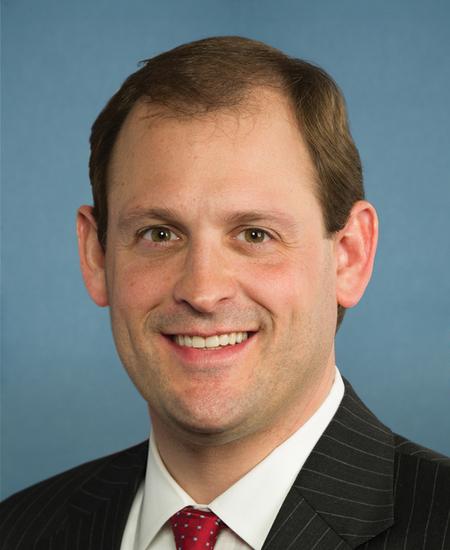
Photo of Andy Barr
R United States House · District 6 · Kentucky

Rep. Andy Barr

Compare
Total votes
2,818
all sessions
Attendance
96%
122 missed
Lower than 86% of chamber peers
With party
97%
of cast votes
Higher than 90% of chamber peers
Bipartisan score
2%
crosses aisle rarely
Lower than 91% of chamber peers
Sponsored
847
bills & resolutions
Near the chamber average
Committees
5
assignments
847 bills and resolutions

Sponsored bills

Total
847
Primary
128
Co-sponsor
719
This page
847
matching current filters
Primary HR 7758
In committee · Delaware House · Lead sponsor
The Dalilah Law

Maddy summaryThis bill, known as the Dalilah Law, would restrict commercial driver's licenses to U.S. citizens, lawful permanent residents, and holders of specific work visas. It requires states to verify the citizenship or visa status of all CDL applicants and renewals within 180 days of enactment, while also mandating English language proficiency testing for all license holders. States that fail to enforce these requirements or issue licenses to ineligible individuals risk losing federal transportation funding. The law also imposes lifetime disqualifications for operating commercial vehicles without proper immigration status.

In committee Mar 4, 2026 0 co-sponsors
Primary HR 7759
In committee · Delaware House · Lead sponsor
Afghanistan Vetting and Accountability Act of 2026

Maddy summaryThis bill requires the Department of Homeland Security to verify personal and biometric information and conduct in-person interviews for all individuals evacuated from Afghanistan between January 20, 2021, and January 20, 2022, excluding U.S. citizens and military members. It mandates the creation of a database tracking these individuals' vetting status, criminal records, and receipt of unemployment compensation or federal benefits. Afghan evacuees who do not provide the required information or complete the in-person vetting process would be ineligible to receive unemployment compensation or other federal means-tested public benefits. The bill also requires quarterly reports to Congress on compliance and independent audits by the Government Accountability Office to verify implementation.

In committee Mar 3, 2026 0 co-sponsors
Co-sponsor HR 6550
In committee · Delaware House · Co-sponsor
American FIRST Act of 2025

Maddy summaryThis bill requires the Federal Reserve, Office of the Comptroller of the Currency, and FDIC to provide detailed annual reports on their interactions with international financial regulatory forums. The reports must include information about the forums they participate in, their funding sources, how their work aligns with U.S. interests, and the positions taken by U.S. representatives. The bill specifically targets five major international financial regulatory bodies including the Basel Committee on Banking Supervision and Financial Stability Board. These reporting requirements will be added to the agencies' existing annual reports to Congress. The legislation aims to increase transparency about U.S. financial regulatory engagement with international bodies.

In committee Feb 25, 2026 1 co-sponsor
Primary HR 6552
In committee · Delaware House · Lead sponsor
Bank-Fintech Partnership Enhancement Act

Maddy summaryHR 6552, the Bank-Fintech Partnership Enhancement Act, mandates a study by the Federal Reserve, Comptroller of the Currency, and FDIC into how partnerships between banks and financial technology companies support new banking formations and community bank health. The study must examine specific benefits like reduced time-to-market for products, lower compliance costs, and improved technological capabilities, then identify potential legal or regulatory changes to foster such partnerships. The regulators must submit a report to Congress within six months of the bill's enactment. This is a procedural bill focused on research, not direct policy changes affecting businesses or consumers.

In committee Feb 25, 2026 0 co-sponsors
Primary HR 6553
In committee · Delaware House · Lead sponsor
TIER Act of 2025

Maddy summaryThe TIER Act of 2025 adjusts financial regulatory thresholds to account for economic growth. It raises key asset thresholds for large banks and financial institutions - from $250 billion to $370 billion in most cases (e.g., in the Federal Reserve Act and Financial Stability Act). The bill also establishes a new mechanism requiring periodic, automatic adjustments to these thresholds every five years based on U.S. GDP growth, starting in 2031. These changes directly affect large bank holding companies and financial firms subject to federal oversight under current regulations. The adjustments aim to keep regulatory standards aligned with the evolving size of the economy.

In committee Feb 25, 2026 0 co-sponsors
Primary HR 4781
In committee · Delaware House · Lead sponsor
RESCUE Act of 2025

Maddy summaryThe RESCUE Act of 2025 amends federal permitting rules to streamline approvals for projects extracting minerals or carbon from specific waste sources. It directly affects companies and projects working with acid mine drainage, coal waste, mine tailings, or coal byproducts to recover rare earth elements, minerals under the 1872 Mining Law, or microfine carbon. The key provision adds these activities to the existing FAST Act permit process, removing barriers for processing materials from mining waste streams. This change aims to expedite development of domestic rare earth and carbon resources without altering environmental standards. The bill focuses on clarifying permit eligibility rather than creating new regulations.

In committee Feb 24, 2026 0 co-sponsors
Primary HR 7644
In committee · Delaware House · Lead sponsor
Millennium Challenge Corporation Strategic Modernization Act

Maddy summaryHR 7644 modernizes the Millennium Challenge Corporation (MCC) to strengthen U.S. economic security amid global competition. It creates a Critical Minerals Task Force to assess supply chain vulnerabilities and identify countries for projects that diversify mineral sourcing, and adds a "Great Power Competition Factsheet" to evaluate partner countries' exposure to strategic rivals like China and Russia. The bill requires early engagement with U.S. private sector entities in project design to mobilize private capital and mandates that MCC compacts be implemented within 5 years. These changes aim to align MCC’s existing aid model - focused on governance, economic freedom, and poverty reduction - with U.S. strategic priorities without altering its core development mission.

In committee Feb 23, 2026 0 co-sponsors
Co-sponsor HR 7622
In committee · Delaware House · Co-sponsor
Iran Human Rights, Internet Freedom, and Accountability Act of 2026

Maddy summaryThis bill directs U.S. agencies to support Iranian people's access to uncensored information and hold Iranian officials accountable for human rights abuses. It requires the State Department and FCC to report on technologies (like satellite networks and mesh systems) that could bypass internet restrictions in Iran, and authorizes $2 million annually to develop such tools. The bill also establishes a new "Iran Kleptocracy Initiative" at FinCEN to track corruption, freeze assets of Iranian regime officials and state-owned businesses, and coordinate with international partners. These measures apply to U.S. policy toward Iran but do not alter Iran's domestic laws; they focus on U.S. sanctions, technology development, and anti-corruption efforts targeting the Iranian regime.

In committee Feb 20, 2026 1 co-sponsor
Primary HR 7588
In committee · Delaware House · Lead sponsor
Eliminating Fraud in the CFPB’s Complaint Database Act

Maddy summaryHR 7588, the *Eliminating Fraud in the CFPB’s Complaint Database Act*, requires consumers to verify complaint details under penalty of perjury before submitting complaints to the Consumer Financial Protection Bureau (CFPB). It mandates that complaints must be filed by the consumer directly or by an authorized representative with proof of authorization, and that consumers must notify the business involved at least 60 days prior to filing with the CFPB. Covered businesses (like banks) can close duplicate, frivolous, or unauthorized complaints without further action and must report closures to the CFPB. The bill also ensures confidentiality for narrative complaint content, allowing only aggregated, non-identifiable data to be published publicly.

In committee Feb 17, 2026 0 co-sponsors
Showing 51 to 60 of 847 bills
Previous 1 5 6 7 85 Next