

Securing Guam's Shores Reimbursement Act of 2023 This bill requires the Department of Homeland Security to make grants to Guam for expenses related to security measures associated with non-U.S. nationals ( aliens under federal law) unlawfully entering the territory through the shores. Additionally, no grant may be used to reimburse nonprofit organizations, fund legal representation, or provide educational, housing, food, or health care resources to non-U.S. nationals who unlawfully entered the territory.
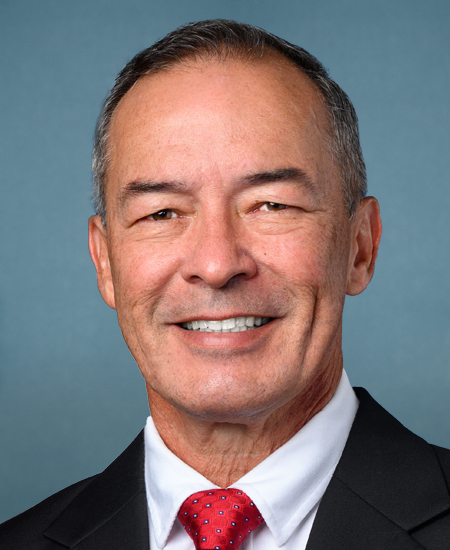
Rep. James C. Moylan
Sponsored bills
Maddy summaryHR 303, the Retired Pay Restoration Act, allows certain disabled military retirees to receive both full retired pay and veterans’ disability compensation without forfeiting retired pay. It specifically extends this benefit to retirees with service-connected disabilities rated below 50% (previously ineligible), while continuing existing provisions for those with 50-90% ratings and 100% ratings. The bill eliminates the "one dollar for one dollar" offset for these retirees, effective January 2021, meaning they no longer lose retired pay to receive disability compensation. This directly affects disabled military retirees with qualifying service-connected disabilities under 50% who were previously required to sacrifice retired pay. The law amends Title 10 to redefine "qualified retirees" and streamline concurrent payment eligibility.
Security First Act This bill reauthorizes the Operation Stonegarden program from FY2024 through FY2027 and addresses other border security issues. (Operation Stonegarden provides grants to enhance the border security capabilities of state, local, and tribal governments.) From FY2024 through FY2027, the money from unreported monetary instruments seized from individuals crossing the U.S.-Mexico border and transferred into the Department of the Treasury general fund shall be made available without further appropriation to the Department of Homeland Security (DHS) to fund Operation Stonegarden. DHS must report to Congress on (1) DHS hiring practices from 2018 to 2021, and (2) whether certain Mexican drug cartels meet the criteria to be designated as foreign terrorist organizations. DHS must also periodically report to Congress about the technology needed to secure the U.S.-Mexico land border.
Maddy summaryHCONRES 13 is a concurrent resolution expressing Congress's support for maintaining the current policy that prohibits imposing new fees on local radio stations for playing music. It states that Congress should not impose any performance fee, tax, royalty, or charge on local radio stations for broadcasting sound recordings over the air, or on businesses like bars and restaurants that play music publicly. The resolution argues that such fees would harm local radio stations - critical sources for emergency information and community programming - and jeopardize the economic model that has supported both radio and the music industry for decades. This resolution does not create new law but formally opposes potential legislative changes to the existing fee structure.
Maddy summaryThis bill amends the Defense Base Act to explicitly exclude Guam from its coverage. It modifies the law's definition of "Territory or possession outside the continental United States" by adding a new provision stating Guam is not included. As a result, Guam would no longer be considered a covered territory under this specific federal workers' compensation law for defense-related work. The change directly affects Guam's status regarding benefits for defense workers employed there under this act.
Maddy summaryHR 787, the Empowering Nonprofits Act, reduces the non-governmental cost-sharing requirement for direct federal grants to eligible nonprofits by 25% for five years after the law takes effect. It directly affects 501(c)(3) nonprofit organizations located in states where over 20% of residents live below the federal poverty line. The bill requires executive agencies to lower the portion nonprofits must contribute toward grant costs, making federal funding more accessible for organizations serving high-poverty communities. This change applies to grants awarded directly to qualifying nonprofits, with no additional requirements for recipients.
Stop Human Trafficking in School Zones Act This bill establishes an enhanced penalty—an additional prison term of up to five years—for certain human trafficking offenses and sex offenses involving minors that occur within 1,000 feet of the real property comprising a school, school-sponsored activity, playground, or public housing facility; or within 100 feet of certain other places where children gather (e.g., a youth center or swimming pool). The additional prison term must be served consecutively with the prison term imposed for the underlying offense.
Maddy summaryThe HEAL Act (HR 603) requires the U.S. Holocaust Memorial Museum Director to study how public elementary and secondary schools teach about the Holocaust and related antisemitism. The study will examine curriculum requirements, teaching methods (like project-based learning), instructional materials, and assessment approaches across states and school districts. It specifically analyzes whether Holocaust education is mandatory, optional, or integrated across subjects, and how schools address antisemitism and genocide prevention. The resulting report, due within 180 days of the study or three years after enactment, will inform Congress but does not change current school policies. This is a data-gathering measure, not a policy mandate.
Maddy summaryThis bill expands foreign investment review to cover U.S. agriculture by requiring transactions involving foreign control of agricultural businesses to undergo scrutiny by the Committee on Foreign Investment (CFIUS). It classifies agricultural supply chains as both critical infrastructure and critical technologies, directly affecting foreign entities seeking to acquire or influence U.S. farms, food production, and supply chains. The bill mandates annual reports from the Secretary of Agriculture and the Government Accountability Office on foreign investments in agriculture, including risks to food security and intellectual property. These provisions aim to mitigate potential threats to U.S. food supply chains from foreign adversaries through enhanced oversight.
Maddy summaryHR 22, the *Protecting America’s Strategic Petroleum Reserve from China Act*, blocks the U.S. government from selling petroleum from the Strategic Petroleum Reserve to entities under Chinese Communist Party control or unless sellers guarantee the oil won’t be exported to China. It directly affects the Department of Energy’s management of the reserve and any foreign entities seeking to purchase reserve petroleum. The key mechanism requires the Secretary of Energy to prohibit sales to China-linked entities or impose strict export restrictions on any sale. This policy change aims to prevent strategic petroleum resources from reaching entities tied to China’s government.