

Maddy summaryThe Clean Energy Workforce Act authorizes $100 million to help schools and colleges train students for jobs in clean energy, renewable energy, and climate change fields. The funding supports two main programs: grants for partnerships between schools and local businesses to create or expand educational courses that prepare students for these industries, and grants for educational facilities to become more energy-efficient and use renewable power. To ensure quality, the bill requires a review committee of educators and industry experts to evaluate grant applications, with priority given to programs that reach underserved students and share their methods with other schools.
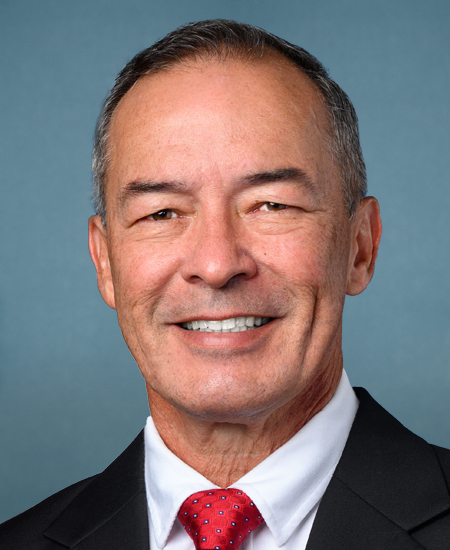
Rep. James C. Moylan
Sponsored bills
Maddy summaryThis bill requires the Department of Veterans Affairs to set a standard for how quickly veterans receive appointments after being referred for care, whether at VA facilities or through community providers. The VA Secretary must publish this standard in the Federal Register and report to Congress quarterly on how many referrals meet the timing requirement, broken down by service type and medical center performance. Each report must also include a ranking of VA medical centers from best to worst in meeting the standard, with data available to the public on a VA website. The VA must update the standard as scheduling processes change and include annual progress reports on steps taken to improve care timeliness.
Maddy summaryThis House Resolution commends the Holy See for its enduring diplomatic relationship with Taiwan and affirms the U.S. Congress's support for preserving these ties. It also recognizes Taiwan's commitment to religious freedom, contrasting it with actions by the People's Republic of China. The resolution encourages expanded engagement between Taiwan and the Holy See, specifically through increased high-level visits by clergy and church officials.
Maddy summaryThis bill, known as the Protecting Consumers from Deceptive AI Act, aims to combat the spread of misleading deepfakes by requiring clear labeling for content created or significantly altered by artificial intelligence. It mandates that developers of AI applications embed machine-readable watermarks and metadata into audio and visual files to identify their AI origins, while also requiring online platforms to display this information to users. To support these efforts, the legislation directs the National Institute of Standards and Technology to form task forces that will develop technical standards for content verification and establish guidelines for privacy and interoperability. Enforcement of these labeling requirements will be handled by the Federal Trade Commission, which can penalize violations as unfair or deceptive practices and may approve self-regulatory guidelines to help companies achieve compliance.
Maddy summaryHR 6331, the ADVERSARIES Act, amends export control definitions to clarify which entities face restrictions. It specifically expands the definition of "entity" to include Chinese military companies listed under the 2021 National Defense Authorization Act, entities on Commerce Department lists (Supplements 4 and 7 to Part 744), and their 50%+ owned subsidiaries or affiliates. This change directly affects U.S. exporters and researchers who must now comply with export controls when dealing with these designated entities. The bill does not create new restrictions but formally incorporates existing lists into the legal definition under the Export Control Reform Act. It ensures U.S. export rules explicitly cover these specific strategic entities and their affiliates.
Maddy summaryThe STRIDE Act requires the U.S. State Department to coordinate with allied nations on semiconductor supply chain security, specifically targeting prevention of technology transfers to countries of concern like China. It establishes mechanisms for aligning export controls on semiconductor manufacturing equipment, materials, and design tools, and mandates regular reporting on diplomatic progress. Countries failing to implement sufficient security measures face potential U.S. export restrictions under the Foreign Direct Product Rule. The bill directly affects U.S. trade policy with allies and semiconductor companies operating in global supply chains.
Maddy summaryThis House Resolution recognizes the efforts and public safety contributions of linemen and the important role they play in maintaining the nation's energy infrastructure. It expresses support for designating April 18, 2026, as "National Lineman Appreciation Day" and acknowledges linemen as first responders.
This resolution supports the recognition of Distracted Driving Awareness Month. The resolution also supports the efforts of the Department of Transportation, state and local governments, and state and local law enforcement to prevent and stop distracted driving.
Maddy summaryThis resolution expresses the House of Representatives' strong support for designating April 19 through April 25, 2026, as "National Crime Victims' Rights Week." It recognizes the impact of crime on victims and survivors, appreciates organizations that assist them, and encourages continued efforts to support victims' rights and services.
Maddy summaryThe Territorial Small Business Development Act of 2026 amends the Small Business Act to establish a new program for small businesses in Guam, American Samoa, and the Commonwealth of the Northern Mariana Islands. This program will provide assistance similar to that offered to socially and economically disadvantaged small businesses. A key provision removes the net worth eligibility requirement for applicants to this new program. To qualify, businesses must be at least 51% owned and controlled by residents of these territories, whose principal place of business is located there, and who can demonstrate residency for the preceding 10 years.