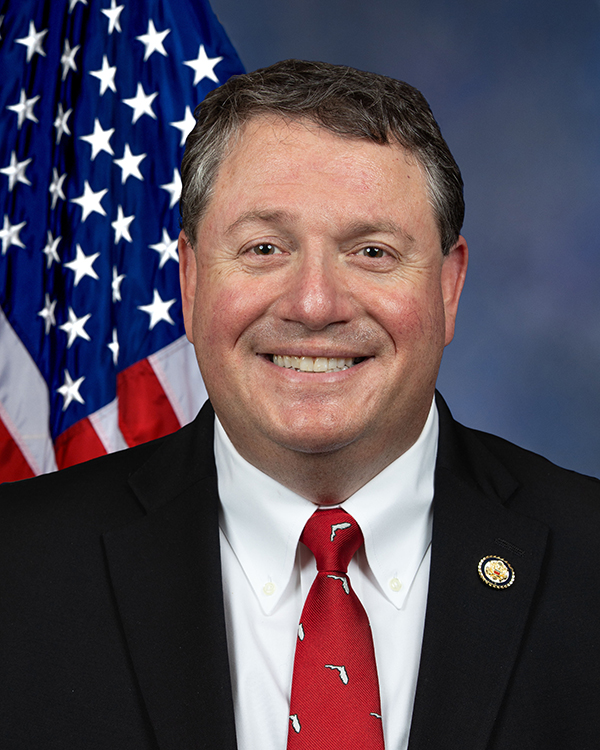
Photo of Randy Fine
R United States House · District 6 · Florida On the 2026 ballot

Rep. Randy Fine

Compare
Total votes
564
all sessions
Attendance
83%
113 missed
Lower than 93% of chamber peers
With party
92%
of cast votes
Lower than 90% of chamber peers
Bipartisan score
4%
crosses aisle rarely
Higher than 89% of chamber peers
Sponsored
246
bills & resolutions
Near the chamber average
Committees
7
assignments
246 bills and resolutions

Sponsored bills

Total
246
Primary
30
Co-sponsor
216
This page
246
matching current filters
Co-sponsor HR 7371
In committee · Delaware House · Co-sponsor
No Flight, No Fight Act of 2026

Maddy summaryHR 7371 (No Flight, No Fight Act of 2026) bans air carriers from transporting adult roosters as cargo, except for shipments originating from or destined to qualifying commercial farms. The bill requires shippers to provide USDA-certified documentation proving the farm meets the $350,000 annual gross income threshold for commercial operations. It defines "adult rooster" as a male chicken over 6 months old and specifies that exemptions apply only to legitimate agricultural purposes, not to prevent illegal activities like cockfighting. The Department of Transportation will enforce this rule, with violations subject to civil penalties, effective 180 days after enactment.

In committee Feb 5, 2026 1 co-sponsor
Co-sponsor HR 7359
In committee · Delaware House · Co-sponsor
Somalia Immigration Moratorium Act

Maddy summaryThis bill prohibits most Somali citizens and nationals from obtaining U.S. visas or immigration status for 25 years after enactment. It amends immigration laws to block new admissions while allowing exceptions for those already lawfully admitted, lawful permanent residents, and individuals with specific diplomatic visas (A-1, G-1, etc.). The law directly affects Somali nationals seeking to immigrate to the U.S. and takes effect immediately upon passage. It creates a permanent policy change to restrict immigration from Somalia, with limited exceptions for existing residents and certain travelers.

In committee Feb 4, 2026 1 co-sponsor
Primary HR 7357
In committee · Delaware House · Lead sponsor
TSP Fiduciary Security Act of 2026

Maddy summaryThe TSP Fiduciary Security Act of 2026 requires the Thrift Savings Fund (TSP), which manages retirement savings for federal employees and uniformed service members, to avoid investments harming national security. It adds a new duty for the TSP's managing board to prevent investments from threatening U.S. national security, directing the Secretary of Labor to create regulations within one year to establish standards for TSP investments and voting rights. These regulations will presume investments in China-based entities, or those breaching government contracts involving critical defense technology, as non-compliant. The bill also explicitly prohibits TSP mutual funds from including investments in China-based companies or their subsidiaries. Additionally, it mandates annual congressional reports on TSP investment reviews and enforcement outcomes.

In committee Feb 4, 2026 0 co-sponsors
Co-sponsor HR 5438
In committee · Delaware House · Co-sponsor
Incentivize Savings Act

Maddy summaryThis bill modifies federal budget rules for unspent agency funds. It requires federal agencies to allocate 49% of unused funds to the next fiscal year, 49% toward paying the national debt, and 2% for retention bonuses (capped at 10% of an employee's base pay). Agencies must also limit future budget requests to the previous year's amount adjusted for inflation. The bill directly affects all executive branch agencies (excluding the Red Cross), altering how they manage leftover budget authority. It does not create new savings programs for individuals but changes government fiscal management procedures.

In committee Feb 4, 2026 1 co-sponsor
Co-sponsor HR 3699
In committee · Delaware House · Co-sponsor
Energy Choice Act

Maddy summaryThis bill prevents state or local governments from banning or restricting energy connections (like installation, modification, or access) based on the type or source of energy, such as electricity, natural gas, or renewable fuels. It directly affects consumers choosing energy providers and energy companies seeking to offer services. The key provision prohibits local laws, regulations, or policies that limit energy services sold in interstate commerce, covering all energy types listed in the bill’s definitions. It does not create new programs but limits regulatory authority at the state or local level. The law aims to ensure open access to diverse energy sources without source-based restrictions.

In committee Feb 4, 2026 1 co-sponsor
Co-sponsor HR 7325
In committee · Delaware House · Co-sponsor
Truth and Healing Commission on Indian Boarding School Policies Act of 2026

Maddy summaryThis bill establishes a Truth and Healing Commission to investigate the history and impacts of U.S. Indian Boarding School policies on Native American communities, including their cultural, emotional, and physical effects. The Commission will document these policies' history through research, public meetings across all 12 Bureau of Indian Affairs regions and Hawai'i, and consultation with survivors, tribes, and relevant Federal agencies. It will develop recommendations for federal action on memorialization, education, and addressing ongoing impacts, with a final report due six years after enactment. The Commission will include a Survivors Truth and Healing Subcommittee with 15 members representing boarding school survivors, their descendants, and tribal communities. The bill requires trauma-informed care at public meetings and mandates consultation with Native American communities throughout the process.

In committee Feb 3, 2026 1 co-sponsor
Co-sponsor HR 7296
In committee · Delaware House · Co-sponsor
SAVE America Act

Safeguard American Voter Eligibility Act or the SAVE America Act This bill requires individuals to provide documentary proof of U.S. citizenship when registering to vote, and requires photo identification to vote, in federal elections. Specifically, the bill prohibits states from accepting and processing an application to register to vote in a federal election unless the applicant presents documentary proof of U.S. citizenship. The bill specifies what documents are considered acceptable proof of U.S. citizenship, such as identification that complies with the REAL ID Act of 2005 that indicates U.S. citizenship. Further, the bill (1) prohibits states from registering an individual to vote in a federal election unless, at the time the individual applies to register to vote, the individual provides documentary proof of U.S. citizenship; and (2) requires states to establish an alternative process to demonstrate U.S. citizenship. Each state must take affirmative steps on an ongoing basis to ensure that only U.S. citizens are registered to vote, which shall include establishing a program to identify individuals who are not U.S. citizens using information supplied by certain sources. Additionally, states must remove noncitizens from their official lists of eligible voters. The bill (1) provides for a private right of action for certain violations, and (2) establishes criminal penalties for certain offenses. Individuals voting in federal elections must present an eligible photo identification document. An individual who votes by absentee ballot must submit a copy of their identification document with both the request for, and the submission of, the absentee ballot.


In committee Jan 30, 2026 1 co-sponsor
Co-sponsor HR 7169
In committee · Delaware House · Co-sponsor
UBER Act

Maddy summaryThe UBER Act establishes new federal requirements for ride-sharing and shared-transportation companies to receive government contracts. To qualify, every driver must be at least 21 years old, hold a valid license from a single state, pass a road test, and demonstrate sufficient English proficiency to communicate with the public and read traffic signs, with an exception for drivers who use American Sign Language. Companies that fail to certify that all their drivers meet these standards will be banned from federal contracts for five years.

In committee Jan 21, 2026 1 co-sponsor
Co-sponsor HR 6875
In committee · Delaware House · Co-sponsor
AI OVERWATCH Act

Maddy summaryThe AI OVERWATCH Act requires U.S. exporters to obtain a license for sending certain high-performance integrated circuits (defined by specific technical specifications like processing power or bandwidth) to countries designated as "concerns," including China, Russia, Iran, and North Korea. Before approving such licenses, the Commerce Department must submit detailed certifications to Congress, including assurances the export won’t support military/intelligence capabilities of the recipient country and won’t harm U.S. semiconductor availability or AI leadership. The bill also creates an exemption for U.S. companies meeting strict security and ownership standards ("trusted United States persons") to export these chips to non-target countries without a license. Additionally, it mandates a national security strategy assessing how such exports affect U.S. AI competitiveness, particularly regarding China’s semiconductor production and capabilities.

In committee Jan 21, 2026 1 co-sponsor
Co-sponsor HRES 998
In committee · Delaware House · Co-sponsor
Commending President Trump, his administration, and the brave men and women of the Armed Forces, Intelligence Community, and Justice Department for the remarkable success of "Operation Absolute Resolve".

Maddy summaryThis resolution (HRES 998) is a symbolic House of Representatives commendation honoring President Trump, U.S. military/intelligence agencies, and Justice Department personnel for the alleged success of "Operation Absolute Resolve" in apprehending Venezuelan leader Nicolás Maduro. It cites Maduro's charges (including narcoterrorism conspiracy) and the Maduro regime's alleged dismantling of Venezuelan democracy, state-sponsored drug trafficking, and human rights abuses. The resolution expresses support for Venezuela's democratic transition but contains no new policy, funding, or legal changes. As a procedural resolution, it does not directly affect any individuals or alter laws.

In committee Jan 14, 2026 1 co-sponsor
Showing 91 to 100 of 246 bills
Previous 1 9 10 11 25 Next