

Safe Step Act This bill requires a group health plan to establish an exception to medication step-therapy protocol in specified cases. A medication step-therapy protocol establishes a specific sequence in which prescription drugs are covered by a group health plan or a health insurance issuer. A request for such an exception to the protocol must be granted if (1) an otherwise required treatment has been ineffective, (2) such treatment is expected to be ineffective and delaying effective treatment would lead to irreversible consequences, (3) such treatment will cause or is likely to cause an adverse reaction to the individual, (4) such treatment is expected to prevent the individual from performing daily activities or occupational responsibilities, (5) the individual is stable based on the prescription drugs already selected, or (6) there are other circumstances as determined by the Employee Benefits Security Administration. The bill requires a group health plan to implement and make readily available a clear process for an individual to request an exception to the protocol, including required information and criteria for granting an exception. The bill further specifies timelines under which plans must respond to such requests.
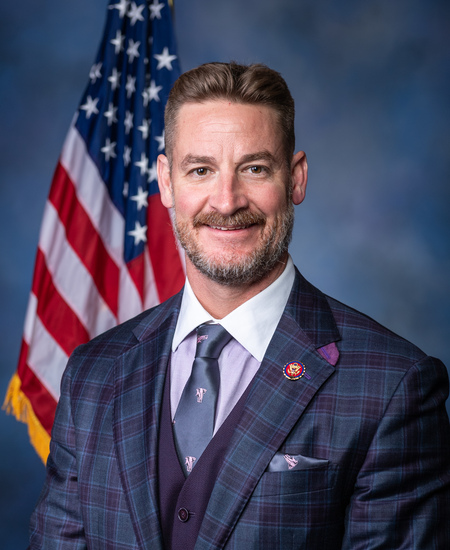
Rep. W. Gregory Steube
Sponsored bills
This bill prohibits the use of federal funds (1) 15 days after its enactment, to support the mission of the National Guard in the District of Columbia in response to the attacks on the U.S. Capitol buildings and grounds on January 6, 2021; or (2) to install permanent fencing around the perimeter of any U.S. Capitol buildings or grounds. On January 7, 2021, in response to the attacks, razor wire fencing was erected to secure the perimeter of the U.S. Capitol; the fencing was initially to remain in place for 30 days and was kept in place through periodic extensions.
Puppies Assisting Wounded Servicemembers Act of 2021 or the PAWS Act of 2021 This bill requires the Department of Veterans Affairs (VA) to implement a grant program for the purpose of pairing service dogs with eligible veterans. Organizations that receive grants must provide veterinary health insurance coverage, hardware, and travel expenses for each service dog and veteran participating in the program. Eligible veterans are those who (1) are enrolled in the VA health care system, (2) have been evaluated and treated for post-traumatic stress disorder (PTSD) but remain diagnosed with PTSD, (3) may benefit from a service dog, and (4) agree to successfully complete training provided by an eligible organization. Veterans are required to see a VA health care provider at least once every six months to determine whether the veteran continues to benefit from a service dog. Eligible organizations are nonprofit organizations that provide service dogs to veterans with PTSD, meet publicly available standards set forth by the Association of Service Dog Providers for Military Veterans, have expertise in the needs of veterans with PTSD, agree to cover all costs in excess of the grant amount to guarantee the benefits of the program, agree to reaccept or replace a service dog provided to a veteran, and submit an application to the VA. Any improvement in PTSD symptoms as a result of the provision of a service dog shall not affect the veteran's eligibility for any other VA benefits. The Government Accountability Office must report on the grant program.
Veterans Expedited TSA Screening Safe Travel Act or the VETS Safe Travel Act This bill makes certain veterans eligible for the Transportation Security Administration (TSA) PreCheck Program at no cost if they meet the program's background check and security requirements. Veterans who are eligible for this fee waiver are those who are in the annual patient enrollment system of the Department of Veterans Affairs (VA) and require the use of a wheelchair, prosthetic limb, or other assistive device to aid with mobility due to (1) loss, or loss of use, of a limb; (2) full or partial paralyzation; or (3) permanent blindness. The VA and the TSA must develop and implement a process to provide disabled veterans effective outreach about TSA programs that are designed to improve the screening process for passengers with disabilities.
Heartbeat Protection Act of 2021 This bill makes it a crime for a physician to knowingly perform an abortion (1) without determining whether the fetus has a detectable heartbeat, (2) without informing the mother of the results, or (3) after determining that a fetus has a detectable heartbeat. It provides an exception for an abortion that is necessary to save the life of a mother whose life is endangered by a physical (but not psychological or emotional) disorder, illness, or condition. A physician who performs a prohibited abortion is subject to criminal penalties—a fine, up to five years in prison, or both. A woman who undergoes a prohibited abortion may not be prosecuted for violating or conspiring to violate the provisions of this bill.
Blocking Rioters and Insurrectionists from our Cities to Keep us Safe Act of 2021 or the BRICKS Act of 2021 This bill increases criminal penalties for rioting and related offenses (e.g., inciting a riot). First, the bill increases from 5 to 10 years the statutory maximum prison term for a rioting offense. Second, it establishes higher statutory maximum penalties for rioting offenses that involve certain aggravating characteristics. Specifically, it provides a prison term of up to 25 years for a rioting offense that results in serious bodily injury or includes a dangerous weapon, explosives, or fire; and a prison term of any years or for life for a rioting offense that results in death or includes kidnapping, attempt to kidnap, aggravated sexual abuse, attempt to commit aggravated sexual abuse, or attempt to kill.
Stop Greenlighting Driver Licenses for Illegal Immigrants Act This bill prohibits a state from receiving certain federal law enforcement grants if it takes certain immigration-related actions. Specifically, a state may not receive such grants if it (1) issues a driver license to an individual who does not have proof of U.S. citizenship or lawful presence in the United States, or (2) prohibits a local or state government entity or official from sharing immigration enforcement information with the Department of Homeland Security.
Born-Alive Abortion Survivors Protection Act This bill establishes requirements for the degree of care a health care practitioner must provide in the case of a child born alive following an abortion or attempted abortion. Specifically, a health care practitioner who is present must (1) exercise the same degree of care as would reasonably be provided to any other child born alive at the same gestational age, and (2) ensure the child is immediately admitted to a hospital. Additionally, a health care practitioner or other employee who has knowledge of a failure to comply with the degree-of-care requirements must immediately report such failure to law enforcement. A health care practitioner who fails to provide the required degree of care, or a health care practitioner or other employee who fails to report such failure, is subject to criminal penalties—a fine, up to five years in prison, or both. An individual who intentionally kills or attempts to kill a child born alive is subject to prosecution for murder. The bill bars the criminal prosecution of a mother of a child born alive under this bill and allows her to bring a civil action against a health care practitioner or other employee for violations.
States' Education Reclamation Act of 2021 This bill abolishes the Department of Education (ED) and repeals any program for which it has administrative responsibility. The Department of the Treasury shall provide grants to states, for FY2021-FY2029, for elementary, secondary, and postsecondary education purposes permitted by state law. The level of funding is set at the amount provided to states for federal elementary and secondary education programs and the amount provided for federal postsecondary education programs, respectively, for FY2021, minus the funding provided for education programs that the bill transfers to other federal agencies. States must contract for an annual audit of their expenditures or transfers of grant funds. Program administrative responsibility and delegation of authority are transferred as follows: ED's job training programs to the Department of Labor, each special education grant program under the Individuals with Disabilities Education Act to the Department of Health and Human Services (HHS), ED's Indian education programs to the Department of the Interior, each Impact Aid program under the Elementary and Secondary Education Act of 1965 to the Department of Defense, the Federal Pell Grant program and each federal student loan program to Treasury, and programs under the jurisdiction of the Institute of Education Sciences or the D.C. Opportunity Scholarship Program to HHS.
Whole Milk for Healthy Kids Act of 2021 This bill revises requirements for milk provided by the National School Lunch Program of the Department of Agriculture (USDA). Currently, schools participating in the program must provide milk that is consistent with the most recent Dietary Guidelines for Americans; USDA regulations require milk to be fat-free or low-fat and allow only fat-free milk to be flavored. The bill removes these restrictions and instead permits schools to offer students whole, reduced-fat, low-fat, and fat-free flavored and unflavored milk.