

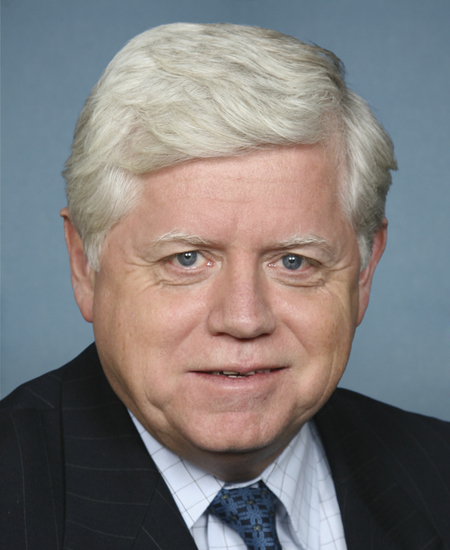
Photo of John B. Larson
D United States House · District 1 · Connecticut

Rep. John B. Larson

Compare
Total votes
2,837
all sessions
Attendance
97%
72 missed
Near the chamber average
With party
98%
of cast votes
Higher than 88% of chamber peers
Bipartisan score
1%
crosses aisle rarely
Lower than 89% of chamber peers
Sponsored
1,146
bills & resolutions
Near the chamber average
Committees
3
assignments
1,146 bills and resolutions

Sponsored bills

Total
1,146
Primary
39
Co-sponsor
1,107
This page
1,146
matching current filters
Co-sponsor HR 2549
In committee · Delaware House · Co-sponsor
Tax Fairness for Workers Act

Tax Fairness for Workers Act This bill allows an above-the-line tax deduction for union dues and expenses. (An above-the-line deduction is subtracted from gross income and is available whether or not a taxpayer itemizes other deductions.) The bill also reinstates the miscellaneous itemized tax deduction for unreimbursed expenses attributable to the performance of services as an employee (Under current law, all miscellaneous itemized deductions are suspended through 2025).

In committee Apr 15, 2021 1 co-sponsor
Co-sponsor HR 2573
In committee · Delaware House · Co-sponsor
Affordable Housing Credit Improvement Act of 2021

Affordable Housing Credit Improvement Act of 2021 This bill revises provisions of the low-income housing tax credit and renames it as the affordable housing credit . The bill increases the per capita dollar amount of the credit and its minimum ceiling amount beginning in 2021 and extends the inflation adjustment for such amounts. The bill modifies tenant income eligibility requirements and the average income formula for determining such income. It also revises rules for student occupancy of rental units and tenant voucher payments, and prohibits any refusal to rent to victims of domestic abuse. The bill further modifies the credit to increase state allocations of the credit; repeal the qualified census tract population cap; prohibit local approval and contribution requirements; increase the credit for certain projects designated to serve extremely low-income households; increase the credit for certain bond-financed projects designated by state agencies; eliminate the basis reduction for properties that receive certain energy-related tax benefits; and increase the population cap for difficult development areas (i.e., areas with high construction, land, and utility costs relative to area median gross income). The bill also includes Indian and rural areas as difficult development areas and modifies other requirements relating to casualty losses, acquisition credits, and foreclosures.

In committee Apr 15, 2021 1 co-sponsor
Co-sponsor HR 2517
In committee · Delaware House · Co-sponsor
Comprehensive Care for Alzheimer’s Act

Comprehensive Care for Alzheimer's Act This bill allows the Center for Medicare and Medicaid Innovation (CMMI) to test a Dementia Care Management Model that provides comprehensive care to Medicare beneficiaries with Alzheimer's disease or a related dementia. Under the model, participating health care providers receive payment under Medicare for comprehensive care management services that are provided to individuals with diagnosed dementia, excluding Medicare Advantage enrollees, hospice care recipients, and nursing home residents. Required services include medication management, care coordination, and health, financial, and environmental monitoring, as well as trainings and other support services for unpaid caregivers. Providers must furnish services through interdisciplinary teams and must ensure access to a team member or primary care provider 24-7. The CMMI must set payments and determine quality measures for the model in accordance with specified requirements. The bill also allows the CMMI to design a similar model under Medicaid.

In committee Apr 15, 2021 1 co-sponsor
Co-sponsor HR 2525
In committee · Delaware House · Co-sponsor
Report and Educate About Campus Hazing Act

Report and Educate About Campus Hazing Act or the REACH Act This bill requires institutions of higher education (IHEs) that participate in federal student-aid programs to report hazing incidents and implement hazing education programs. Specifically, the bill requires each IHE to disclose hazing incidents that were reported to campus security authorities or local police agencies in its annual security report. The bill defines the term hazing to mean any intentional, knowing, or reckless act committed by a student, or a former student, of an IHE against another student (regardless of that student's willingness to participate), that (1) is connected with an initiation into, an affiliation with, or the maintenance of membership in an organization that is affiliated with the IHE (e.g., an athletic team); and (2) contributes to a substantial risk of physical injury, mental harm, or degradation or causes physical injury, mental harm, or personal degradation. In addition, each IHE must implement a comprehensive program to prevent hazing, which must include information on hazing awareness, hazing prevention, and the IHE's policies on hazing.

In committee Apr 14, 2021 1 co-sponsor
Co-sponsor HR 2489
In committee · Delaware House · Co-sponsor
Martha Wright Prison Phone Justice Act

Martha Wright Prison Phone Justice Act This bill establishes requirements related to certain charges, practices, classifications, or regulations in connection with confinement facility (i.e., jail or prison) communications services. Specifically, the bill requires the Federal Communications Commission (FCC) to establish maximum rates and charges that a provider of prison communications services may charge for such services. The bill provides interim rate caps until the FCC establishes such rates and charges. The bill requires a provider of prison communications services to assess all charges for communications on a per-minute basis for the actual duration of the communication, and it prohibits a provider from charging a per-communication or per-connection charge. A provider also may not charge an ancillary service charge except in certain circumstances. Further, the bill prohibits a provider from assessing a site commission, which is a payment or donation made to certain entities that operate or oversee a confinement facility.

In committee Apr 14, 2021 1 co-sponsor
Co-sponsor HR 2484
In committee · Delaware House · Co-sponsor
Lowest Price for Patients Act

Lowest Price for Patients Act This bill requires pharmacies to disclose to consumers when dispensing a prescription drug (1) the cost of the drug under the consumer's insurance plan, and (2) the cost of the drug without using their plan.

In committee Apr 14, 2021 1 co-sponsor
Co-sponsor HR 1868
Signed into law · Delaware House · Co-sponsor
To prevent across-the-board direct spending cuts, and for other purposes.

This bill makes several budgetary and technical changes to provisions under Medicare and Medicaid. The bill continues to exempt Medicare from sequestration until December 31, 2021. (Sequestration is a process of automatic, usually across-the-board spending reductions under which budgetary resources are permanently cancelled to enforce specific budget policy goals.) The bill also specifically applies certain modified payment limits to rural health clinics that temporarily enrolled in Medicare during the public health emergency relating to COVID-19 (i.e., coronavirus disease 2019) or that applied to enroll by December 31, 2020; and preserves higher Medicaid disproportionate-share hospital payments for public hospitals in California under forthcoming payment methodology changes.

Signed into law Apr 14, 2021 1 co-sponsor
Co-sponsor HR 40
In committee · Delaware House · Co-sponsor
Commission to Study and Develop Reparation Proposals for African Americans Act

Commission to Study and Develop Reparation Proposals for African Americans Act This bill establishes the Commission to Study and Develop Reparation Proposals for African Americans. The commission shall examine slavery and discrimination in the colonies and the United States from 1619 to the present and recommend appropriate remedies. The commission shall identify (1) the role of the federal and state governments in supporting the institution of slavery, (2) forms of discrimination in the public and private sectors against freed slaves and their descendants, and (3) lingering negative effects of slavery on living African Americans and society.

In committee Apr 14, 2021 1 co-sponsor
Co-sponsor HR 2465
In committee · Delaware House · Co-sponsor
Healthy Families Act

Healthy Families Act This bill provides for paid and unpaid sick leave for employees to meet their own medical needs and those of their families. It requires employers with 15 or more employees to provide their employees with at least one hour of earned paid sick leave for every 30 hours worked, up to a maximum of 56 hours of paid sick leave in a year. An employer with fewer than 15 employees may also provide the same amount of paid sick leave, but may opt out of such requirement, in which case such employer must provide its employees at least 56 hours of unpaid leave in a year. An employee may use sick leave for absences (1) resulting from a physical or mental illness, injury or medical condition; (2) resulting from obtaining professional medical diagnosis or care, or preventive medical care; (3) to care for a child, parent, spouse, a domestic partner, or other blood or close relative; and (4) resulting from domestic violence, sexual assault, or stalking. The bill makes it unlawful for any employer to interfere with, restrain, or deny the exercise of an employee's right to accrue sick leave as provided by this bill. An employee may take legal action to enforce the right to sick leave granted by this bill and the Department of Labor must investigate complaints of violations of the requirements of this bill. Labor is authorized to conduct a public awareness campaign to educate and inform the public of the requirements for paid sick leave provided by this bill.

In committee Apr 13, 2021 1 co-sponsor
Co-sponsor HR 2455
In committee · Delaware House · Co-sponsor
TRIA Act of 2021

Resetting the Impact Act of 2021 or the TRIA Act of 2021 This bill requires certain data collection and recommendations relating to a Medicare post-acute care prospective payment system to incorporate the effects of COVID-19 on providers and patients. Current law requires the Centers for Medicare & Medicaid Services (CMS) and the Medicare Payment Advisory Commission to develop a prototype for a unified Medicare payment system for post-acute care that is based primarily on patient characteristics (e.g., cognitive ability, functional status, or impairments) rather than the provider setting (e.g., skilled nursing facility, home health agency, inpatient rehabilitation facility, or long-term care hospital). The bill requires the prototype to account for the role of post-acute care providers during public health emergencies, particularly in light of the COVID-19 emergency and the related effects on such providers and their patients. The bill also delays the development of the prototype until two years after the later of January 1, 2022, and the date by which the CMS has collected eight calendar quarters of data after the emergency ends and other changes have been implemented.

In committee Apr 13, 2021 1 co-sponsor
Showing 1,021 to 1,030 of 1,146 bills