

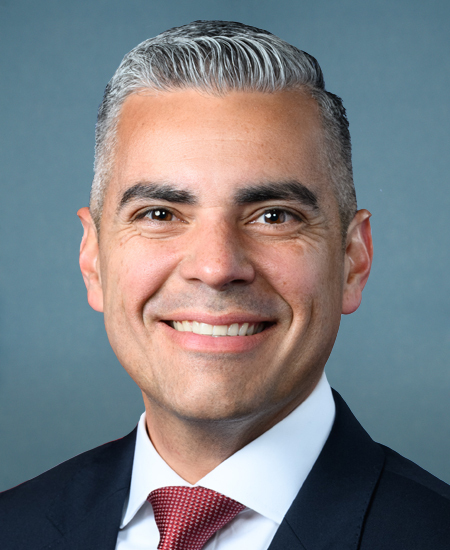
Photo of Juan Ciscomani
R United States House · District 6 · Arizona On the 2026 ballot

Rep. Juan Ciscomani

Compare
Total votes
1,860
all sessions
Attendance
96%
70 missed
Lower than 81% of chamber peers
With party
89%
of cast votes
Near the chamber average
Bipartisan score
6%
crosses aisle rarely
Near the chamber average
Sponsored
742
bills & resolutions
Near the chamber average
Committees
7
assignments
742 bills and resolutions

Sponsored bills

Total
742
Primary
63
Co-sponsor
679
This page
742
matching current filters
Co-sponsor HR 7230
In committee · Delaware House · Co-sponsor
Buying American Cotton Act of 2026

Maddy summaryThis bill creates a tax credit for businesses selling products made with U.S.-grown cotton. The credit equals 24% of the cotton's market value if processed only in the U.S. or in countries with U.S. trade deals, or 18% for other processing locations. To qualify, cotton must be digitally traced from U.S. farms to finished products and certified by the USDA as meeting origin requirements. It directly affects clothing and textile manufacturers selling qualifying products in the U.S. market.

In committee Jan 22, 2026 1 co-sponsor
Co-sponsor HR 7178
In committee · Delaware House · Co-sponsor
U.S.-Israel Anti-Killer Drone Act of 2026

Maddy summaryHR 7178, the U.S.-Israel Anti-Killer Drone Act of 2026, requires enhanced U.S.-Israel cooperation to counter Iranian unmanned systems. The bill directs the U.S. and Israel to jointly develop, test, and deploy counter-drone technologies through their existing Operations Technology-Working Group, including sharing threat intelligence and conducting joint training. It increases annual funding for this cooperation from $55 million to $100 million and mandates detailed annual reports to Congress on progress, threat assessments, and the adequacy of current counter-drone capabilities. The bill directly affects U.S. and Israeli military forces by accelerating joint efforts to address threats from Iran-origin drones targeting U.S. allies and military assets in the Middle East.

In committee Jan 21, 2026 1 co-sponsor
Co-sponsor HR 4105
In committee · Delaware House · Co-sponsor
VET Act of 2025

Maddy summaryHR 4105, the VET Act of 2025, establishes a federal grant program to help veterans, active-duty service members transitioning out of the military, and their spouses secure jobs in the energy industry. The program provides grants to energy companies (including manufacturers of solar, wind, or nuclear equipment) to cover costs like job training, recruitment, and relocation for eligible individuals - prioritizing those with military energy experience, in opportunity zones, or facing barriers like homelessness. Grants are capped at $10,000 per hire, with a maximum $500,000 annual limit per company, funded at $60 million yearly from 2026-2031. Companies must report on job retention, employee satisfaction, and program outcomes to the Department of Labor, with a final evaluation due to Congress by 2030.

In committee Jan 21, 2026 1 co-sponsor
Co-sponsor HR 224
Signed into law · Delaware House · Co-sponsor
Disabled Veterans Housing Support Act

Maddy summaryHR 224, the Disabled Veterans Housing Support Act, modifies how income is calculated for housing assistance programs by requiring that veterans' service-connected disability compensation (from the VA) be excluded when determining eligibility for low/moderate income housing. This directly affects disabled veterans who receive VA disability payments, ensuring these funds do not count against them for housing assistance under HUD programs. The bill amends the Housing and Community Development Act of 1974 to mandate this exclusion in income calculations. Additionally, it requires a report within one year examining how disability compensation is treated across HUD programs and recommending improvements to better serve veterans.

Signed into law Jan 20, 2026 1 co-sponsor
Co-sponsor HR 7145
In committee · Delaware House · Co-sponsor
To amend title XIX of the Social Security Act to establish a definition of essential health system in statute and for other related purposes.

Maddy summaryHR 7145 defines "essential health systems" as hospitals serving large numbers of Medicaid and low-income patients, specifically targeting non-Federal, nonprofit, or government-run hospitals that meet one of three criteria for at least two of the past three years (e.g., high Medicaid patient percentage, high uncompensated care, or top 16th percentile in state rankings for low-income care). The bill requires MACPAC to annually publish an "essential health system index" ranking qualifying hospitals nationally, by state, and within local areas, using data from Medicare reporting. Hospitals designated as essential health systems receive a five-year designation, renewable if they maintain eligibility. This framework aims to identify facilities providing critical community care for vulnerable populations through standardized metrics.

In committee Jan 16, 2026 1 co-sponsor
Co-sponsor HR 7115
In committee · Delaware House · Co-sponsor
Jumpstart Savings Act

Maddy summaryThe Jumpstart Savings Act creates a new tax-advantaged savings program for state-run accounts that help individuals save for career-specific training and expenses. It directly affects workers, apprentices, and students pursuing certified trades or occupations by allowing tax-free contributions to accounts covering costs like community college tuition, apprenticeship fees, certification exams, trade tools, and business startup expenses. The bill enables rollovers from existing 529 college savings plans into these accounts and requires states to administer the programs with reporting rules similar to current 529 plans. The program will apply to taxable years beginning after December 31, 2025, and is designed to support career advancement in regulated fields.

In committee Jan 15, 2026 1 co-sponsor
Co-sponsor HR 7033
In committee · Delaware House · Co-sponsor
Federal Correctional Officer Paycheck Protection Act of 2026

Maddy summaryThis bill would increase the base pay for Federal Bureau of Prisons correctional officers by 35 percent, replacing their current base rate for all pay calculations (including retirement and locality adjustments). It applies to officers whose duties involve inmate custody, control, or direct custodial contact, including certain supervisory staff and lower-grade Bureau of Prisons employees with similar duties. The pay increase is capped at the Executive Schedule level V rate and would expire after five years unless a Department of Justice Inspector General review finds progress in reducing non-custodial staff use for custodial duties and excessive overtime. The review, required 180 days before expiration, would assess impacts on recruitment, retention, and institutional safety.

In committee Jan 13, 2026 1 co-sponsor
Co-sponsor HR 4509
In committee · Delaware House · Co-sponsor
NOPAIN for Veterans Act

Maddy summaryHR 4509, the NOPAIN for Veterans Act, requires the Department of Veterans Affairs (VA) to add FDA-approved non-opioid pain medications to its national formulary within one year of their approval for pain management. These medications must reduce pain without acting on opioid receptors, directly affecting veterans receiving VA care who need pain treatment. The bill mandates the VA include such drugs in its formulary and drug standardization list, expanding access to non-opioid options. It also prohibits using funds from the Cost of War Toxic Exposures Fund to implement these changes, with implementation required within 90 days of the bill's enactment.

In committee Jan 13, 2026 1 co-sponsor
Co-sponsor HR 3453
In committee · Delaware House · Co-sponsor
Empower Charter School Educators to Lead Act

Maddy summaryHR 3453, the Empower Charter School Educators to Lead Act, creates new federal grants to help educator-led teams plan and open charter schools. It provides up to $100,000 per team for pre-charter planning, targeting groups led by educators with at least 4.5 years of school-based experience (including after-school programs) and a demonstrated ability to lead. To qualify, teams must submit a community needs assessment and a plan showing how their proposed school will address those needs. The bill reserves 5% of relevant funding for these educator-led grants, adjusting existing ESEA grant formulas to prioritize this new support. This directly affects educators seeking to start charter schools and the communities where those schools would operate.

In committee Jan 13, 2026 1 co-sponsor
Co-sponsor HR 909
Passed · Delaware House · Co-sponsor
Crime Victims Fund Stabilization Act of 2025

Maddy summaryHR 909, the Crime Victims Fund Stabilization Act of 2025, modifies how funds from the False Claims Act are deposited into the Crime Victims Fund. It specifies that from 2025 through 2029, certain False Claims Act proceeds (specifically those for qui tam plaintiff payments and government damage reimbursements) cannot be deposited into the fund. This change directly affects the composition of the Crime Victims Fund by excluding these specific revenue streams during the specified period. The bill does not create new benefits or alter victim services; it only adjusts fund allocation rules for existing False Claims Act revenues.

Passed Jan 13, 2026 1 co-sponsor
Showing 91 to 100 of 742 bills
Previous 1 9 10 11 75 Next