

Directing Responsibility to Interior for Leases and Licenses Act or the DRILL Act This bill requires the Department of the Interior to issue permits under the Mineral Leasing Act for all pending applications to drill for oil and gas on public land if the applications are complete and meet the requirements of the National Environmental Policy Act of 1969 and other applicable law. In addition, the bill creates a variety of requirements for Interior to report on and publish data concerning leases and permits to develop oil, gas, and renewable energy.
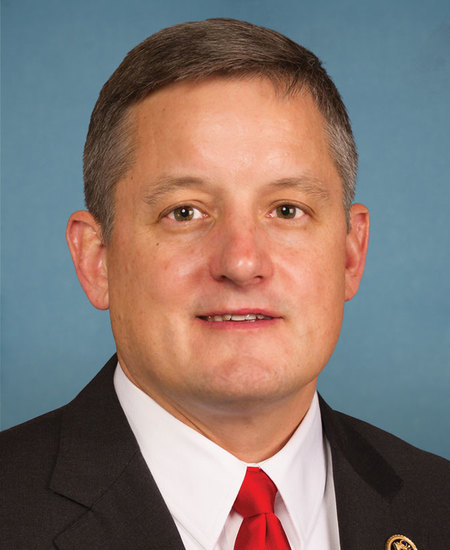
Rep. Bruce Westerman
Sponsored bills
This bill establishes deadlines by which the Department of Agriculture and the Department of the Interior must complete certain environmental reviews and environmental impact statements required under the National Environmental Policy Act of 1969. It also modifies maximum terms for and other aspects related to certain rights-of-way on federal lands.
Determination of NEPA Adequacy Streamlining Act This bill requires the Department of Agriculture and the Department of the Interior to use a previously completed environmental assessment or environmental impact statement required under the National Environmental Policy Act of 1969 for a proposed transmission, pipeline, or renewable energy facility project if the proposed project is substantially the same as one addressed in the previous assessment or statement.
Securing America's Mineral Supply Chains Act of 2022 This bill addresses various matters related to mineral resources and ensuring adequate supply chains for them, with a particular focus on minerals that are critical to the U.S. economy and national security and critical energy resources. For example, the bill modifies various requirements related to permitting and other aspects of mining on federal land, including specific modifications related to critical energy resources; restricts mineral withdrawals on federal land and prohibits moratoria on or reversals of certain mineral leases, claims, or permits without congressional approval; establishes programs and requires activities to advance technologies for critical mineral production, carbon mineralization, and recovery of critical minerals from mine waste; provides support for workforce development related to mining; permits the inclusion of certain fuel minerals (e.g., uranium) on a list of minerals that are critical to the U.S. economy and national security; and requires efforts to diversify supply chains and promote domestic sources for critical energy resources.
Permitting for Mining Needs Act of 2022 This bill expedites the review of mining projects on federal lands and limits judicial review of mining projects.
Simplifying Grants Act of 2022 This bill sets forth procedures for simplifying the grant process for nonurbanized areas, for both existing and new grant programs. Each agency must make publicly available a checklist for covered local governments with respect to each grant program of the agency for which such governments are otherwise eligible that includes each requirement for every step of the grant process. The Office of Management and Budget must report to Congress (1) within 270 days of this bill's enactment, evaluating the extent to which agencies have simplified the requirements and made the checklist available; and (2) each April 1st, evaluating the amount of technical assistance provided and the amount of funds awarded.
This resolution supports the designation of National Dyslexia Awareness Month and calls on Congress, schools, and educational agencies to recognize that dyslexia has significant educational implications that must be addressed.
Endangered Species Transparency and Reasonableness Act of 2022 This bill revises requirements concerning determinations on whether a species is a threatened or endangered species under the Endangered Species Act of 1973 (ESA) and caps attorney's fees to prevailing parties in ESA citizen suits. The U.S. Fish and Wildlife Service (USFWS) and the National Marine Fisheries Service (NMFS) must publish online, subject to privacy or administrative limitations, the best scientific and commercial data available that are the basis for each determination. The bill states that the term best scientific and commercial data available includes all data submitted by a state, tribal, or county government. Thus, the USFWS and NMFS would no longer consider whether data from those sources are the best scientific and commercial data available. Instead, the data would be automatically deemed the best scientific and commercial data available regardless of the quality of the data. Before making a determination on whether a species is an endangered or threatened species, the USFWS and NMFS must provide affected states with all of the data that is the basis of the determination. The Department of the Interior must also publish and maintain an online searchable database that discloses federal expenditures related to litigation under the ESA.
Maddy summaryThis bill designates the Department of Veterans Affairs clinic in Mishawaka, Indiana, as the "Jackie Walorski VA Clinic" to honor former U.S. Representative Jackie Walorski, who served on the House Committee on Veterans' Affairs and advocated for veterans. The law requires all federal references - including laws, documents, and maps - to use the new name for the clinic, effective upon enactment. It does not change the clinic’s services, funding, or operations, as it is a purely commemorative naming resolution.
Ouachita National Forest Overnight Camping Act This bill requires the identification and development of campsites and related facilities in the Ouachita National Forest in Arkansas. The Department of Agriculture (USDA) shall (1) identify areas within Albert Pike Recreation Area that may be suitable for overnight camping; (2) review each area identified; and (3) from the areas identified, select and establish campsites and related facilities within the recreation area for public use. USDA must ensure (1) that at least 54 campsites are available, of which not less than 8 shall have electric and water hookups; and (2) that each campsite and related facility identified or established is located outside of the 1% annual exceedance probability flood elevation. Not later than 30 days after the enactment of this bill, USDA shall open each campsite within the recreation area that (1) exists on the enactment of this bill, and (2) is located outside of the 1% annual exceedance probability flood elevation.