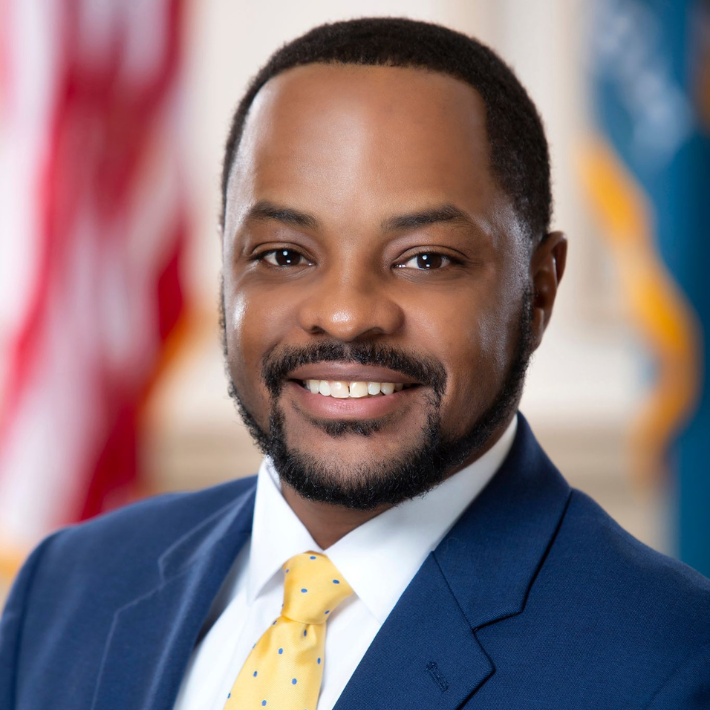
Photo of Darius Brown
D Delaware Senate · District 2

Sen. Darius Brown

Compare
Total votes
3,345
all sessions
Attendance
92%
276 missed
Lower than 91% of chamber peers
With party
98%
of cast votes
Lower than 87% of chamber peers
Bipartisan score
1%
crosses aisle rarely
Near the chamber average
Sponsored
894
bills & resolutions
Near the chamber average
Committees
6
assignments
894 bills and resolutions

Sponsored bills

Total
894
Primary
770
Co-sponsor
124
This page
894
matching current filters
Primary SB 1
Signed into law · Delaware Senate · Lead sponsor
AN ACT TO AMEND TITLE 19 OF THE DELAWARE CODE RELATING TO THE FAMILY AND MEDICAL LEAVE INSURANCE PROGRAM.

This Act, the Healthy Delaware Families Act, creates a statewide paid family and medical leave insurance program. Delaware employees can access up to 12 weeks of paid family and medical leave through the State's paid leave trust fund for a qualifying event, including for the following: (1) To address a worker's own serious health condition. (2) To care for a family member with a serious health condition. (3) To bond and care for a new child. (4) To address the impact of a family member's military deployment. This Substitute to Senate Bill No. 1 differs from Senate Bill No. 1 with regard to the eligibility determination process, covered relationships, length of leave, forms of leave covered, cumulative leave, eligibility criteria, implementation timeline, appeal process, departmental powers, and not requiring participation from certain smaller businesses. This Substitute differs from Senate Substitute No. 1 to Senate Bill No. 1 by making technical corrections, clarifying intent and providing greater statutory detail with regard to appeals, coordination of benefits, definitions, private plans, and departmental powers, and providing temporary flexibility regarding implementation.

Signed into law May 10, 2022 0 co-sponsors
Primary HB 262
Passed · Delaware House · Lead sponsor
AN ACT TO AMEND TITLE 6 OF THE DELAWARE CODE RELATING TO DATA BROKERS AND CONSUMER PROTECTION.

This Act seeks to provide consumers with critical information about how their personal information is being used by data brokers. This Act requires data brokers to register with the Consumer Protection Unit of the Department of Justice and answer questions regarding their use of personal information that would be published online to inform consumers. A fee schedule is established based on the size of the data broker that would fund the enforcement of the statute. Entities or individuals who collect personal information but do not sell or license that personal data are not required to register. Registration only applies to data brokers who sell or license information. The Act prohibits acquiring or providing brokered personal information where it will be used for certain unlawful purposes, or where it was obtained through fraudulent means. The Act requires data brokers to protect brokered personal information.

Passed May 5, 2022 0 co-sponsors
Co-sponsor SB 218
Signed into law · Delaware Senate · Co-sponsor
AN ACT TO AMEND TITLE 18 OF THE DELAWARE CODE RELATING TO THE LIVING DONOR PROTECTION ACT.

This Act, known as the Living Donor Protection Act, prohibits discrimination based on an individual’s status as a living organ or tissue donor in the offering, issuance, cancellation, coverage, price, or other condition of an insurance policy, including a life, health, disability, or long-term care insurance policy. At least 20 states have similar laws, including Maryland, New Jersey, and Pennsylvania.

Signed into law Apr 28, 2022 1 co-sponsor
Co-sponsor HB 328
Signed into law · Delaware House · Co-sponsor
AN ACT TO AMEND TITLE 21 AND TITLE 11 OF THE DELAWARE CODE RELATING TO DRAG RACING AND OTHER DANGEROUS OPERATIONS OF MOTORIZED VEHICLES.

This Act makes several adjustments to the law prohibiting drag racing and other speed contests. Many individuals lawfully gather to share their enthusiasm for vehicles and may do so while abiding the rules of the road and without otherwise endangering persons or property. However, others have taken their enthusiasm into dangerous directions that often results in damage to property, injury, or death. For example, Kirkwood Highway has experienced an uptick in large crowds engaged in dangerous driving behavior and as the result of a drag racing event at the Christiana Mall Fashion Center, there was a vehicular fatality. Whether by drag racing, trick or stunt riding, conducting burnouts in intersections, doing donuts in parking lots, or taking over roadways to showboat, these dangers are further amplified by the crowd size that follows and the attempted notoriety sought through social media posts. The intent of the statute is to promote law-enforcement’s ability to enforce the statute, eliminate prior inadvertent loopholes in the current statute regarding geographic and vehicle type limitations, update the statute to reflect current dangerous driving trends and behavior, and ultimately serve as a deterrent for future unsafe behavior. The current statute incorporates potential penalties for the individual and their licensing status, but it does not address the actual vehicle, as the tool and mechanism that is central to the dangerous behavior. This Act enhances existing penalties and promotes public safety by restricting drivers charged with these dangerous driving behaviors access to their vehicles. • First, while a first offense remains an unclassified misdemeanor, a subsequent offense becomes a Class A Misdemeanor. The minimum applicable fines are substituted for mandatory community service instead. • Second, for the purpose of this statute, a subsequent offense is defined as one occurring within 5 years from a prior offense, rather than the default of 2 years set forth in 21 Del. C. § 713. • Third, the statute expands the list of prohibited conduct to better encompass existing dangerous driving behavior, like tire burnouts in intersections that are not part of races and the dangers to persons or property they pose. • Fourth, within the context of 21 Del. C. § 4101(a)(3), the statute more clearly defines the geographic enforceability of the statute on non-highway property, such as commercial parking lots, while still allowing commercial property or other owners to consent to the use of their property for these purposes. • Fifth, the statute expands the types of vehicles that the provision addresses, to include ATV’s and OHV, which are excepted from the 21 Del. C. § 101 definition of vehicles, but which are also used to engage in this behavior. Non street-legal vehicles are often used to participate in the dangerous driving behavior. • Sixth, recognizing that law-enforcement resources, crowd size, environmental factors, and other safety concerns do not always allow law-enforcement to prioritize on-scene engagement with single vehicles while the behavior in this statute is occurring, the Act expands law-enforcement’s ability to later investigate and arrest for violations of this statute. Under the current statute, violators, when contemplating commission of such offenses, might rely on the fact that law-enforcement safety and resource concerns might dictate that the violators cannot be apprehended on scene or that chasing them might be too dangerous to do. This Act expands the definition of “witnessed” by a law-enforcement officer, under 21 Del. C. § 701(a), to include after the fact review of video surveillance or any other video that captures the violation. • Seventh, the Act allows for the vehicles used, as the mechanism by which the dangerous behavior is conducted, to be impounded, de-registered, otherwise immobilized, or even eligible for forfeiture proceedings under certain conditions. As the same time, the Act does not prohibit an innocent owner from applying for return of the vehicle from the Court, under certain conditions, if their vehicle is used in a violation of this statute.


Signed into law Apr 28, 2022 1 co-sponsor
Primary HB 50
In committee · Delaware House · Lead sponsor
AN ACT TO AMEND TITLE 10 OF THE DELAWARE CODE RELATING TO JUVENILE RECORDS.

Recognizing that a criminal charge can have lasting collateral consequences for a juvenile on employment and education opportunities, this bill raises the age in which a juvenile’s information, such as their name and mug shot, may be released by the state. The bill also seeks to address issues related to the release of such information on publicly-maintained social media pages. This bill seeks to balance both the rights of juveniles and the public’s right to know by saying that the names and photos of juveniles who have been charged and/or found delinquent of Class A misdemeanors, and Title 11 felonies, may only be released when the offending juvenile is 16 or older. This legislation also adds clarifying language to prevent the inadvertent release of sensitive information online that could have lasting impacts on a juvenile long after they have been charged, and in some cases, acquitted, of a crime.

In committee Apr 14, 2022 0 co-sponsors
Showing 681 to 690 of 894 bills
Previous 1 68 69 70 90 Next