This Act removes the exclusive jurisdiction of the Superior Court for offenses under § 4836 of this Title on the basis of the voluntary and involuntary exclusion lists. This would allow the Court of Common Pleas to hold jurisdiction over these offenses as these are class A misdemeanor offenses.
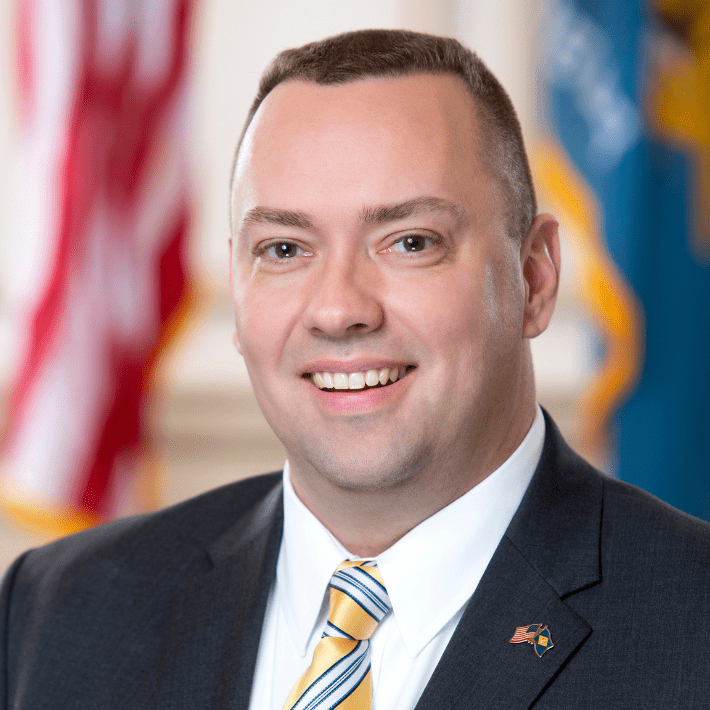
Sen. Brian Pettyjohn
Sponsored bills
This Act recognizes the statutory authority of the Governor to act in the event of an emergency or disaster. During protracted emergencies and disasters, particularly those lasting more than 30 days, good governance requires participation by the General Assembly to approve renewal of Emergency Orders. This approval requirement may be waived only when it is not possible for both houses of the General Assembly to convene a quorum. The Governor retains the authority to terminate Emergency Orders without approval when the emergency or disaster has passed. Any new non-weather related emergency order issued within 6 months of the termination of a prior order and based upon substantially similar reasons shall be invalid unless approved by the General Assembly. Additionally, any non-weather related emergency order that requires the closure of any business, industry, religious, or non-profit facility must specifically delineate which type of business or facilities are to be closed.
This resolution designates October 18-24, 2021 as "Free Speech Week" in the State of Delaware.
This Act adds the term “adjudication” to this section of the criminal code to enable juvenile defendants to petition the court for their adjudications of delinquency to be vacated and their juvenile criminal record to be expunged in regard to crimes, other than defined violent felonies, committed as a direct result of being victims of human trafficking.
This bill increases the membership of the Human Trafficking Interagency Coordinating Council to 24 members by adding representatives from the House of Representatives, the Senate, the Criminal Justice Council, the Department of Transportation, and the Division of Professional Regulation, a person who has been a victim of human trafficking, and a person who has prior experience working with victims of human trafficking in a legal or advocacy capacity. This bill also changes the quorum for the Council from 7 members to 13.
This Act allows nurse practitioners and physician assistants to recommend medical marijuana for adult patients. This Act does not require the Department of Health and Social Services to promulgate new regulations before implementing this Act because § 10113 of Title 29 exempts amendments to existing regulations to make them consistent with changes in basic law from the process otherwise required under Chapter 101 of Title 29. This Act also makes technical corrections to conform existing law to the standards of the Delaware Legislative Drafting Manual.
This Act is the first leg of a Constitutional Amendment reflecting the recommendations of the Advisory Panel to the Delaware Economic and Financial Advisory Council (DEFAC) on Potential Fiscal Controls and Budget Smoothing Mechanisms established as per House Joint Resolution 8 of the 149th General Assembly (Panel). This Act would build upon the State’s existing appropriation limit methodology by moving the Budget Reserve Account into a newly defined Budget Stabilization Fund, defining rules for deposits to and withdrawals from said Budget Stabilization Fund, and adding a check of the appropriation limit against an index comprised of relevant indicators of growth of the State’s economy. The Panel further recommended that any final adoption of the structural budget reforms included in this Act be accompanied by statutory enactment of structural reforms to the Personal Income Tax by broadening the tax base as initially recommended by the DEFAC Advisory Council of Revenues report dated May 2015 and further detailed in the Panel’s report dated June 1, 2018.
This Act requires the State to reimburse healthcare expenses incurred by eligible pensioner spouses on Medicare who are required to enroll in their former employer's healthcare coverage and their former employer's coverage pays less than the State's coverage would pay. This creates fair and equal benefit coverage for all spouses of eligible pensioner's whether they have former employer coverage or not.
This Concurrent Resolution recognizes the young men participating in the 2021 session of Delaware’s Boys State and commends its sponsor, the American Legion Department of Delaware.
The constitutional requirement to create new legislative districts following the U.S. Census was intended to ensure equal representation at all levels of government. However, Delaware’s current process of redistricting is deeply flawed. It allows the majority party in each legislative chamber to gerrymander state legislative maps in a self-serving attempt to preserve and expand partisan political power. All other considerations have become secondary in this process. This defect is common to many states and some have tried to address the issue by creating election commissions charged with redrawing legislative lines. The challenge in such a system is ensuring that these commissions can conduct their function in a balanced, objective, and non-partisan fashion. This bill proposes a new method that avoids this significant hurdle by leveraging partisan self-interest to create a protocol that results in an equitable outcome. This fresh approach to reapportionment is described in a paper by 3 Carnegie Mellon University professors entitled: “A Partisan Districting Protocol with Provably Nonpartisan Outcomes.” It utilizes a system analogous to a proven, prudent method for instructing 2 children to fairly divide a piece of cake between themselves. The first child cuts the cake, while the second has the option of selecting which piece he or she wishes to consume. In the protocol outlined in this bill, the two competing parties are the partisan caucuses of each General Assembly chamber. The first caucus will initially draw all the legislative districts, observing established legal redistricting standards. The second caucus will have the ability to “freeze” a set number of the districts, locking their boundaries into place. They will then be able to redraw the remaining districts as they wish, delivering the new maps back to the first caucus. This group will then also engage in the freeze and redraw process, with the cycles continuing until all the districts have been defined. With both sides getting equal “bites of the apple,” each has a practical ability to affect the outcome and a reason to work together to achieve a mutually acceptable conclusion. The bill also includes safeguards to ensure public notification and participation in the process, as well as a contingency to allow the judicial branch to draw the new legislative maps should the General Assembly be unable to achieve the task. This legislation assumes calling the General Assembly into special session to approve the finalized maps, providing enough time for the process to be conducted in a deliberative manner.