This Act creates a tuition reimbursement program for volunteer firefighters, similar to already existing programs for law enforcement officers and National Guard members. Pursuant to this program, active volunteer firefighters may be reimbursed for tuition for 2 undergraduate level courses or one masters level course per semester at any Delaware college or university. The State Fire Prevention Commission is charged with promulgating rules and regulations and administering the program.
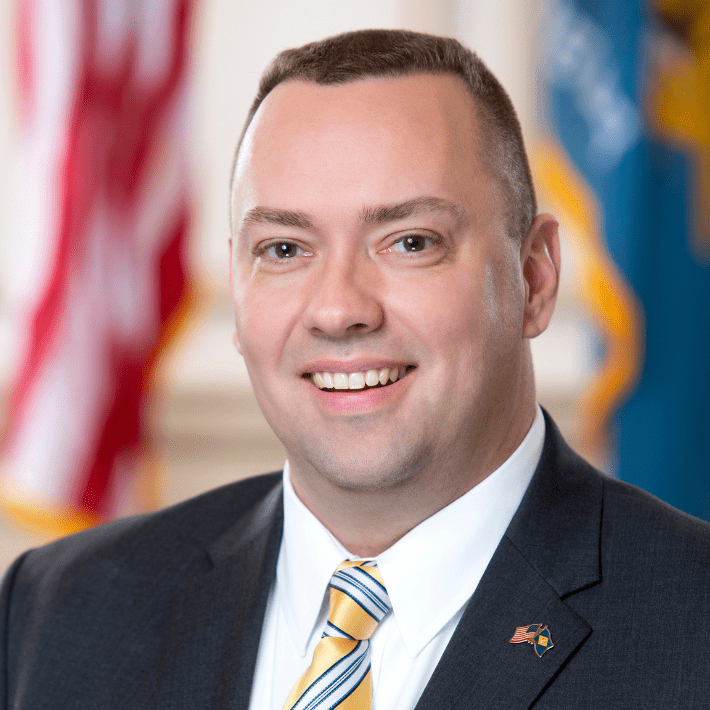
Sen. Brian Pettyjohn
Sponsored bills
This Act clarifies that a person with a special license plate or permit for persons with disabilities may park for an unlimited period where the length of time is otherwise limited and must be able to park in a metered parking space for at least 1 hour. This Act clarifies that it is a violation of the state equal accommodations law to prohibit parking as authorized for a person with a special license plate or permit for persons with disabilities. This Act also makes technical corrections to conform existing law to the standards of the Delaware Legislative Drafting Manual.
This Act eliminates the ability of a candidate to change their candidacy to become a candidate for a different office after the deadline for notification of candidacy has passed. This Act takes effect on January 1 following its enactment into law. This Act also makes technical corrections to conform existing law to the standards of the Delaware Legislative Drafting Manual.
This Act permits wedding venues and persons renting a premises for other social gatherings to allow customers to bring alcoholic beverages onto the premises, if licensed by the Commissioner as a bottle club. This Act also makes technical corrections to conform existing law to the standards of the Delaware Legislative Drafting Manual.
The Delaware General Assembly incorporated the Board of Public Works of the City of Lewes (the “BPW”) in 1901 when it, separate from the Charter adopted for the City of Lewes, enacted the Charter of the BPW and empowered it to establish, control, and regulate the utility system for the City of Lewes. The BPW is a public body under the Delaware Freedom of Information Act and is subject to the obligations and requirements of a public body under Delaware’s Sunshine Laws. The BPW reviews and approves budgets, contracts, and utility policies, including concerning rates, in meetings that are open to the public. The BPW Directors are directly accountable to the ratepayers who elect them to handle matters concerning utility policy. This Act seeks to address the City’s concern that it have a codified role in the extension of the Lewes utility system to property located outside of the City of Lewes municipal limits by amending the Charter of the BPW to specifically require going forward the Mayor and City Council’s prior consent for the BPW to expand utility service to any territory outside of the City of Lewes municipal limits. Through this change, the Mayor and City Council will have an important role in any future expansion of the utility system, while still preserving, consistent with the Charter of the BPW, the BPW Directors’ responsibility over utility policy concerning said utility system for the benefit of the ratepayers. This Act also resolves uncertainty created by a recent Delaware Superior Court decision concluding that the BPW may only sue and be sued where specifically noted within the Charter of the BPW. The Superior Court’s recent decision, for example, creates a cloud of uncertainty over whether the BPW can sue and be sued under contracts it lawfully executes in its own corporate name. This Act removes this uncertainty by expressly giving the BPW the general power to sue and be sued. To promote collaboration and dialogue between the BPW Board of Directors and the City of Lewes Mayor and City Council, this Act also prohibits each incorporated entity from suing the other entity for a period of five years.

This Act represents the consensus agreement among the Department of Safety and Homeland Security, the Department of Transportation, and stakeholders to provide the public with access to de-identified accident data. Access to the crash history of intersections will enable the public to weigh in on development discussions and roadway projects. This Act also clarifies when accident reports may be released and the purposes for which accident reports can be used. This Act also makes technical corrections to conform existing law to the standards of the Delaware Legislative Drafting Manual. This Act requires a greater than majority vote for passage because § 11(a) of Article VIII of the Delaware Constitution requires the affirmative vote of three-fifths of the members elected to each house of the General Assembly to impose a fee and this Act codifies the existing practice of allowing a state law-enforcement agency to charge a reasonable fee for a copy of an accident report.
This Act requires the Delaware Health Information Network (“DHIN”) to provide the Gift of Life program – the State’s approved organ procurement organization, or “OPO” – with access to data on potential anatomical donors when the data is needed to determine the suitability for organ, tissue and eye donation for any purpose identified in Delaware’s Uniform Anatomical Gift Act. This Act is the result of the 2019 report of the Joint Legislative Oversight and Sunset Committee's task force under Senate Resolution No. 9 of the 150th General Assembly.
Chiropractic care is a drugless system of health care. It is uniquely positioned as a treatment for back pain and chronic headaches, which a peer-reviewed medical journal has indicated are alarming drivers of opioid-related deaths. Other peer-reviewed studies have indicated that chiropractic physician care reduces opioid usage rates, costs significantly less than the opioid treatment path, and contributes to preventing addiction and overdose death. In Delaware, back problems are a top-three cost driver and are among the most common conditions resulting in disability and lost productivity. This Act helps to address these issues in Delaware and improves access for Delawareans seeking opioid-free treatment by ensuring chiropractors are reimbursed at least at the level of Medicare and not at historically persistent lower rates.
This Act is a result of the Joint Legislative Oversight and Sunset Committee’s (“JLOSC”) 2019 review of the Delaware Advisory Council on Career and Technical Education (“DACCTE”), and adds a requirement to DACCTE’s annual report to provide students and families access to information regarding educational, employment, and training opportunities.
This Act is the result of the 2019 report of the Joint Legislative Oversight and Sunset Committee’s task force under Senate Resolution No. 9 of the 150th General Assembly, which recommended permitting the Delaware Health Information Network (“DHIN”) to use clinical healthcare data in its possession for appropriate analytic and public health purposes. This Act largely tracks current law regarding the use of health care claims data that DHIN holds. It requires DHIN to promulgate regulations to permit appropriate health-care payers, providers, purchasers, or researchers to access clinical data in DHIN’s possession under terms and conditions that DHIN and its Board of Directors establish. This Act maintains and enhances language that requires DHIN to disclose individually-identifiable patient information only with direct patient consent or for purposes permitted by the federal Health Insurance Portability and Accountability Act of 1996 and associated regulations (“HIPAA”). This Act also provides additional protections to consumers, by codifying DHIN’s general practice of providing Delaware residents with access to their own health information and requiring DHIN to promulgate regulations giving residents the ability to require DHIN to provide that health information to third parties under appropriate terms and conditions. This Act also makes technical corrections to conform existing law to the standards of the Delaware Legislative Drafting Manual.