

Passed Jan 10, 2023
0 co-sponsors
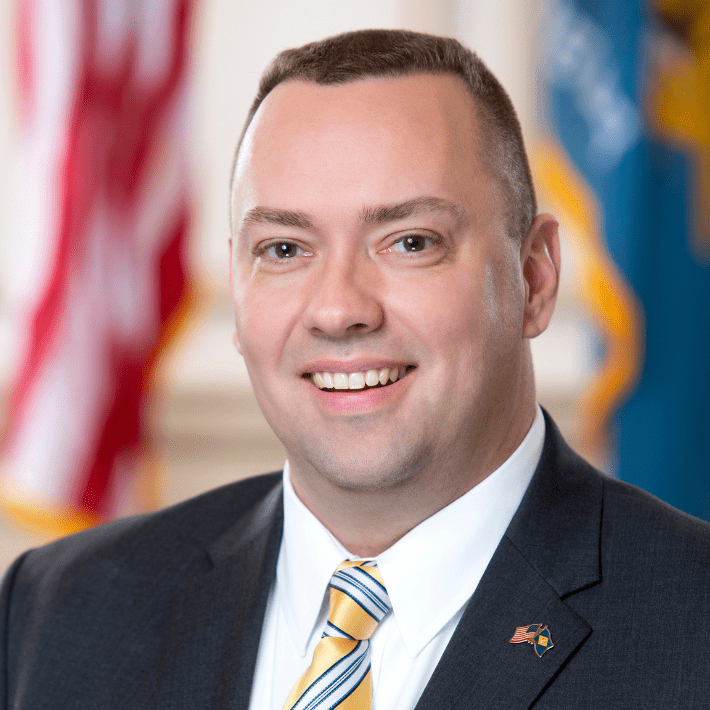
Sen. Brian Pettyjohn
Total votes
4,080
all sessions
Attendance
96%
153 missed
Near the chamber average
With party
99%
of cast votes
Near the chamber average
Bipartisan score
1%
crosses aisle rarely
Near the chamber average
Sponsored
1,820
bills & resolutions
Near the chamber average
Committees
11
assignments
1,820 bills and resolutions
Sponsored bills
Total
1,820
Primary
1,282
Co-sponsor
538
This page
1,820
matching current filters
AN ACT TO AMEND TITLE 14 AND TITLE 29 OF THE DELAWARE CODE RELATING TO DISABLED VETERANS SCHOOL TAX CREDIT.
This Act expands the Disabled Veterans School Tax Credit to include a deceased disabled veteran's surviving spouse. HB 214 with HA 1, passed by the 151st General Assembly, created the Disabled Veterans Property Tax Relief and Education Expense Fund. School boards are currently authorized to create a credit against school taxes for up to the full amount of school tax liability for property owned by a disabled veteran who meets certain requirements. This Act would allow a disabled veteran's surviving spouse to maintain the credit that their deceased veteran spouse was claiming if their deceased veteran spouse, immediately before death, was both claiming the credit and had not had the right to claim the credit withdrawn and the surviving spouse meets all of the following requirements: (1) Was a titled owner of the qualified property before the deceased veteran’s death. (2) Has not remarried. (3) Owns and occupies the qualified property as their principal residence. A surviving spouse is no longer eligible to maintain the credit if they do any of the following: (1) Remarry. (2) Stop being a titled owner of the qualified property. (3) Stop occupying the qualified property as their principal residence. This Act requires the Secretary of Finance, in consultation with the receiver of taxes and county treasurer, to establish a process to determine the eligibility of a surviving spouse and to allow an eligible surviving spouse to maintain the credit without disruption after the death of their disabled veteran spouse. This Act also makes technical corrections to conform existing law to the standards of the Delaware Legislative Drafting Manual.
Signed into law Nov 2, 2022
1 co-sponsor
AN ACT TO AMEND TITLE 3 OF THE DELAWARE CODE RELATING TO THE REGULATION OF SEEDS.
This Act updates Chapter 15 of Title 3, the regulatory provisions for seeds, by making technical and substantive revisions. This Act makes the following corrections, in addition to technical corrections to conform existing law to the standards of the Delaware Legislative Drafting Manual: 1. Updates the defined terms and reorganizes the terms into alphabetical order. 2. Corrects the names of plants. 3. Reorganizes the label requirements so there is a separate Code section for each category of seeds. 4. Updates the label requirements to align with federal law. 5. Adds references to applicable federal and state laws. 6. Corrects the enforcement provisions to align with current practices and terminology. 7. Repeals duplicative Code sections. 8. Uses gender neutral language. This Act adds all of the following: 1. Specific requirements for hermetically sealed seed. 2. That labels include a clear "Sell By" date. 3. Definitions for the terms "Department", “germination”, and “hard seed”. 4. Revises the definitions of "origin", "pure seed", and "variety".
Signed into law Nov 2, 2022
1 co-sponsor
AN ACT TO AMEND TITLE 24 OF THE DELAWARE CODE RELATING TO ATHLETE AGENTS.
This Act adopts the Uniform Law Commission's Revised Uniform Athlete Agents Act ("Revised Act"), revising Chapter 54, Title 24 of the Delaware Code, which is based on the Uniform Law Commission's Uniform Athlete Agents Act ("Uniform Act"). The Uniform Law Commission “provides states with non-partisan, well-conceived and well-drafted legislation that brings clarity and stability to critical areas of state statutory law.” In the early 2000's, Delaware and 42 other states adopted the Uniform Act. Delaware's version of the Uniform Act included a Board of Athlete Agents Examiners ("Board"), which was sunsetted by the Joint Legislative Oversight and Sunset Committee in 2012 and removed from the Delaware Code by Senate Bill 184 of the 146th General Assembly (78 Del. Laws, c. 376). In addition to removing provisions related to the Board, Senate Bill 184 also removed provisions requiring athlete agents doing business in Delaware to be registered and subject to administrative oversight. In 2015, the Uniform Law Commission adopted the Revised Act to enhance protections for student athletes and educational institutions, create a uniform body of athlete agent registration information, and simplify the registration process. The changes made to the Uniform Act by the Revised Act became necessary as athlete agent tactics have become more advanced and the industry has become more sophisticated. The need for the Revised Act is highlighted by a recent FBI investigation into athlete agent activities related to the college basketball programs at a number of Division I schools. The need is also highlighted by the National Collegiate Athletic Association’s adoption of an interim policy in June 2021 that removes restrictions on student athletes receiving compensation for their name, image, and likeness. Coinciding with this change, there has been an increase in athlete agent registrations in states with laws requiring registration. The adoption of the Revised Act provides safeguards for student athletes by requiring that athlete agents be registered and that agency contracts contain specific notice provisions. The Revised Act has been enacted by 18 states, with 4 of those enactments occurring in 2021.
Signed into law Nov 2, 2022
1 co-sponsor
AN ACT TO AMEND TITLE 14 OF THE DELAWARE CODE RELATING TO LIVESTREAMING BOARD MEETINGS OF THE UNIVERSITY OF DELAWARE, DELAWARE STATE UNIVERSITY, AND DELAWARE TECHNICAL AND COMMUNITY COLLEGE.
This Act requires that meetings of the Board of Trustees for the University of Delaware, Delaware State University, and Delaware Technical and Community College must be livestreamed using technology that permits the public to hear all participants contemporaneously. This Act also requires that recordings of the livestreamed meetings must be maintained on a public website. This Act also makes technical corrections to conform existing law to the standards of the Delaware Legislative Drafting Manual. This Act requires a greater than majority vote for passage because § 1 of Article IX of the Delaware Constitution requires the affirmative vote of two-thirds of the members elected to each house of the General Assembly to amend a charter issued to a corporation for educational purposes sustained in whole or part by the State, including the University of Delaware and Delaware State University.
Signed into law Nov 2, 2022
1 co-sponsor
AN ACT TO AMEND TITLE 16 OF THE DELAWARE CODE RELATING TO NALOXONE AND OTHER OPIOID ANTAGONISTS.
An opioid antagonist is a medication approved by the United States Food and Drug Administration (FDA) for emergency reversal of a known or suspected opioid overdose. Currently, naloxone is the only FDA-approved opioid antagonist, however, the FDA is expected to approve at least 1 new, more powerful opioid antagonist in 2022. The current naloxone program allows public safety personnel and trained lay people to receive and administer naloxone to individuals suspected of experiencing an opioid overdose. This Act allows the Department of Health and Social Services to expand the current program to include additional opioid antagonists. This Act also makes technical corrections to reflect that advance practice registered nurses have the authority to prescribe medication and to conform existing law to the standards of the Delaware Legislative Drafting Manual as follows: 1. Reorganizing the current Chapter 30G of Title 16 from a single Code section to a chapter with several Code sections so that similar provisions are grouped together. 2. Using consistent phrases and terminology.
Signed into law Nov 2, 2022
1 co-sponsor
AN ACT TO AMEND TITLE 18 OF THE DELAWARE CODE RELATING TO PRIVATE FLOOD INSURANCE.
This bill facilitates the expansion of the private flood insurance market through the adoption of the National Council of Insurance Legislators’ Model Private Primary Residential Flood Insurance Model. This Model has been used to facilitate increased consumer choice and access to flood insurance.
Signed into law Nov 2, 2022
1 co-sponsor
AN ACT TO AMEND TITLE 11 AND TITLE 16 OF THE DELAWARE CODE RELATING TO THE ELIGIBILITY OF REGISTERED QUALIFYING PATIENTS UNDER THE DELAWARE MEDICAL MARIJUANA ACT TO PURCHASE OR POSSESS FIREARMS.
At least 36 states allow for the medical use of marijuana. However, federal firearm laws have not kept pace and currently prohibit an individual who is “an unlawful user of or addicted to any controlled substance” from possessing or purchasing a firearm. It is still unlawful under federal law to use or possess marijuana. This Act makes clear that an individual is not disqualified under Delaware law from possessing a firearm because the individual is a registered qualifying patient under the Delaware Medical Marijuana Act, if the registered qualifying patient is not a person prohibited under § 1448 of Title 11 of the Delaware Code. This Act makes also clear that a registered qualifying patient may engage in a firearm transaction between unlicensed persons under § 1448B of Title 11 if the transaction is exempt under § 1448B(c) of Title 11 and the registered qualifying patient is not otherwise a person prohibited under § 1448 of Title 11. A registered qualifying patient’s purchase of a firearm through a federal firearms licensee (“FFL”) is still prohibited under federal law. This Act also makes technical corrections to conform existing law to the standards of the Delaware Legislative Drafting Manual.
Vetoed Oct 27, 2022
0 co-sponsors
AN ACT TO AMEND TITLE 21 OF THE DELAWARE CODE RELATING TO SPECIAL LICENSE PLATES.
This bill creates a special license plate for the Boy Scouts of America.
Signed into law Oct 26, 2022
0 co-sponsors
AN ACT TO AMEND TITLE 18 AND TITLE 29 OF THE DELAWARE CODE RELATING TO INSURANCE COVERAGE OF DIABETES EQUIPMENT AND SUPPLIES.
This Act caps the amount that an individual, group, or State employee plan may charge for diabetes equipment and supplies, other than insulin, at $35 per month. This cap does not apply to accident-only, specified disease, hospital indemnity, Medicare supplement, long-term care, disability income, or other limited benefit health insurance policies.
Signed into law Oct 26, 2022
1 co-sponsor
Ask Maddy
·
AI policy assistant
Ask Maddy about Brian Pettyjohn
Scope: delaware
Hi! I can help you understand Brian Pettyjohn's legislative record. What would you like to know?
Try one of these
i
Maddy answers using official bill text and legislative records. Always verify before sharing.
Sources cited inline