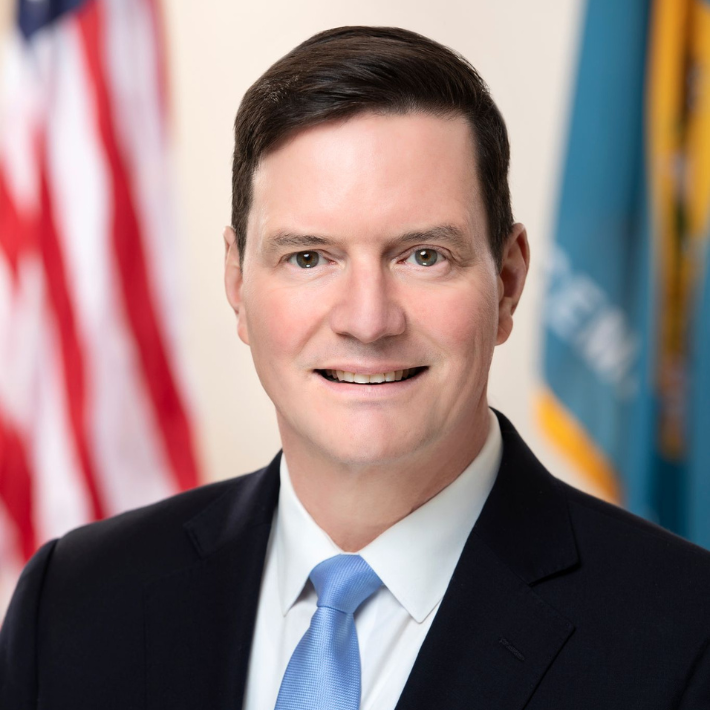
Photo of Trey Paradee
D Delaware Senate · District 17

Sen. Trey Paradee

Compare
Total votes
3,385
all sessions
Attendance
92%
299 missed
Lower than 78% of chamber peers
With party
99%
of cast votes
Higher than 95% of chamber peers
Bipartisan score
0%
crosses aisle rarely
Lower than 98% of chamber peers
Sponsored
1,142
bills & resolutions
Near the chamber average
Committees
6
assignments
1,142 bills and resolutions

Sponsored bills

Total
1,142
Primary
770
Co-sponsor
372
This page
1,142
matching current filters
Co-sponsor HB 215
Signed into law · Delaware House · Co-sponsor
AN ACT TO AMEND TITLE 7 OF THE DELAWARE CODE RELATING TO RECYCLING AND WASTE REDUCTION.

This bill eliminates the sunset provision on the “at-store” recycling program for plastic bags. The program established in 2009 included a sunset provision until 2014. In 2014, the General Assembly extended that sunset provision to 2017. This bill eliminates the sunset provision permanently to encourage the continued routine for consumers to recycle plastic bags through “at-store” programs. The bill will also require all stores subject to the requirements of this section to register by June 30, 2018, and provide information to DNREC regarding compliance on a form to be provided by DNREC.

Signed into law Jul 17, 2017 1 co-sponsor
Co-sponsor SB 45
Signed into law · Delaware Senate · Co-sponsor
AN ACT TO AMEND TITLE 16 OF THE DELAWARE CODE RELATING TO THE UNIFORM CONTROLLED SUBSTANCES ACT.

This Bill adds 3,4-dichloro-N-[2-(dimethylamino)cyclohexyl]-N-methylbenzamide (U-47700) to Schedule I of the Uniform Controlled Substances Act. U-47700, also known as “Pink,” is a synthetic opioid recently encountered by law enforcement and public health officials and is being abused for its opioid properties. It is available over the Internet and is marketed as a “research chemical.” The safety risks to users are significant and the public health risks include large numbers of drug treatment admissions, emergency room visits and fatal overdoses. On November 14, 2016, the Federal Drug Enforcement Agency temporarily placed U-47700 in Schedule I for a two-year period, finding that this synthetic opioid has a high potential for abuse, no currently accepted medical use in treatment in the United States and lacks accepted safety for use under medical supervision. By Emergency Order dated December 15, 2016, the Secretary of State temporarily placed U-47700 in Schedule I. This Order is effective for 120 days. The permanent addition of U-47700 to Schedule I is required in the interest of public protection.

Signed into law Jul 17, 2017 1 co-sponsor
Co-sponsor HB 99
Signed into law · Delaware House · Co-sponsor
AN ACT TO AMEND TITLES 14 AND 29 OF THE DELAWARE CODE RELATING TO ADMINISTRATION OF SCHOOL PROPERTY TAX CREDITS.

This bill would require that a resident 65 years of age or older claiming a tax credit against school taxes must be a resident of the state for at least 10 years before qualifying for such credit. The current requirement is only for 3-year residency. This bill makes a conforming change in the Code provision governing reimbursements from the General Fund. It also eliminates language related to 2001 taxes, which is no longer relevant. This change will be effective for tax and fiscal years after January 1, 2017. Those residents who would have become eligible over the last three years under the prior version of the statute will remain eligible.

Signed into law Jul 17, 2017 1 co-sponsor
Co-sponsor SB 24
Signed into law · Delaware Senate · Co-sponsor
AN ACT TO AMEND TITLE 16 OF THE DELAWARE CODE RELATING TO MEDICAL MARIJUANA.

This Act removes the requirement that a psychiatrist be the physician who signs the written certification in support of an applicant's application for medical marijuana and adds anxiety to the list of debilitating conditions which a person can have to be eligible for medical marijuana. This Act also makes technical corrections to the statute.

Signed into law Jul 12, 2017 1 co-sponsor
Co-sponsor SB 132
In committee · Delaware Senate · Co-sponsor
AN ACT TO AMEND TITLE 18 RELATING TO INSURANCE COVERAGE FOR FERTILITY CARE SERVICES.

This Act requires that health insurance offered in this State provide coverage for fertility care services, including in vitro fertilization ("IVF") procedures for persons, who along with their partner, suffer from a disease or condition that results in the inability to procreate or to carry a pregnancy to viability. Like all other diseases, infertility should be covered by insurance. According to the National Infertility Association, RESOLVE, infertility affects 1 in 8 couples and 1 in 4 cannot afford treatment. Everyone deserves the right to procreate. Right now, many Delaware families diagnosed with infertility fall into a “coverage gap” and pay out-of-pocket for fertility care services. Only certain employers provide any fertility care coverage in Delaware and many of these plans provide very limited coverage. Families generally must pay high co-pays or adhere to service restrictions and lifetime dollar caps that strictly limit their treatment options, and thus make it unaffordable for many of them to proceed without risking their financial security or without achieving a successful pregnancy. For example, 1 IVF cycle can cost between $15,000 and $25,000 and, on average, it takes 2 to 3 cycles to achieve pregnancy. Additionally, highly inflated managed care pharmacy prices for IVF medications, where families with coverage can pay as much as 100% more for medications compared to prices charged to self-pay families, often contribute to 25-50% or more of total IVF costs, which can quickly drain lifetime caps and severely limit overall IVF care options. According to the National Conference of State Legislatures, 15 states currently have laws requiring insurance coverage for infertility diagnosis or treatment, including 2 states that border Delaware, New Jersey and Maryland. This puts the State at a significant competitive disadvantage, as many reproductive age residents intentionally change employers and leave Delaware to gain more attractive fertility care benefits. It is also well-documented that individuals who self-pay for IVF procedures, or have limited benefits, often demand that 2 or more embryos be transferred to their uterus. This is a dangerous and costly approach for heavily burdened health care resources, and can be completely avoided, with greater access to covered fertility care services. This Act require insurers to cover fertility care services based on the latest IVF technologies to increase pregnancy success rates for singleton births at the lowest possible costs. This will greatly reduce the risk of multiple births and greatly reduce hospital and health care costs, thus saving employers money. Several recent studies have found that the cost of perinatal and neonatal care for twins is about $100,000, whereas singleton pregnancies cost about $13,000. Triplet pregnancies can cost $400,000 or more. For every 100 pregnancies from IVF that are singletons (but could have been twins), about $8.7 million dollars is saved, on top of reduced pain and suffering for parents and premature babies. This Act would significantly reduce this high financial and societal burden, with the promotion of IVF technologies that exclusively use single-embryo transfers. This Act could increase the number of persons treated for infertility, but also increase the number of babies born in Delaware by 2-300 per year, thus increasing the state’s birth rate by 1-2% and providing a boost to the local economy, while also decreasing health care costs.


In committee Jul 12, 2017 1 co-sponsor
Co-sponsor HB 226
Signed into law · Delaware House · Co-sponsor
AN ACT TO AMEND THE DELAWARE CODE RELATING TO STATE ECONOMIC DEVELOPMENT AND TRANSFERRING THE FUNCTIONS OF THE DELAWARE ECONOMIC DEVELOPMENT OFFICE TO A DIVISION OF THE DEPARTMENT OF STATE.

Recognizing a fundamental economic change toward businesses that require innovation, The Honorable John C. Carney, Governor of the State of Delaware, issued Executive Order One on January 18, 2017 creating a Working Group of business and government leaders to study methods to improve coordination between the public and private sectors, attract growing businesses and foster economic development throughout the State. The Governor appointed members of the Working Group representing government, business leaders and the community. The Working Group conducted public meetings in the State to receive input from the public on issues related to business development and retention in the changing economy. The Working Group considered research and input from experts in the area of public/private partnerships as well as statutes and data from other states. The Working Group issued a report to the Governor on April 7, 2017 recommending the establishment of a public/private partnership in Delaware to focus on investment attraction, entrepreneurship and innovation, talent development and retention, and research and analysis. Upon consideration of the Working Group report, the General Assembly intends to appropriate funding for the Public/Private Partnership, a nonprofit public/private partnership comprised of leaders in the public, business and the community to build a stronger entrepreneurial environment in the State. The Public/Private Partnership will focus on leveraging private resources to improve business recruitment, retention and expansion, identify and develop a talented workforce, connecting with the global economy and building a stronger entrepreneurial environment. To ensure public accountability the Partnership will submit to the Governor and the General Assembly tax returns, financial statements, organizational polices and will make available for inspection meeting minutes. To make the most efficient use of available resources, this legislation eliminates the Delaware Economic Development Office because the public/private partnership will be conducting business attraction and development functions formerly performed by that Office. This legislation transfers tourism, the Delaware Motion Picture and Television Commission and duties related to administration and the financial analysis of proposed economic development projects to the Department of State. The transfer will improve efficiency, eliminate redundancy and foster business attraction, innovation, tourism, small business development, business retention, minority, women, disadvantaged and veteran owned businesses. Sections 3 through 21 of this Act simply make conforming changes throughout Title 29 and other titles of the Delaware Code where references to the Delaware Economic Development Office appear. The Division of Small Business, Development and Tourism is referenced in its place. The bill also removes some Code Sections that reference funds and functions that no longer exist.

Signed into law Jun 30, 2017 1 co-sponsor
Primary SJR 2
Signed into law · Delaware Senate · Lead sponsor
URGING THE FEDERAL ENERGY REGULATORY COMMISSION TO ACCEPT EITHER OF PJM INTERCONNECTION, L.L.C.’S ALTERNATIVE METHODOLOGIES FOR ALLOCATING THE COST OF THE ARTIFICIAL ISLAND PROJECT AS RECOMMENDED BY GOVERNOR CARNEY AND GOVERNOR HOGAN.

This Joint Resolution urges the Federal Energy Regulatory Commission to accept either alternative cost allocation methodology of the Artificial Island Project as presented by PJM.

Signed into law Jun 29, 2017 0 co-sponsors
Primary HB 264
In committee · Delaware House · Lead sponsor
AN ACT TO AMEND TITLE 18 OF THE DELAWARE CODE RELATING TO UNFAIR PRACTICES IN THE INSURANCE BUSINESS.

This Act requires insurance companies to pay the insured the amount of the insurance company's offer of settlement which was rejected by the insured party. However, the amount remains subject to both parties' reservation or rights, claims, and arguments for the ultimate outcome of the claim.

In committee Jun 27, 2017 0 co-sponsors
Showing 1,091 to 1,100 of 1,142 bills