This Concurrent Resolution recognizes January 9, 2024, as "Law Enforcement Appreciation Day" in the State of Delaware.
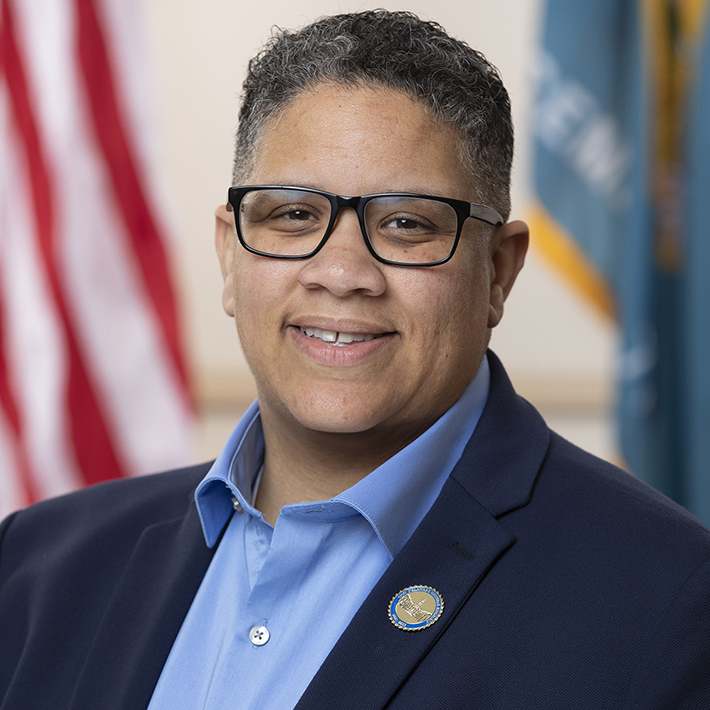
Rep. Kerri Harris
Sponsored bills
This concurrent resolution expresses the State of Delaware General Assembly’s concern for the loss of life in the Israel-Hamas war and calls on the legislature and the citizens of Delaware to recognize our common humanity and the shared strength of our diversity.
This Act makes clear that buyers and renters of residential real property have the right to be accompanied by advisors during all phases of the property transfer process, and requires sellers and landlords to provide written notice of this right to prospective buyers and tenants. This Act also provides for a civil penalty for landlords and their agents who fail to comply with this requirement.
This Act makes changes to the requirements for placement on the sex offender registry of individuals who are adjudicated delinquent of certain offenses. First, it reduces the number of offenses for which placement on the sex offender registry is mandatory and the Family Court has no discretion to relieve a person adjudicated delinquent from the requirement or to reduce the tier assigned. Mandatory registration is still required for all degrees of rape (first through fourth) and conspiracy or attempt to commit any degree of rape. This Act will also allow an individual placed on the registry to petition the Family Court to be relieved from the registration or placed on a lower tier, either at the conclusion of any required treatment or after the passage of 2 years for most offenses, or after the passage of 5 years for those offenses that still require mandatory registration. The ability to petition for a registry review hearing after the mandated review period will apply to anyone placed on the registry because of a juvenile delinquency adjudication, regardless of the date of that adjudication.
This Act expands the Video Lottery Intercept Program by requiring an operator of a video lottery facility to submit an individual's winnings from sports betting and table games to the Division of Child Support Services to satisfy delinquent child support obligations. The Video Lottery Intercept Program currently only collects video lottery winnings.
In 1682 or 1683, the Sussex County Court, created by William Penn, created the land grant that is the subject of this Act (“Warner Grant”). As this Act describes, the Warner Grant consists of land in and adjacent to the City of Lewes largely consisting of what is now Cape Henlopen State Park. As the United States District Court for Delaware would later find, the Warner Grant created a “right of common” held in trust for the benefit the people of Lewes and Sussex County. See United States v. 1,010.8 Acres Situate in Sussex County, 56 F. Supp. 120 (D. Del. 1944). In the early 1970s, nearly 300 years after the Warner Grant was created, a dispute arose over the meaning of the Warner Grant and who had authority to enforce the right of common under the Warner Grant when the City of Lewes leased land in the Warner Grant to a real estate company for the purpose of constructing a housing development. Lawsuits were filed by members of the public and the Attorney General. Eventually, the 130th General Assembly settled that dispute by enacting Chapter 108 of Volume 62 of the Laws of Delaware to establish the Warner Grant Trust (“Trust”) and set the boundaries of the lands in the Trust, known as the Warner Grant Trust Lands (“Lands”). In light of recent proposals for the use of the Lands, the 152nd General Assembly finds that clarification is necessary as to the permitted uses of the Lands and as to how future disputes are to be litigated. To that end, this Act does all of the following: (1) Makes clear that the Department of Natural Resources and Environmental Control (“Department”), as trustee of the Warner Grant Trust Lands, must administer the Lands for the public benefit and adhering to 3 governing priorities: (1) conservation, (2) nature education, and (3) public recreation. (2) Makes clear that the Department must administer the Lands so that a private benefit or financial gain to a for-profit enterprise or public-private partnership is not detrimental to the public benefit. (3) Provides that the Court of Chancery has original jurisdiction over disputes regarding the Lands. (4) Provides that the Attorney General must represent Delawareans in the enforcement of the Trust and, if the Attorney General declines to do so, any resident of Sussex County may sue to enforce the Trust and the Court of Chancery must award attorney’s fees to the plaintiffs who prevail in enforcing the Trust. (5) Includes a provision in the Delaware Code, § 4523 of Title 7, referencing the Department’s duties under this Act to preserve memory of this Act for future generations. Section 1 of this Act amends Chapter 108, Volume 62 of the Laws of Delaware, as amended by Chapter 99, Volume 72 of the Laws of Delaware, which contains 10 sections labelled Section 1 through Section 10. Section 2 of this Act amends the Delaware Code to create a new § 4523 of Title 7.
This bill precludes the so-called LGBTQ+ "panic" defense that seeks to partially or completely excuse or justify a defendant from full accountability for the commission of a crime on the grounds that the actual or perceived sexual orientation, sex, gender, gender identity, or sex assigned at birth of the victim is sufficient to explain, excuse, or justify the defendant's conduct, or contributes to or causes the defendant's mental state, or that the defendant’s reaction thereto constitutes a mental illness, mental defect, or mental disorder sufficient to excuse or justify the defendant's conduct (including under circumstances in which the victim made a nonviolent romantic or sexual advance toward the defendant or in which the defendant and the victim dated or had a romantic or sexual relationship). Sections 1 and 3 of this bill move the definitions for gender identity and sexual orientation currently in the hate crimes statute to the general definitions section of the Criminal Code to maintain standard definitions of these terms throughout the Criminal Code. Section 2 of this bill provides that in any prosecution or sentencing for an offense: (i) a defendant is not justified in using force against another based on the discovery of, knowledge or belief about, or the potential or actual disclosure of the victim’s actual or perceived sexual orientation, sex, gender, gender identity, or sex assigned at birth; (ii) for the purposes of determining whether there is a reasonable explanation or excuse for the existence of extreme emotional disturbance or other asserted mitigating factor or circumstance, such explanation or excuse is not reasonable if it is based on the discovery of, knowledge or belief about, or the potential or actual disclosure of the victim’s actual or perceived sexual orientation, sex, gender, gender identity, or sex assigned at birth; and (iii) a defendant does not suffer from a mental illness, mental defect, mental disorder, serious mental disorder, psychiatric disorder, or other impairment affecting or impacting the defendant’s mental state relating to any questions of intent, knowledge, capacity to appreciate the wrongfulness of the defendant's conduct, disturbance of the defendant's thinking, feeling or behavior, culpability, willpower to choose whether to do or refrain from doing an act, or ability to distinguish right from wrong, based on the discovery of, knowledge or belief about, or the potential or actual disclosure of the victim’s actual or perceived sexual orientation, sex, gender, gender identity, or sex assigned at birth. This bill does not preclude a defendant from availing themself of any defense permitted by the Delaware Criminal Code or other applicable Delaware law on bases other than those specifically precluded by this bill. This House Substitute No. 2 differs from the original in that it corrects the omission of the phrase “or sentencing” in § 472(a), (b), and (c).

This Act provides a definition for 911 Dispatchers. While referenced in other sections of the Code, including being identified as a first responder in § 4319 of Title 11 for purposes of confidentiality of communications by first responders for critical incident stress management services, Dispatchers have not otherwise been defined.
This Act provides that any adult day care facility required to be licensed under Chapter 1 of Title 16 is subject to the existing reporting obligations for facilities under Subchapter III of Chapter 11 of Title 16 of the Delaware Code.
In 2016, the General Assembly passed HB 404, the Concussion Protection in Youth Athletic Activities Act (CPYAAA). This Act clarifies the requirements of CPYAAA and enables the Division of Public Health, in consultation with the State Council for Persons with Disabilities, to promulgate regulations to broadly implement the Act. This Amendment adds the requirement for non-scholastic athletic activity organizations to develop policies and procedures for advising athletes, coaches, officials, parents, and guardians of the signs and symptoms of concussion and explaining the risk of continuing to practice or compete in athletic events or activities after sustaining a concussion, as well as providing information about returning to academic and athletic events or activities after sustaining a concussion.