Maddy summaryThis bill is a commemorative resolution that formally recognizes the 52nd anniversary of Title IX, a federal law prohibiting sex-based discrimination in schools and programs receiving federal funding. It does not create new laws or change existing policies but instead serves to celebrate the historical progress made in educational equity and highlights specific achievements, such as the increase in women's participation in athletics and higher education. The resolution reaffirms the State of Delaware's commitment to upholding Title IX principles and encourages citizens to continue supporting gender equality in education.
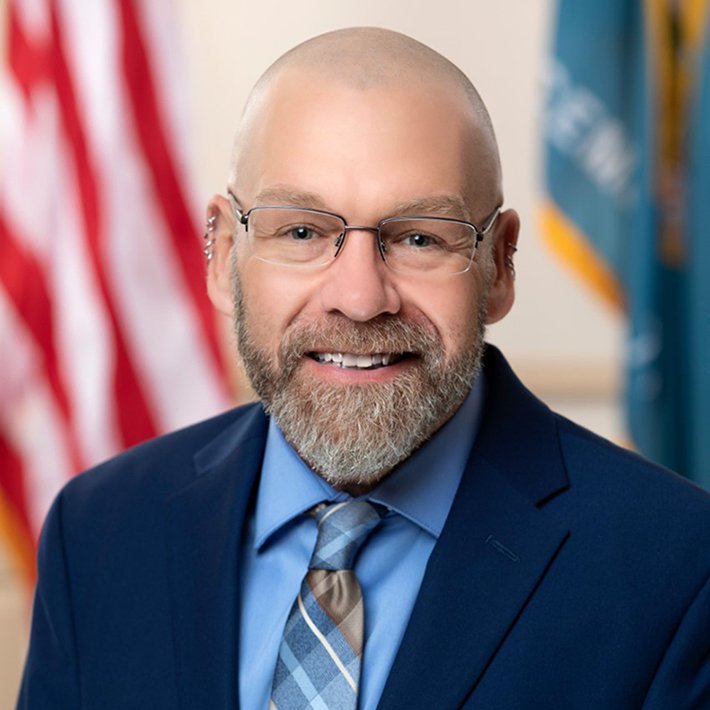
Rep. Eric Morrison
Sponsored bills
This resolution recognizes June 2024, as Alzheimer's and Brain Awareness Month and urges all Delawareans to wear purple to help spread awareness of Alzheimer's and all other dementias.
This Act repeals the option of providing health care insurance to state pensioners under Medicare part C, known as a Medicare Advantage Plan. This Act also makes technical corrections to conform existing law to the standards of the Delaware Legislative Drafting Manual. This Act is known as "The Delaware Medicare Supplement Selection Act".
Maddy summaryThis bill officially designates October 2024 as "Depression Awareness Month" throughout the State of Delaware. It directly affects residents by encouraging the state to promote understanding of depression as a treatable medical condition rather than a personal weakness. The resolution includes a general encouragement for expanded efforts to inform Delawareans about depression awareness, but it does not create new funding, mandate specific programs, or alter existing laws.
The primary purpose of this Act is to remove the requirement that a public school district employee who donates leave to another employee must donate 2 days of leave for the other employee to receive 1 day of leave. Further, this Act repeals Chapter 187 of Volume 81 of the Laws of Delaware ("this law"). Adopted in 2017, this law was designed to provide full-time employees of the State, including employees of school districts, with the ability to donate leave to other employees for use in connection with the birth or adoption of a child under 6 years of age. This law has never taken effect as the law does not take effect until the Office of Management and Budget ("OMB") receives a letter from the Internal Revenue Service ("IRS") stating that the tax treatment of the expansion of the donated leave program contemplated by this law will receive the same tax treatment as Delaware’s current donated leave program. OMB has not requested this letter from the IRS because, based on OMB's research, OMB does not believe this law would receive the same tax treatment by the IRS and because the General Assembly subsequently enacted Chapter 285 of Volume 81 of the Laws of Delaware, which provides 12 weeks of paid leave upon the birth or adoption of a child 6 years of age or younger for those continuously employed for at least 1 year as full-time employees of this State, including employees of school districts. Sections 1 and 2 of this Act re-enact portions of Chapter 187 of Volume 81 of the Laws of Delaware that would have also applied to the existing donated leave program for catastrophic illness. Specifically these provisions are intended to do the following: (1) Clarify how much leave employees of a public school district who do not accrue annual leave must use before being eligible for donated leave. (2) Clarify the interaction between donated leave and leave available under the federal Family and Medical Leave Act. This Act also makes technical corrections to conform existing law to the standards of the Delaware Legislative Drafting Manual, including transferring existing definitions to a central definition section and transferring provisions that are substantive law out of defined terms. This Act is named in honor of Christopher Chujoy, a special education instructional aide in the Red Clay Consolidated School District. Mr. Chujoy was diagnosed in August 2022 with stage IV cancer. Mr. Chujoy used up all of his available sick time before his passing and his situation raised the issue that is the primary purpose of this Act.
Maddy summaryThis legislative resolution designates September 2024 as Sickle Cell Disease Awareness Month in Delaware to highlight the health condition and its impact on the community. The document provides background information on the disease, noting that it affects over 3,000 residents in the state and that the vast majority of patients are from minority backgrounds. It also mentions current efforts by local healthcare providers and a planned statewide data collection program to improve care and policy. Ultimately, the bill serves as a formal acknowledgment rather than a law that changes funding or medical procedures.
This Act protects consumers by regulating home improvement contracts. Among other things, this Act provides the buyer with a right to cancel home improvement contracts within 3 days (5 days for those over the age of 62 or with a disability); limits contract deposits and material deposits; and time periods in which construction must begin. It also prohibits confessions of judgments and hasty debt transfers. Where the court finds a party to a home improvement contract wilfully violates a provision of this new subchapter, the court must award to the prevailing party costs, expenses, and reasonable attorneys’ fees. This Act also creates a requirement that individuals convicted of 2 or more offenses of home improvement fraud after January 1, 2025, must be subject to debarment. This debarment will preclude these individuals from operating a business which engages in home improvement services or from employing other individuals to engage in home improvement services. Debarred individuals may work for a company which engages in home improvement themselves, so long as they are not in control of the company in question. This bill also enhances penalties for home improvement fraud for those with prior convictions for home improvement fraud; and creates enhanced penalties for individuals who engage in home improvement services while operating companies which are not registered with the Delaware Department of Labor’s Contractor Registry. This Substitute differs from the original House Bill No. 427 in that it eliminates original lines 156-181 which contained sentencing enhancements that the Act would otherwise have added for those convicted of home improvement fraud who are found not to have complied with the home improvement protections set forth in Chapter 36 of Title 19. It changes the definition of “debarment” in original line 113 and “qualifying conviction” in original lines 131-133 to provide greater clarity. It changes the enhanced penalties for violations of home improvement fraud from those set forth in original lines 137-143.
This House Substitute bill clarifies it is only for new or substantially modified permits and specifies it is only for the following permits: (1) Clean Air permit; (2) Coastal Zone Act permit; (3) Solid waste permit; (4) National Pollutant Discharge Elimination System permit and (5) Hazardous waste permit. As in the original bill the applicant is still required to go through a community outreach process for any qualified project, defined as a project within an underserved community or within 3 miles of an underserved community that meets the definition of a “qualified project” under DNREC’s Regulations. Underserved community is defined as (1) A specified geographic area where the percentage at poverty level is greater than twice the State Average Median Household Income as determined by the most recent United States Census or (2) Any specified community in the most current community mapping tool on the Department’s website. It is anticipated that DNREC will have an environmental justice area viewer, or similar tool, as a link on its website. However, under this House Substitute bill the applicant must submit, with their permit application, a Community Outreach Plan. At a minimum the Community Outreach Plan must: (1) identify a facility community liaison; (2) schedule a community meeting in or within 3 miles of the boundaries of the underserved community; (3) provide a written overview of information to be provided in the permit application; (4) publish the community meeting notice on-line and in at least 1 newspaper and, if available, 1 in the predominate non-English language if the underserved community is identified as limited English proficiency, at least 30 days prior to the scheduled community meeting. The community meeting must allow for interaction and questions and answers. The community meeting must be recorded or transcribed and made publicly available. Any written materials and oral and visual presentations must be accurate, free of technical language, and written in plain English consistent with federal guidelines. The applicant must also provide an Underserved Community Outreach Report to DNREC as part of the permit application and review process by DNREC. The Report must include: (1) The community demographics that qualify it as an underserved community; (2) Community liaison’s contact information; (3) Benefits of the qualified project to the community; (4) Proposed activities and their impact on air, water, soil, and health; (5)That releases of emissions over permit levels will be reported in accord with DNREC regulations; (6) Description of operations conditions or control measures that serve to reduce or mitigate pollution associated with the permit application; (7) Compliance history of facility over last 5 years and verification that any fines, penalties and remedial obligations have been fulfilled; and (8) all applicable state and federal permits held by the facility. All material provided by mail or at the community meeting and all notices must also be provided to DNREC. Trade secrets, as defined in Title 6 of the Delaware Code, do not have to be disclosed in any community outreach materials or presentations. Under this House Substitute Bill DNREC must approve, reject, or require modifications to the Community Outreach Plan within 30 days of its submittal. If the proposed Community Outreach Plan complies with the requirements of this Act it must be approved by DNREC subject to any agreed modifications. Once approved by DNREC the applicant must complete the Community Outreach Plan within 3 months. If the Secretary of DNREC determines any false information was provided by the applicant, it will be considered a falsification of the permit application. All cost incurred in complying with these new pre-permit community outreach requirements are to be paid by the applicant. Under this House Substitute bill an applicant’s permit shall not be considered complete until a DNREC approved Community Outreach Plan is completed. This House Substitute bill not only requires the Department to promulgate regulations, within 6 months of enactment, but it adds they must be created in collaboration with a Stakeholder Committee made up of appointees of the Governor, the Secretary of the Department, the Chair of the House Natural Resources and Energy Committee and the Chair of the Senate Environment, Energy, and Transportation Committee. This Act will be effective within 30 days of publication of notice by the Register of Regulations that DNREC has advised it that it has promulgated regulations to administer this Act.

This act adds adult sibling of a decedent to the definition of next of kin in Chapter 47 of Title 29 of the Delaware Code relating to the Division of Forensic Science. This expansion of the definition of next of kin will, for example, allow the Medical Examiner to release the personal property of a decedent to an adult sibling of a decedent, when there is no other next of kin. It will also allow the Medical Examiner to provide a copy of a post mortem examination report to an adult sibling, upon written request, when there is no other next of kin.
This bill provides important consumer protections for property insurance contracts by improving the reliability of mailed notifications of policy cancellation or renewal. Section 1 of this bill requires insurers to deliver any homeowners’ notices of cancellation or nonrenewal by USPS certified mail or USPS Intelligent Mail barcode. Further, whereas currently an insurer can cancel or non-renew a policy because of two non-weather-related claims over the lifetime of the policy, this legislation provides a reasonable claims lookback period for non-weather-related claims, as is already the case for claims in other portions of this subsection of the Code. Section 2 of this bill precludes an insurance carrier from refusing to renew a homeowners’ policy based on non-weather claims unless 2 or more claims occur within the 36-month period immediately preceding the expiration of the current policy period.