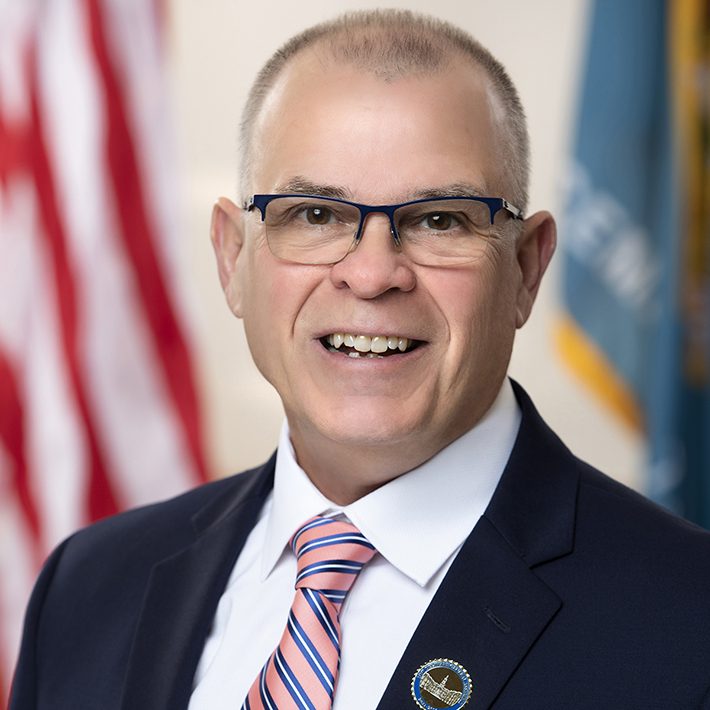
Photo of Ed Osienski
D Delaware House · District 24 On the 2026 ballot

Rep. Ed Osienski

Compare
Total votes
2,772
all sessions
Attendance
99%
18 missed
Higher than 91% of chamber peers
With party
99%
of cast votes
Higher than 90% of chamber peers
Bipartisan score
0%
crosses aisle rarely
Lower than 91% of chamber peers
Sponsored
1,277
bills & resolutions
Higher than 80% of chamber peers
Committees
8
assignments
1,277 bills and resolutions

Sponsored bills

Total
1,277
Primary
749
Co-sponsor
528
This page
1,277
matching current filters
Primary SB 170
Signed into law · Delaware Senate · Lead sponsor
AN ACT TO AMEND TITLE 29 OF THE DELAWARE CODE RELATING TO OFFSHORE WIND ENERGY.

This Act directs the Department of Natural Resources and Environmental Control to work with PJM Interconnection, LLC to study the transmission impacts of offshore wind development, to work with neighboring states on offshore wind transmission, and to study and report back to the Governor and the General Assembly on a process for procuring offshore wind power.

Signed into law Aug 3, 2023 0 co-sponsors
Primary HB 83
Signed into law · Delaware House · Lead sponsor
AN ACT TO AMEND TITLE 14 OF THE DELAWARE CODE RELATING TO ORAL HEALTH SCREENINGS.

This Act requires every public school and charter school to provide students enrolled in kindergarten with an oral health screening by the last student attendance day of each school year. Notification to the parent or guardian must be done and a copy of the oral health screening results sent home. A referral to a dentist, if required, will be provided by the Bureau of Oral Health and Dental Services. The Division of Public Health (DPH), through the Delaware Smile Check Program, offers school-based oral screenings, at no cost to the school districts, schools, including charter schools, or the students. This Substitute Bill takes out the requirement to advise teachers of the results of the oral health screenings, including Special Education Coordinators and Educational Diagnosticians of students with an IEP. This Substitute Bill also removes any follow-up requirements, by the school, with the student’s parent or guardian. The Substitute Bill also makes the school requirements, under this Act, contingent on the Delaware Smile Check Program remaining in effect or a comparable program to provide free oral health screenings to all enrolled kindergarten students. This Act takes effect for the 2024-2025 school year.

Signed into law Aug 3, 2023 0 co-sponsors
Primary SB 124
Signed into law · Delaware Senate · Lead sponsor
AN ACT TO AMEND TITLE 16 OF THE DELAWARE CODE RELATING TO THE REPORTING OF CHILD ABUSE AND NEGLECT.

This Act clarifies when reports of child abuse or neglect, including suspected human trafficking of a child, are required to be made orally to the Department’s report line and when they may be made via the Department’s online reporting portal. This Act also clarifies that licensed professionals who make reports may not remain anonymous.

Signed into law Jul 31, 2023 0 co-sponsors
Primary HB 60
Signed into law · Delaware House · Lead sponsor
AN ACT TO AMEND TITLES 18, 29, AND 31 RELATING TO BREAST CANCER SCREENING AND DIAGNOSTIC PROCEDURES.

To prevent Delawareans from facing exorbitant costs for potentially life-saving screenings and follow-up tests, and to allow providers to use clinical judgement in the use of breast cancer examination tools based on established national standards, this Act requires that all insurance policies issued or renewed in this State include coverage of supplemental and diagnostic breast examinations on terms that are at least as favorable as the coverage of annual screening mammograms. The Act covers all group, blanket, and individual health insurance policies (except specified accident, specified disease, hospital indemnity, Medicare supplement, long-term care or other limited benefit health insurance policies) as well as the State employee healthcare plan and Medicaid. This substitute bill differs from the original bill in that it makes technical corrections, excludes certain health, and adds to the definition of breast MRI.

Signed into law Jul 26, 2023 0 co-sponsors
Primary SB 102
Signed into law · Delaware Senate · Lead sponsor
AN ACT TO AMEND TITLE 29 OF THE DELAWARE CODE RELATING TO PREVAILING WAGE.

This Act closes a loophole in the prevailing wage statute that was being used to pay workers below the prevailing wage by performing work offsite instead of onsite, regardless of whether it was necessary to do so. This bill also makes technical corrections to conform existing law to the standards of the Delaware Legislative Drafting Manual.

Signed into law Jul 26, 2023 0 co-sponsors
Primary HB 236
Signed into law · Delaware House · Lead sponsor
AN ACT TO AMEND TITLE 19 OF THE DELAWARE CODE RELATING TO EMPLOYER ASSESSMENTS.

This Act will continue for calendar year 2024 the temporary relief provided in calendar year 2023 to employers who pay unemployment tax assessments. It will continue to reduce new employer tax rates, hold constant overall employer tax rates from last calendar year, and reduce the maximum earned rate. This Act will also continue the temporary simplification of the tax rate schedules that are used to calculate unemployment assessments paid by employers. The Governor’s agreement to use federal pandemic funds to restore the pandemic-depleted Unemployment Trust Fund made the Unemployment Trust Fund sufficiently solvent and is allowing the Department to implement unemployment tax relief measures to Delaware employers for an additional one-year period for calendar year 2024. The Department estimates that these unemployment tax assessment changes will reduce the tax obligation of employers an estimated $50 million compared to the tax rates absent the temporary relief. This Act also restructures the supplemental assessment that is currently collected from all employers, keeping it at the same rate of 0.2%, but depositing it in the Special Administration Fund instead of the UI Trust Fund. This Act expands the uses for the Special Administration Fund to include future technology needs of the Department and makes technical corrections to the administration provisions of the Special Administration Fund to align with current State Treasurer practices.

Signed into law Jul 25, 2023 0 co-sponsors
Primary HB 161
Signed into law · Delaware House · Lead sponsor
AN ACT TO AMEND TITLE 29 OF THE DELAWARE CODE RELATING TO THE ENERGY EFFICIENCY INVESTMENT FUND.

This Act allows the Department of Natural Resources and Environmental Control to assist more small businesses and organizations in making energy efficiency improvements to their facilities by raising the proportion of those projects that can be funded through grants or loans by the Energy Efficiency Investment Fund. Currently, assistance is capped at 30% of the project cost up to $250,000, leaving an applicant to come up with the remaining 70% or more. This can be prohibitive for smaller entities. By raising the eligible proportion of the project cost to 60%, without changing the maximum funding, the Department can help more small businesses, local governments, and nonprofits reduce their operating costs and environmental impact.

Signed into law Jul 21, 2023 0 co-sponsors
Primary HB 242
Passed · Delaware House · Lead sponsor
AN ACT TO AMEND TITLE 16 OF THE DELAWARE CODE RELATING TO HOSPITAL VISITATION POLICY.

This legislation is an attempt to strike a balance between the need to protect hospital staff, hospital patients, and the public from harm during a State of Emergency, pandemic, or infectious disease outbreak with the expectation that patients should be able to receive support from their family and spiritual counselors during a time of personal crisis. This act shall be known as "The No Patient Left Alone Act." Specifically, it migrates decision-making authority on visitation policies from elected and unelected state officials to the medical personnel operating Delaware’s hospitals – the trained professionals best positioned to make these difficult decisions during an especially challenging time. While it is the intention of this act to facilitate limited in-person patient visitation, its gives hospitals and designated medical professionals broad authority and discretion to safeguard the welfare of all involved parties. Hospitals would be able to: restrict the number of visitors patients could receive daily; require visitors to undergo and pass a specified health screening; and use personal protective equipment while visiting. Hospitals would be able to specify the required personal protective equipment, making it available for visitors to purchase on-site, subject to availability. Entry could be denied to visitors that failed their health screenings; were found to have a communicable disease; were found to have been exposed to a communicable disease; or failed to sign a statement indicating that they understood the visitation policy, and held the hospital and its staff harmless for all assumed risk directly associated with the primary cause of the State of Emergency, pandemic, or infectious disease outbreak. Attending physicians and other medical professionals designated in the bill would retain the authority to deny in-person visitation if they deemed their patients would be at risk for contracting an infectious disease or if they believed visitation posed a serious community health risk. Such determinations would be valid for up to seven days and subject to renewal. Hospitals could deny visitation if a state agency regulation, federal order, federal law, or federal regulation required it. If a prospective hospital visitor were denied in-person visitation with patients, the hospital would be required, to its best efforts, to develop alternate visitation protocols that would allow visitation to the greatest extent safely possible. This could include, but not be limited to, streaming audio and video. Hospitals could not prohibit in-person visitation by a religious counselor to a seriously ill or dying patient, providing that the counselor complied with all visitation mandates established pursuant to this act. A visit by a religious counselor would not be counted against any daily visitation limit set by the hospital. The Department of Health and Social Services would be responsible for overseeing the implementation, operation, and enforcement of this act. Hospitals could be subject to fines for violating the terms of this act, providing the violations continue after the hospitals have been informed of the need to take corrective action. This measure would become effective 180 days after its enactment. This substitute bill differs from the bill it replaces in the following ways: • It eliminates the liability provisions previously contained on lines 56 through 62, and line 103, replacing it with a new liability section - 1014A (c)(3)(E) - that is more refined and requires a signed acknowledgment by the visitor of the risk they are assuming. This acknowledgement does not allow the hospital or personnel to be held harmless for intentional misconduct or gross negligence. • It adds the terms “advanced practice clinician, or chief medical officer” to the sections previously on lines 63 through 67 dealing with the healthcare professionals authorized to restrict visitation for justifiable medical or public health reasons. • Adds the term “state agency regulation” to the section previously on lines 48 through 50 that specify the reasons a hospital may be compelled to deny visitation. • Rewrites the section previously on lines 41 through 47 to improve the clarity of the list of conditions under which a hospital can deny entry to, or remove a visitor from, the hospital's premises. • Corrects language previously on lines 39 through 40 to reflect an earlier change to the bill that deals with the requirement for visitors to wear personal protective equipment, as stipulated by the hospital, when visiting a hospital patient. • Adds a new section - 1014A (i) - stipulating that other than the potential restrictions stipulated in Subsection (c) and Subsection (e) a hospital may not prohibit in-person visitation by a doula providing doula services as defined in § 6536A of Title 11 with a pregnant or postpartum person.


Passed Jul 21, 2023 0 co-sponsors
Showing 491 to 500 of 1,277 bills
Previous 1 … 49 50 51 … 128 Next