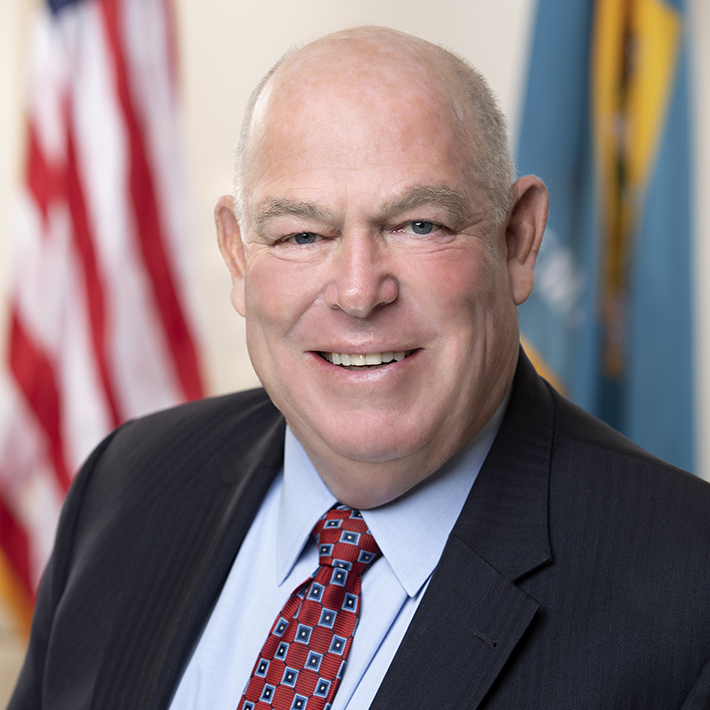
This Concurrent Resolution provides for a Joint Session of the House of Representatives and the Senate to be convened for the purpose of hearing an address by the Honorable John C. Carney, Governor of the State of Delaware.
Sponsored bills
This Concurrent Resolution requests an advisory opinion of the Justices of the Delaware Supreme Court regarding the proper construction of § 13 of Article III of the Delaware Constitution.
This concurrent resolution remembers and recognizes the life and service of former Delaware Governor Ruth Ann Minner.
This Senate Concurrent Resolution honors and recognizes the leadership, achievements, and sacrifices of Dr. Martin Luther King, Jr. and urges all citizens of the First State to participate fittingly in the observance of Dr. Martin Luther King, Jr. Day on January 17, 2022.
This Concurrent Resolution recognizes January 9, 2022, as "Law Enforcement Appreciation Day" in Delaware.
This Act amends the maps of the district boundaries for the House of Representative and Senate Districts in the Delaware General Assembly in response to the 2020 U.S. Decennial Census. This Act also includes provisions to effectuate changes in Delaware law necessitated by the 2020 U.S. Decennial Census. Districts are designated by census blocks. A map of Delaware by census block is located on the U.S. Census website: https://www2.census.gov/geo/maps/DC2020/PL20/st10_de/censusblock_maps/. The final House of Representatives Maps (October 28, 2021) and data are located on the General Assembly website: https://legis.delaware.gov/redistricting/2022finalhousedistricts. The final Senate Maps (October 25, 2021) and the Census Block Breakdown by Senate District with the related census tracts and census blocks descriptions and data are located on the General Assembly website: https://legis.delaware.gov/Redistricting/2022FinalSenateDistricts.
Section 1 of this bill establishes the crimes of possession of an unfinished firearm frame or receiver with no serial number, possession of and manufacturing a covert or undetectable firearm, possession of and manufacturing an untraceable firearm, and manufacturing or distributing a firearm using a three-dimensional printer. This bill also makes it a crime to possess a firearm frame or receiver with a removed, obliterated, or altered serial number. This bill makes very limited exceptions to the requirement that certain guns have serial numbers which are: (1) Firearms manufactured before 1968; (2) Muzzle loaders that only use black powder, and antique replicas. Finally, this bill makes clear that § 1463 of Title 11 concerning untraceable firearms does not apply to members of the military forces or members of a police force in this State duly authorized to carry an untraceable firearm, and does not apply to the manufacture or importation for sale to a law-enforcement or military entity in this State. Section 2 is a severability clause. Section 3 provides that Section 1459A of Title 11, which is possession of an unfinished firearm frame or receiver with no serial number, takes effect 90 days after the Act's enactment into law.
Delaware has been irreparably harmed by the opioid crisis. In 2018, 400 people died of an overdose in Delaware, and in 2019, 431 people died of an overdose. Settlements from opioid distributors, manufacturers, and pharmacies are expected to provide significant monies over a substantial period of time to Delaware. These funds are intended to address to harm caused by the opioid crisis in our communities. This Act establishes the Prescription Opioid Settlement Fund (Settlement Fund) and Prescription Opioid Distribution Commission (Commission), to ensure that settlement money is used to remediate and abate the opioid crisis and is not diverted to other purposes. The Commission is part of the Behavioral Health Consortium and is established to ensure that decisions on how to spend funds are reached through consensus driven process that takes into account the views and experience of affected communities. The Behavioral Health Consortium will distribute money received by the Settlement Fund and the Prescription Opioid Impact Fund (Impact Fund), enacted by Senate Bill No. 34 of the 150th General Assembly, according to the recommendations of the Commission. The Commission shall seek input from the public and relevant stakeholders and shall convene a Local Government Committee to ensure that recommendations from counties and municipal governments are carefully considered. The terms of settlement agreements, bankruptcy plans, or other agreements for the payment of monies by defendants in opioid-related litigation will likely include terms that establish how the money must be spent. The Commission is required to adhere to those terms. The Commission must produce an annual report regarding the receipt and disbursement of funds. This Act preserves the status quo of the existing parties to litigation while limiting the ability for new local government opioid suits to be brought, because new lawsuits could limit the size of Delaware’s recovery in global settlements that are expected to be reached. This Act repeals the sunset of the Prescription Opioid Impact Fee (Impact Fee) and Impact Fund It also repeals the report requirement for the Impact Fund because the information in that report will be included in the new report that the Commission must produce. This Act requires a greater than majority vote for passage because § 4 of Article VIII of the Delaware Constitution requires the affirmative vote of three-quarters of the members elected to each house of the General Assembly to appropriate funds to a county or municipality. This Act also requires a greater than majority vote for passage because § 1 of Article IX of the Delaware Constitution requires the affirmative vote of two-thirds of the members elected to each house of the General Assembly to amend a charter issued to a municipal corporation.

The purpose of this act is to open up The Delaware Student Excellence Equals Degree Act (SEED Act) to adult Delaware residents, who are not recent high school graduates. Currently, about 56% of Delawareans age 25-64 lack a post-secondary degree. This expansion of the SEED grant program will encourage adult learners to return to school to enhance their knowledge and skills and increase their job opportunities. Adult individuals with a high school diploma or less education were significantly impacted by Covid-19-related job loss. This legislation can help to mitigate the effects of the pandemic on those adults. Tennessee has instituted a similar program called the Tennessee Reconnect Act.
This Act creates the Korey Thompson Student Emergency Housing Assistance Fund for the benefit of housing insecure undergraduate students at any college or university in Delaware and appropriates $90,000 to the Fund for FY2022. DSHA is charged with administering the Fund and reporting to the Governor and the General Assembly how the funds are spent.