

This Act repeals § 2117, Title 31, which relates to an individual who, by reason of loss or impairment of eyesight or hearing, has a right to be accompanied by a “seeing eye dog,” also known as a “guide dog,” in public conveyances; hotels; lodging places; all places of accommodation, amusement, or resort; and other places to which the general public is invited. This Act is a result of the Joint Legislative Oversight and Sunset Committee’s review of the Division for the Visually Impaired, and furthers the goal of modernizing Chapter 21, Title 31. Section 2117 is antiquated and no longer appropriate to include in Chapter 21, Title 31. The rights of an individual who is accompanied by a service dog are adequately and more appropriately protected through Chapter 45, Title 6 (Equal Accommodations), Chapter 95, Title 16 (Delaware White Cane Law); and § 1917, Title 2 (Transportation Networks – No discrimination; accessibility).
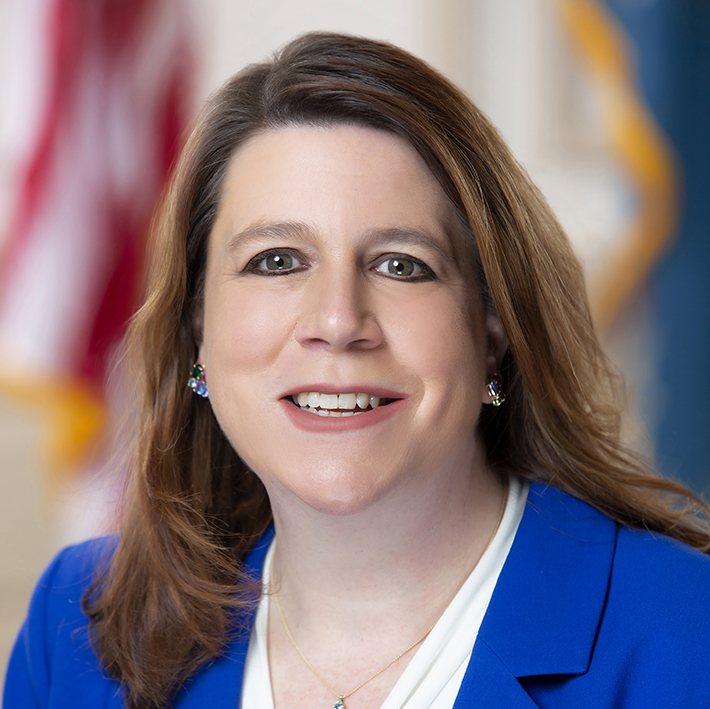
Rep. Krista Griffith
Sponsored bills
This Act is a result of the Joint Legislative Oversight and Sunset Committee’s (“JLOSC”) review of the Division for the Visually Impaired. Under this Act, the Delaware Industries for the Blind (“DIB”) is repealed. DIB closed operations in March 2017 after experiencing several challenges, including all of the following: - Responding to the recession. - Reduction of resources permitted for state agencies to award employee recognition rewards. - Being classified as a sheltered workshop. - An ineffective and inefficient business model that ultimately resulted in cash flow issues. This Act also makes needed updates to § 9606, Title 16, which relates to the Blind Enterprise Program, a program under Delaware’s Division of Vocational Rehabilitation, authorized by the federal Randolph-Sheppard Act, and monitored by the federal Rehabilitation Services Administration. Finally, this Act makes technical corrections to conform existing law to the standards of the Delaware Legislative Drafting Manual.
This Act terminates the Medical Marijuana Act Oversight Committee ("Committee"). After Joint Legislative Oversight and Sunset Committee's ("JLOSC") thoroughly reviewed the Committee, JLOSC concluded that the Office of Medical Marijuana ("Office") oversees a functioning medical marijuana program without support from the Committee. Since October 15, 2015, the Committee has made only 2 recommendations to the Office relating to the medical marijuana program and has not made recommendations to the Governor or the General Assembly. Therefore, the Committee is not meeting a public need. The termination of the Committee is made under JLOSC's authority to terminate an agency under § 10214 of Title 29, and without opposition from the Committee, the Office, or the Department of Health and Social Services.
In cases where the Family Court finds that there are sufficient grounds to order the removal of a child from their home and the Family Court orders custody of the child to the Division of Family Service (DFS), DFS often partners with law enforcement to enforce the order. There have been rare cases where a parent or legal guardian refuses to respond to DFS and law enforcement’s attempts to enforce the order to take custody of the child, resulting in uncertainty and a heightened concern for the child’s safety. Currently, it is unclear under the Delaware Code whether law enforcement is authorized to enter private property to enforce a Family Court custody order, even after all other avenues and strategies have been exhausted by DFS and law enforcement. The Act clarifies that a law enforcement officer has the authority to enter private property to enforce a Family Court custody order. It also specifies that in private (non-DFS) custody cases, law enforcement has the authority to enter private property to take custody of a child when the Family Court custody order requests the assistance of law enforcement. The Act does not require that law enforcement enter private property to take custody of a child.
This Act clarifies that of the 6 members of the Delaware Native Species Commission (Commission) that represent stakeholder commercial interests, such as land development, farming, and business, no more than 2 members can represent the same commercial interest. This legislation is necessary for the Commission to have the relevant expertise and perspectives for its work.
This Act renames the Claymont Regional Transportation at First State Crossing in Claymont, Delaware as the "Harris B. McDowell, III Transportation Center" after Senator Harris B. McDowell, III, the longest serving member of the Delaware General Assembly.
The Joint Resolution directs the Delaware Emergency Management Agency (DEMA) and Division of Public Health (DPH) to conduct After Action Reviews to assess the State’s pandemic response. DEMA and DPH are also maintaining the ability to increase personnel and supplies as needed in response to future surges of COVID-19. Additionally, the Joint Resolution directs the Legislative and Executive branches to work together on initiatives to combat the effects of the COVID-19 pandemic.
This Act permits multidisciplinary team members to share information freely amongst themselves to better protect the welfare of abused children in the State of Delaware. This Act also establishes a framework for parties in Family Court civil proceedings to have access to records created and maintained by a child advocacy center related to forensic interviews it conducts such that the Family Court can utilize those records to avoid retraumatizing children by having to interview them again as part of court proceedings.
Acquiring a driver’s license is an important part of young adults in foster care achieving normalcy and eventual independence. Yet, youth in long term foster care face numerous unique barriers in this endeavor. Not only are there logistical challenges in the process of obtaining a license for teenagers not in parental care, but the automobile insurance industry’s rules can be unaccommodating and financially prohibitive. And, research shows that youth who leave foster care with a driver’s license are more likely to have a successful outcome, avoiding homelessness and incarceration, as reliable transportation is a crucial step to employment. Like Senate Bill No. 151, this Substitute Act seeks to aid youth in foster care by doing the following: (1) Establishing a pilot program within the Office of the Child Advocate (“Office”) that would pay the cost of driver education, licensure and other costs incidental to licensure, and motor vehicle insurance. (2) Prohibiting automobile insurers from using certain factors in determining a foster child’s automobile insurance rates. (3) Prohibiting the DMV from charging certain fees related to licensure for a foster child participating in the Office’s pilot program. (4) Exempting certain individuals from liability for negligence of a foster child. This Substitute differs from Senate Bill No. 151 as follows: (1) By directing that the Act is to be implemented the earlier of April 1, 2023, or the date of publication in the Register of Regulations of a notice by the Child Advocate that the Act is to be implemented. (2) By setting the date reports from the Office of the Child Advocate are due based on the implementation date of the Act. (3) By directing the Act to expire, or sunset, 2 years from the implementation date of the Act.
Citing the increasing number of false confessions recorded by the National Registry of Exonerations and recent science around adolescent brain development, several states across the nation have passed legislation to ban the use of deceptive interrogation techniques on juveniles. Deceptive tactics is limited to the knowing use of misleading statements about evidence or communications of false promises of leniency to extract a confession or other incriminating evidence from a youth suspected of breaking the law. To date, Delaware has yet to have a wrongful conviction case involving a false confession but according to groups such as the Innocence Project, wrongful convictions can often take decades to be revealed. Three other states, Illinois, Utah and Oregon, have passed similar legislation. Additional states, including Colorado and California, are currently considering similar legislation. This Act mirrors efforts in other states by prohibiting the knowing use of false statements about evidence, or false or misleading promises of leniency during custodial interrogations of persons under the age of 18. Any statement elicited from a person in violation of this section is inadmissible in any subsequent juvenile delinquency or criminal court proceeding.