

This House Concurrent Resolution honors and recognizes the leadership and achievements of Dr. Martin Luther King, Jr. and urges all citizens of the First State to participate fittingly in the observance of “Dr. Martin Luther King, Jr. Day” on January 20, 2020.
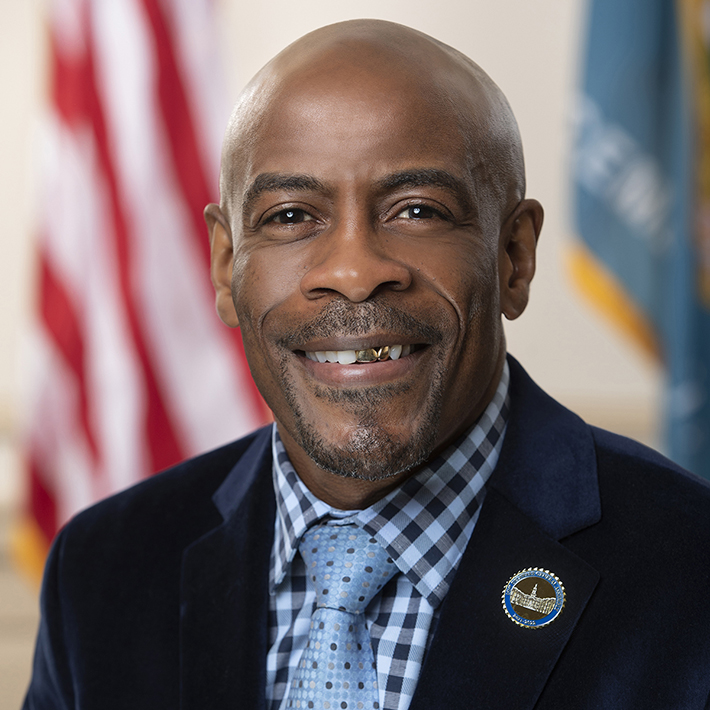
Rep. Nnamdi Chukwuocha
Sponsored bills
Section 1 of this bill moves the date of primary elections for statewide office, county office, and municipal office to the fourth Tuesday in April, which is the date of the presidential primary (in presidential election years). The dates for submitting and withdrawing notification of candidacy have been adjusted accordingly. Section 2 of the bill changes the deadline for a minor political party selecting its candidate at the party’s convention. Section 3 of the bill changes the deadline for filing certificates of nomination from September 1st to April 1st. Section 4 changes the “closed” period in which a voter is not allowed to change his or her political affiliation to match the 60-day limit in 15 Del. C. § 3189 for presidential primaries.
This act will allow a critical need reimbursement to be distributed directly to an institute of higher education or Secretary of Education approved Alternative Routes to Teacher Licensure and Certification program for an eligible teacher who is taking noncredit-earning seminars or workshops or credit-bearing coursework in order to attain a Standard Certification in a state-approved critical need area.
This Act requires that the health education programs presented by the Department of Education include instruction on what it means to "consent" in the context of a sexual encounter.
This Bill enables the use of roof or ground mounted solar systems on privately owned residential dwellings by making covenants or other restrictions that effectively prohibit or unreasonably restrict the installation of solar photovoltaic systems in Delaware void and unenforceable, regardless of the date recorded. This Bill also explains that it is the policy of the State of Delaware to protect the public health, safety, and welfare by encouraging the development and use of renewable resources and to remove obstacles thereto. This Bill further provides for costs and reasonable attorneys' fees to be awarded to the prevailing party in any litigation arising under the provisions of this Section. This Bill does not render void and unenforceable reasonable restrictions on roof or ground mounted solar systems.
The Delaware Equal Accommodations Law, Chapter 45 of Title 6 of the Delaware Code, prevents discrimination against people because of their race, age, marital status, creed, color, sex, disability, sexual orientation, gender identity, or national origin. This Act enhances the protections under the Delaware Equal Accommodations Law by prohibiting retaliatory discrimination against an individual for either of the following: (1) Opposing an act or practice that is an unlawful practice under the Delaware Equal Accommodations Law. (2) Making a charge, testifying, assisting, or participating in any manner in an investigation, proceeding, or hearing to enforce the Delaware Equal Accommodations Law.
This Act prohibits the practice known as patient brokering, which is the practice where patient brokers are paid a fee to place insured people in treatment centers so that the treatment centers receive thousands of dollars in insurance claim payments for each patient. Increasingly, patient brokers fraudulently enroll patients in low-deductible health plans with out-of-network treatment benefits. Patient brokers target individuals with substance use disorders, who are told that they are receiving their treatment through a scholarship. Not only does this perpetrate fraud against insurers, when insurance plans are terminated for nonpayment of the premium, individuals are discharged from the treatment program with no services or housing and often in a state that is far from home.
This Bill modifies the impact of criminal history on an applicant’s eligibility for licensure. It gives the Board discretion to grant waivers for felony convictions for crimes committed against a person where more than 3 years have elapsed, and more than 2 years have elapsed for other felonies. The Board is precluded from considering a conviction where more than 10 years have elapsed since the date of conviction.
This Act is identical to Senate Bill No. 127 from the 149th General Assembly, which was passed by the Senate and reported out of the House Administration Committee. This Act corrects an inadvertent error in Delaware law that has permitted people younger than 18 years of age to vote in final-stage elections. People must be 18 years of age or older to be eligible to vote in a final-stage election such as general elections, special elections, school board elections, and school district referendums. However, people younger than 18 years of age can vote in any preliminary election, such as primary elections, if they will be 18 years of age at the time of the final-stage election.
This Act modifies the impact of criminal history for applicants for licensure to the Board of Electrical Examiners (Board). Specifically, this Act: (1) Permits the Board to grant waivers for felony convictions for crimes committed against a person where more than 3 years have elapsed, and more than 2 years have elapsed for other felonies. (2) Permits the Board to grant waivers for felony and misdemeanor convictions if the applicant is on Level I or II probation. (3) Precludes the Board from considering a conviction where more than 10 years have elapsed since the date of conviction. (4) Requires an applicant to submit evidence that the applicant has not been convicted of a felony sexual offense. This Act also makes technical corrections to conform existing law to the standards of the Delaware Legislative Drafting Manual.