This Act allows the parent or guardian of a military-connected student to preliminarily enroll the student by remote registration in a school district where the parent or guardian is in the active military of the United States or in full-time status during active service with a force of the Delaware National Guard, if the parent or guardian is being transferred to Delaware under military orders and is transferred to or is pending transfer to a military installation within Delaware.
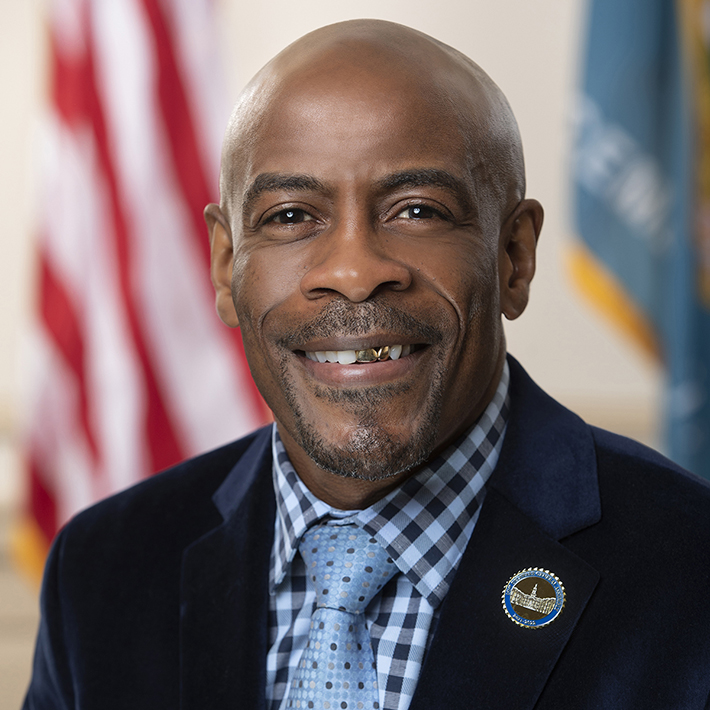
Rep. Nnamdi Chukwuocha
Sponsored bills
This Act establishes a mental health services unit for Delaware elementary schools. The unit is at a ratio of 250 full-time equivalent students grades K-5 for a full-time school counselor, school social worker, or licensed clinical social worker. Additionally a unit ratio of 700 full time equivalent students for grades K-5 for employment of a full-time school psychologist. This Act defines “mental health services” as prevention, response, and coordination services delivered to students in elementary schools. Mental Health disorders are the most common health problem for school aged youth. According to the National Institute of Mental Health (NIMH), one in five youth are affected by a mental health disorder. Additionally, 50% of lifetime mental illnesses begin by age 14. Untreated mental illness leads to negative outcomes including increased risk of dropout, homelessness, substance abuse, other chronic illnesses, incarceration, and possibly suicide. According to the National Alliance on Mental Health, ninety percent of people who have taken their own life have had an underlying mental health condition, and suicides are on the rise. According to the Center for Disease Control and Prevention, suicides are now the second leading cause of death for youth ages 10-14. Delaware schools need trained and experienced mental health professionals to provide prevention and support programs and services to students. Currently, as reported by Delaware school districts, 86% of elementary schools do not employ a school social worker, and ratios of students to school counselors and school psychologists far exceed national best practices. This bill will lower ratios and increase access to mental health services for elementary school students.

This bill provides that the spouse and any child of a member of the active military service of the United States, who has been assigned to duty elsewhere immediately following assignment to duty in Delaware, shall be deemed to be an in-state resident for the purposes of determining the tuition, fees, and other charges at Delaware public universities, colleges, or community colleges as long as the spouse or child remains enrolled at such institution.
This bill allows schools and school districts to submit an application to the Department of Education to have a school designated as a Purple Star School.
Year-long teacher residency programs are a partnership between an educator preparation program and a Delaware school district or charter school to provide a year-long immersive experience for teacher candidates, allowing them a full and supported, on the ground experience of teaching in a Delaware school. The teacher resident also receives a stipend while participating in the program, which may be used to defray education and living expenses. These programs are the gold standard for teacher preparation and they assist in attracting and retaining quality, diverse educators. For the last several years, the General Assembly has appropriated funds in the annual budget to support and sustain these programs. This bill codifies the program and establishes guidelines for how and when the funds will be awarded and what they may be used for. The Department of Education continues to be charged with administration of the funds.
This Act changes the current evaluation system for all teachers from the former Delaware Performance Appraisal System II evaluation to a new Delaware Teacher Growth and Support System. The goal of this new evaluation system is to build a culture of professionalism and learning within every school by converting the evaluation system from a teacher-focused to a learning-focused system. It also increases accountability by requiring a beginning, middle and end of the year review of both the teacher’s professional learning goals and student improvement goals. All teachers (not just 4-8 testing subjects) will be held accountable for student growth. The new evaluation system will only apply to teachers. Specialists and administrators will continue to be evaluated under the Delaware Performance Appraisal System II. Under this Act the new evaluation system will be phased in with a minimum of 3 local education agencies participating in a pilot program for academic year 2021-2022, which will sunset on June 30, 2022. Under Section 2 and 3 of this Act, effective academic year 2022-2023, all teachers will fall under the Delaware Teacher Growth and Support System and all specialists and administrators will be evaluated under Delaware Performance Appraisal System II.
This Act provides increased funding for kindergarten through third grade students identified as eligible for basic special education services. Currently, basic special education is provided for students in fourth through twelfth grade who are identified as eligible for basic special education and related services; there is no additional unit funding for students in kindergarten through third grade who may be eligible for basic special education services. The Act adds a designation of “K-3 Basic Special Education (basic)” and over three years reduces the number of students comprising a unit from the current 16.2 to 8.4. This Act will increase the unit count funding for K-3 Basic Special Education (basic) students by School Year 2023-2024, Fiscal Year 2024, to be consistent with the 8.4 unit of pupils currently available to students in grades 4 through 12. Sections 1 through 3 of this Act change the funding chart currently in the Code to subsections and provides for a decrease in the ratio between the number of students enrolled and the unit count for basic special education from 16.2 currently to 12.2 in Fiscal Year 2022, 10.2 in Fiscal Year 2023, and 8.4 in Fiscal Year 2024. Section 4 of this Act delays the effect of each Section until the start of each new fiscal year in the 3-year cycle over which this Act’s changes are intended to occur.
This bill makes certain technical amendments to the Delaware Voluntary Clean Energy Financing Program Based on Property Assessments (D-PACE) Act. The amendments are based upon comments received from New Castle County and the lending community. The bill clarifies the interplay between the Act and existing tax and foreclosure sale statutes and that the lien for the energy improvements will remain with the property following a tax monition sale and mortgage foreclosure. It also clarifies the authority of the Sustainable Energy Utility and third party capital providers to enforce the lien for delinquent assessments for clean energy improvements.
This bill will provide Delaware students with strong academic credentials and a demonstrated commitment to volunteer public service to receive scholarship monies sufficient to cover the full cost of tuition at Delaware State University. The intent of this bill is to increase the number of students in Delaware who not only attend the University but who successfully complete degree programs.
Many of the State’s waters do not meet water quality standards to support their designated uses, such as for drinking, swimming or supporting aquatic life. The Clean Water for Delaware Act establishes a framework for assessing needs and planning and implementing projects that support Delaware’s efforts to improve the quality of the State’s water supply and waterways. A Delaware Clean Water Trust account is created as a funding source for executing projects highlighted by this framework. The Trust account will have oversight from the Clean Water Trust Oversight Committee (the “Committee”). The Committee will draw upon recommendations from the Water Infrastructure Advisory Council, (WIAC), the county Conservation Districts’, experts in the effected Cabinet agencies and other public input with the goal of assisting municipal and county governments and others in implementing affordable water quality projects. The Committee is required to develop and publish an Annual Report and multi-year Strategic Plan for Clean Water with annual updates.