

Maddy summaryThis bill amends federal energy conservation law to require federal agencies to consider mechanical insulation as a standard energy-saving measure during building evaluations. It defines "mechanical insulation property" as materials that reduce energy loss in mechanical systems while meeting ASHRAE 90.1 standards, including insulation placed in service with those systems. The law adds mechanical insulation to the list of measures agencies must evaluate for potential installation in federal buildings as part of their required energy and water assessments. This directly affects federal agencies managing buildings, ensuring they formally assess this specific efficiency measure during routine evaluations.
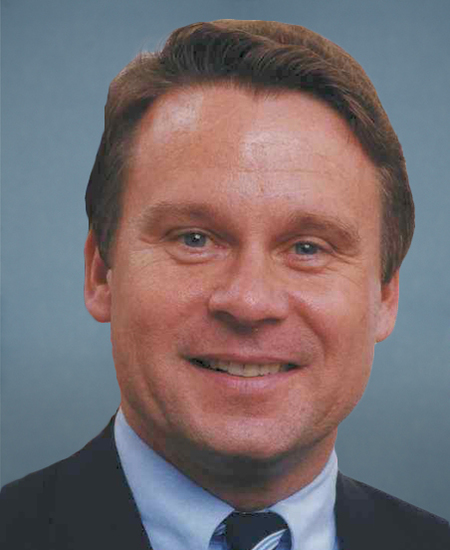
Rep. Christopher H. Smith
Sponsored bills
Maddy summaryThis bill (HR 6803) is a commemorative resolution that renames Newark Penn Station in Newark, New Jersey, as the "Donald M. Payne, Jr. Transit Center at Newark Penn Station." It does not create new policies or affect funding; it solely changes the official name of the transit station and all federal references to it. The designation honors Congressman Donald M. Payne, Jr., who represented New Jersey's 10th District and advocated for transit infrastructure during his service. The bill has no direct impact on transportation operations, riders, or policy - it is purely a ceremonial renaming.
Maddy summaryThis bill would revoke the tax-exempt status of nonprofit organizations (like charities or health groups) that provide or fund abortions, except in specific cases. It directly affects organizations currently classified under Section 501(c)(3) of the tax code, such as some healthcare providers or advocacy groups. Key provisions define "abortion" as intentionally terminating a pregnancy (excluding cases where the mother’s life is at risk, or the pregnancy resulted from rape or incest), and deny tax exemption to groups meeting this definition. The change would take effect for tax years starting after the bill’s enactment date.
Maddy summaryHRES 1022 is a non-binding congressional resolution expressing support for Catholic schools and celebrating the 52nd annual National Catholic Schools Week (January 25-31, 2026). It recognizes Catholic schools' contributions to education, noting their role in serving 1.7 million students across diverse backgrounds, with high graduation rates and community-focused values. The resolution specifically supports the week's goals, highlights the National Catholic Educational Association and U.S. Conference of Catholic Bishops' partnership, and applauds the 2026 theme "Catholic Schools: United in Faith and Community." It does not create new policies, allocate funding, or impose obligations.
Maddy summaryHR 6945 clarifies that states may use federal grants under Section 403 of the Social Security Act to support pregnancy centers meeting specific criteria. These centers must promote protecting both mother and unborn child life while providing services like counseling, pregnancy testing, and material support (e.g., diapers, baby clothes). The bill explicitly prohibits interpreting existing law as barring such funding for eligible centers. It does not create new funding but defines which pregnancy resource organizations qualify for existing grants.
Maddy summaryThe Trafficking Survivors Relief Act (HR 4323) allows victims of human trafficking to petition courts to vacate convictions for non-violent federal crimes (level A offenses) or expunge arrest records if those offenses were directly related to their trafficking victimization. The bill establishes clear procedures for filing these motions, requires courts to consider testimony from anti-trafficking service providers, and ensures confidentiality for petitioners. It also adds a new "human trafficking defense" that permits defendants to claim duress due to trafficking victimization in criminal cases. The law mandates reports to Congress on implementation, including the number of petitions filed and outcomes, to assess its impact on trafficking survivors.
Maddy summaryThis resolution designates July 6, 2025, as "A Day of Compassion" to commemorate the 90th birthday of the Dalai Lama. It expresses congressional support for the Tibetan people's human rights, religious freedom, and cultural/linguistic protections. The resolution affirms that decisions about Tibetan Buddhist religious leadership - including the selection of a future Dalai Lama - must be made by Tibetan Buddhist authorities, not the Chinese government. It does not create new laws or policies but serves as a symbolic expression of support through congressional recognition.
Maddy summaryThe UBER Act establishes new federal requirements for ride-sharing and shared-transportation companies to receive government contracts. To qualify, every driver must be at least 21 years old, hold a valid license from a single state, pass a road test, and demonstrate sufficient English proficiency to communicate with the public and read traffic signs, with an exception for drivers who use American Sign Language. Companies that fail to certify that all their drivers meet these standards will be banned from federal contracts for five years.
Maddy summaryThis bill authorizes Congress to award Frank Siller a Congressional Gold Medal in recognition of his founding of the Tunnel to Towers Foundation. The foundation supports first responders, military families, and veterans through programs like mortgage assistance, veteran housing, and homelessness support. The medal would be designed and struck by the U.S. Mint, with bronze duplicates sold to cover costs. It is a purely commemorative honor with no policy or funding changes beyond the medal production and sales. The bill directly affects Frank Siller as the recipient of this symbolic tribute.
Maddy summaryThis bill establishes a Senior Advisor for National Security within the USDA to coordinate national security efforts related to food and agriculture. It requires the USDA Secretary to submit biennial reports to Congress and the National Security Council identifying vulnerabilities such as foreign control of agricultural data, supply chain disruptions, cybersecurity risks, and dependence on foreign-sourced inputs. The bill mandates improved interagency coordination, including sharing personnel with defense and intelligence agencies, and requires the USDA to assess gaps in security efforts and propose solutions. The primary direct effect is on the USDA's internal operations and reporting structure, not on agricultural policies or farmers.