

Maddy summaryHB 5265 requires common interest communities (like homeowner associations) to allow financial audits under specific conditions. It permits groups owning at least 20% of voting rights to petition a court for an audit if they provide a certified public accountant's opinion indicating potential financial fraud, along with proof of ownership and confirmation no recent audit occurred. The petitioning group must cover all audit costs, though the association may charge a reasonable fee for providing records. The bill also updates property disclosure forms to include new questions about flood zones, historic districts, HOA dues, and reserve funds for buyers. These changes take effect October 1, 2026.
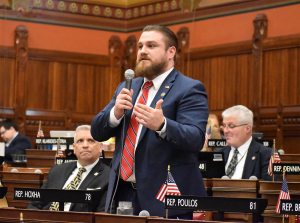
Rep. Joe Hoxha
Sponsored bills
Maddy summaryHB 5422 requires the University of Connecticut to study unidentified aerial phenomena (UAPs) using available resources, consulting with state agencies like the Department of Emergency Services and the Office of Military Affairs, as well as a nonprofit organization focused on UAP investigations. The study must examine the benefits of creating a state UAP research center and the resources needed to establish and operate it. The university must submit its findings to the legislature by July 1, 2027. This bill mandates a research effort but does not create new regulations or funding.
Maddy summaryHB 5123 authorizes the state to issue up to $20,000 in bonds to fund a cloud-based filing system for Plymouth Town. The funds would be provided as a grant through the Office of Policy and Management to Plymouth's local government. This bill directly affects Plymouth Town by providing targeted financial support for upgrading its document management system. The key mechanism is a state bond authorization specifically for this local government technology project, with no broader policy changes or eligibility criteria beyond the town's need.
Maddy summaryHB 5122 authorizes the state to issue up to $2.5 million in bonds to fund technological and electrical upgrades at municipal firehouses. The bill directly affects local fire departments by providing them with state grants for infrastructure improvements. Funds will be distributed through the Department of Emergency Services and Public Protection, specifically for non-structural upgrades like modernizing electrical systems or adding safety technology to firehouse facilities. The bill does not change existing funding mechanisms but creates a new grant program for these specific upgrades.
Maddy summaryHB 5080 would remove the "Combined Public Benefits Charge" from electricity bills for all residential and commercial customers in the state. This charge, currently added to customer bills, would be eliminated and instead funded entirely by the state's General Fund. The bill directly affects every household and business that receives electricity from a distribution company, shifting the cost of public benefits programs (like energy assistance) from consumers to state taxpayers. The legislation aims to simplify bills and reduce costs for electricity users without changing the underlying public benefit programs.
Maddy summaryHB 5087 would create a state-level personal income tax deduction for taxpayers who earn tips or overtime pay, mirroring the existing federal tax treatment for these income types. It directly affects workers in service industries (like restaurants or hospitality) who receive tips or earn overtime, as well as other earners with these income streams. The bill would amend tax law to allow these specific income categories to be deducted when calculating taxable income, similar to how they are treated federally. This policy change simplifies tax filing for affected workers by aligning state deductions with federal rules.
Maddy summarySB 80 requires all facilities incinerating hospital, medical, or infectious waste (treated or untreated) to obtain a Department of Energy and Environmental Protection (DEEP) permit meeting or exceeding U.S. Environmental Protection Agency (EPA) emission standards. This directly affects hospitals, medical facilities, and waste incinerators that burn such waste, including those previously exempt under federal rules. Key provisions mandate continuous monitoring for mercury and hydrochloric acid, monthly sampling for dioxins and furans, and public posting of all monitoring data within 180 days of the bill’s effective date. The bill enforces stricter emissions controls than prior federal exemptions and applies to all applicable facilities statewide.
Maddy summaryHB 5849 amends Connecticut law to change which parties receive payment first when a securities intermediary (like a brokerage) cannot cover all claims on financial assets. It repeals a provision that previously gave priority to creditors with control over financial assets, instead establishing that entitlement holders (such as investors holding securities through intermediaries) always have priority over creditors. This change directly affects investors, brokers, and financial institutions by clarifying payment order during intermediary insolvency. The bill takes effect October 1, 2025, and aligns Connecticut law with standard securities priority rules.
Maddy summaryHB 6105 would reorganize the Bureau of Services for Persons Who are Deaf, Deafblind, or Hard of Hearing, moving it from its current structure to become an independent office within the Department of Aging and Disability Services. This change directly affects Connecticut residents who are Deaf, Deafblind, or hard of hearing by altering how their service agency is administered. The bill’s key provision is establishing the bureau as an independent entity under the Department of Aging and Disability Services, without creating new services or altering eligibility. The measure focuses solely on administrative structure, not policy changes for beneficiaries.
Maddy summaryHB 6598 amends state law to expand what homeopathic physicians can legally do in their practice. This bill directly affects licensed homeopathic physicians by allowing them to perform additional medical activities currently outside their permitted scope. The key mechanism is an amendment to Title 20 of the general statutes, which would formally broaden their practice boundaries under state law. The bill does not specify exact new procedures but aims to remove existing restrictions on their professional activities. This is a straightforward policy change to update regulatory boundaries for this healthcare profession.