

Maddy summarySB 1426 expands Connecticut's Firefighters Cancer Relief Program to provide benefits for firefighters diagnosed with cancer affecting specific body systems (skin, brain, respiratory, etc.). Eligible firefighters must meet strict criteria: no prior cancer evidence at hire, no smoking for 15 years before diagnosis, at least five years of qualifying service (as interior structural firefighters or related roles), and annual health screenings. The bill ensures these firefighters receive workers' compensation-style benefits and retirement/survivor benefits from the relief account, covering uncovered treatment costs, while offsetting any existing benefits from workers' compensation or retirement systems. It becomes effective October 1, 2025, and administers claims like standard workers' compensation under Chapter 568.
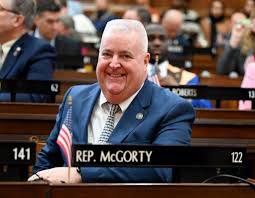
Rep. Ben McGorty
Sponsored bills
Maddy summaryHB 7175 creates a 20% tax credit for eligible farmers who purchase or build qualifying farm machinery, equipment, and buildings after January 1, 2026. To qualify, farmers must earn at least two-thirds of their total income from farming above $30,000, and the property must be used for farming in the state for at least five years. The credit applies to machinery and equipment bought after 2026, as well as qualifying buildings constructed or placed in service after that date, provided they are not leased or acquired from related parties. Farmers, or owners of pass-through entities like S corporations, can claim the credit against state income tax, with unused portions refunded by the state.
Maddy summarySB 1522 renames Connecticut's "Community Investment Account" to the "Donald E. Williams, Jr. Community Investment Account" and increases its funding. The bill directs $45 from each $50 document recording fee collected by town clerks (after retaining $2) to the account, effective July 2025. Funds are distributed as follows: 12% to agricultural sustainability, 25% each to the Departments of Economic Development (for historic preservation), Housing (affordable housing), Environmental Protection (open space grants), and Agriculture (for farm programs, food sales, and farmland preservation). This policy change directly affects municipalities (through fee collection) and state agencies (through funding allocations for specific programs).
Maddy summaryHB 7055 creates two key tax provisions. First, it allows municipalities to establish property tax abatements for the primary residence of surviving domestic partners of police officers, firefighters, or EMTs who die while on duty (effective October 1, 2025). Second, it adds a personal income tax deduction for stipends paid to volunteer firefighters, volunteer fire police officers, and volunteer ambulance members (effective January 1, 2026). These changes directly affect surviving domestic partners of certain first responders and volunteer emergency personnel. The bill modifies existing statutes to provide specific tax relief without altering general tax rates or creating new programs.
Maddy summaryHB 5704 establishes a working group to study how to create a construction workforce pipeline program, focusing on training students and workers for skilled trades jobs. The group will examine expanding high school pre-apprenticeship programs, increasing career awareness, removing barriers to apprenticeships, and exploring financial incentives for employers. It will include representatives from trade associations, schools, business groups, and education officials, with the first report due by December 2025. The bill does not create the program itself but directs a study to inform future policy, with no fiscal impact on state or local budgets.
Maddy summarySB 1389 allows municipalities to pass local ordinances prohibiting "street takeovers" - defined as blocking traffic with intent to cause disorder or nuisance. The bill authorizes municipalities to seize and sell motor vehicles used in violations of such ordinances, with proceeds going to support local police departments or state troopers. Vehicle owners or lienholders are protected if they didn’t know the vehicle was being misused, and existing liens must be respected. This policy directly affects municipalities (which gain enforcement authority), vehicle owners involved in street takeovers, and local law enforcement (which may receive funding).
Maddy summaryThis bill modifies Connecticut's licensing requirements for youth camps operated by the Civil Air Patrol. It requires all such camps to obtain a license (with reduced fees for nonprofits or short-duration camps) and mandates comprehensive background checks for staff working with children, including criminal history, child abuse registry, and sex offender registry checks. The law allows provisional hiring during background checks if supervised by pre-screened staff and gives the commissioner authority to deny licenses based on specific criminal convictions related to child harm. It directly affects Connecticut Wing Civil Air Patrol youth camp operators, staff, and participants by establishing standardized safety protocols.
Maddy summaryHB 6973 allows towns, cities, or boroughs to negotiate with volunteer firefighters and ambulance service members how much they pay toward group health insurance premiums, instead of requiring volunteers to cover 100% of the cost. It applies to active members of volunteer fire/ambulance organizations in municipalities that already offer employee group health plans. Volunteers must still elect coverage, meet active-status requirements, and pay a negotiated share of the premium (not 100%). The bill takes effect October 1, 2025, and does not require municipalities to offer this option.
Maddy summaryHB 6786 (AN ACT CONCERNING THE HIRING RATIO FOR SKILLED TRADES) allows licensed contractors in electrical, plumbing, heating, piping, sprinkler fitter, or sheet metal work to temporarily hire more apprentices than standard ratios require if they meet specific criteria. Directly affecting these contractors, the bill creates a formal application process where businesses must prove they’re in good standing, have no recent wage violations, maintain a 40% apprentice completion rate for licensure, and agree to track apprentice work hours. If approved, the hiring relief applies to specific apprentices for up to six years, even if the business later fails to meet the criteria. The Labor Department must review applications within 10 business days and submit annual reports to the legislature on the program’s impact. The bill takes effect October 1, 2025.
Maddy summaryHB 6915 bans the use of certain second-generation anticoagulant rodenticides (containing brodifacoum, bromadiolone, difenacoum, or difethialone) statewide starting October 1, 2025, affecting most residential, commercial, and general pest control uses. Key exceptions allow continued use for public health activities (e.g., water infrastructure protection, mosquito control), emergency rodent infestations requiring public health approval, specific facilities like medical waste sites and food production facilities, and agricultural operations in designated locations (warehouses, slaughterhouses, etc.). The bill also requires the Environmental Protection Commissioner to develop wildlife protection regulations and submit a 2027 report analyzing impacts on public health, agriculture, and federal compliance. This policy change directly affects pest control businesses, property managers, and agricultural operations while permitting limited uses for public health and critical infrastructure needs.