

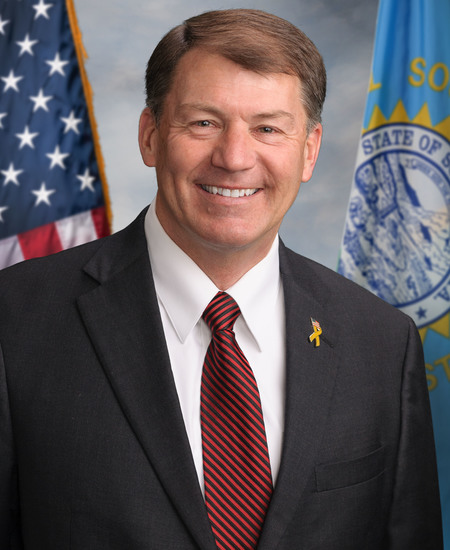
Photo of Mike Rounds
R United States Senate · South Dakota On the 2026 ballot

Sen. Mike Rounds

Compare
Total votes
1,037
all sessions
Attendance
93%
71 missed
Higher than 92% of chamber peers
With party
92%
of cast votes
Near the chamber average
Bipartisan score
5%
crosses aisle rarely
Near the chamber average
Sponsored
1,063
bills & resolutions
Near the chamber average
Committees
18
assignments
1,063 bills and resolutions

Sponsored bills

Total
1,063
Primary
148
Co-sponsor
915
This page
1,063
matching current filters
Co-sponsor SRES 545
Passed · Colorado Senate · Co-sponsor
A resolution designating the week beginning March 13, 2022, as "National Tribal Colleges and Universities Week".

Maddy summarySRES 545 is a symbolic Senate resolution designating the week beginning March 13, 2022, as "National Tribal Colleges and Universities Week." It directly recognizes 35 accredited Tribal Colleges and Universities (TCUs) serving over 230 federally recognized tribes across 15 states. The resolution calls on the public and organizations to observe the week with activities supporting TCUs, which provide culturally grounded education, open enrollment, and workforce preparation in underserved communities. This is a non-binding commemorative measure with no new policy or funding changes.

Passed Mar 14, 2022 1 co-sponsor
Co-sponsor S 321
Signed into law · Colorado Senate · Co-sponsor
"Six Triple Eight" Congressional Gold Medal Act of 2021

"Six Triple Eight" Congressional Gold Medal Act of 2021 This bill provides for the award of a Congressional Gold Medal to the women of the 6888th Central Postal Directory Battalion (commonly known as the Six Triple Eight) in recognition of their pioneering military service, devotion to duty, and contributions to increase the morale of personnel stationed in the European theater of operations during World War II.

Signed into law Mar 14, 2022 1 co-sponsor
Co-sponsor S 3790
In committee · Colorado Senate · Co-sponsor
Ultrasound Informed Consent Act

Ultrasound Informed Consent Act This bill requires abortion providers, as a condition of receiving federal funding, to conduct an ultrasound before performing an abortion. Specifically, before a woman gives informed consent to any part of an abortion, the abortion provider must perform an obstetric ultrasound on the pregnant woman; display the ultrasound images and make audible (when present) the heartbeat and related cardiac sounds for the woman to view and hear while simultaneously explaining the ultrasound depiction and the cardiac sounds; provide a complete medical description of the images, including the dimensions of the embryo or fetus, cardiac activity if present and visible, and the presence of external members and internal organs if present and viewable; and provide the woman with a copy of the ultrasound image. Providers are subject to civil actions and penalties for violations. The bill's ultrasound requirements do not apply in cases where a physical disorder, illness, or injury caused by the pregnancy endangers a woman's life. A woman is also not required to view the ultrasound images; nor may she or the provider be penalized if she declines to do so.

In committee Mar 10, 2022 1 co-sponsor
Co-sponsor S 3779
In committee · Colorado Senate · Co-sponsor
Adjustable Interest Rate (LIBOR) Act

Adjustable Interest Rate (LIBOR) Act This bill provides for the transition of certain financial contracts away from the London Interbank Offered Rate (LIBOR), a reference interest rate based upon the lending terms certain banks offer to each other for various lengths of time. LIBOR is set to be retired in 2023. Various financial contracts reference LIBOR as a benchmark for prevailing interest rates and use LIBOR in calculating certain payments or obligations. In the event a contract referencing LIBOR does not have a fallback or replacement rate provision in effect when LIBOR is retired, or a replacement rate is not selected by a determining person as defined by the bill, the bill provides for a transition to a replacement rate selected by the Board of Governors of the Federal Reserve System. The bill also provides for conforming changes to these contracts, the continuity and enforceability of these contracts, and protections against liability as a result of such a transition.

In committee Mar 8, 2022 1 co-sponsor
Co-sponsor S 3787
In committee · Colorado Senate · Co-sponsor
Home Front Energy Independence Act

Home Front Energy Independence Act This bill prohibits the importation of petroleum and petroleum products from Russia until Russia recognizes the sovereignty and territorial integrity of Ukraine. The bill allows a new tax credit for the sale or blending of ethanol fuels. It also extends through 2025 the income tax credit for biodiesel and renewable diesel used as fuel. The bill modifies requirements relating to the waiver of ethanol reid vapor pressure limitations and E15 labeling. The bill requires the Department of Agriculture to award grants to certain governmental entities for expanding the biofuel infrastructure and agriculture product market.

In committee Mar 8, 2022 1 co-sponsor
Co-sponsor S 3757
Introduced · Colorado Senate · Co-sponsor
Ban Russian Energy Imports Act

Ban Russian Energy Imports Act This bill declares that a national emergency exists with respect to the aggression of Russia against Ukraine. During this emergency, the President must prohibit the importation of crude oil, petroleum, petroleum products, liquefied natural gas, and coal in which Russia or a Russian national has any interest. The bill exempts products that are already loaded or in transit at the time of this bill's enactment.

Introduced Mar 7, 2022 1 co-sponsor
Primary S 3745
In committee · Colorado Senate · Lead sponsor
TAILOR Act of 2022

Taking Account of Institutions with Low Operation Risk Act of 2022 or the TAILOR Act of 2022 This bill addresses the supervision of financial institutions. The bill requires federal financial regulatory agencies to (1) tailor any regulatory actions so as to limit burdens on the institutions involved, with consideration of the risk profiles and business models of those institutions; and (2) report to Congress on specific actions taken to do so, as well as on other related issues. The bill's tailoring requirement applies not only to future regulatory actions but also to regulations adopted within the last seven years. The bill also reduces certain reporting requirements for banks eligible for the community bank leverage ratio. Finally, federal banking agencies must report on the modernization of bank supervision, including examiner workforce and training and statutory changes necessary to achieve more effective supervision.

In committee Mar 3, 2022 0 co-sponsors
Co-sponsor SJRES 32
Passed · Colorado Senate · Co-sponsor
A joint resolution providing for congressional disapproval under chapter 8 of title 5, United States Code, of the rule submitted by the Centers for Medicare & Medicaid Services relating to "Medicare and Medicaid Programs; Omnibus COVID-19 Health Care Staff Vaccination".

This joint resolution nullifies the rule titled Medicare and Medicaid Programs; Omnibus COVID-19 Health Care Staff Vaccination , which was issued by the Centers for Medicare & Medicaid Services on November 5, 2021. The rule requires health care providers, as a condition of Medicare and Medicaid participation, to ensure that staff are fully vaccinated against COVID-19.

Passed Mar 2, 2022 1 co-sponsor
Co-sponsor S 3714
In committee · Colorado Senate · Co-sponsor
American Energy Independence Act of 2022

American Energy Independence Act of 2022 This bill addresses U.S. energy independence, the production and importation of oil and natural gas, and the rescission of specified environmental requirements. Specifically, the bill directs the President to develop a plan for the United States to achieve energy independence by 2024. The Department of Energy (DOE) must also develop a program and issue rules to ensure that the United States achieves such energy independence and becomes a net exporter of energy. The bill also addresses energy pipelines, including by approving the TransCanada Keystone Pipeline in Phillips County, Montana for the import of oil from Canada to the United States. It also provides for energy production, including by requiring regulations to be issued by DOE to reduce requirements on entities harvesting energy through hydraulic fracturing, the Department of Transportation to promote stable and affordable gasoline and diesel prices, and the Department of the Interior to promote the leasing of federal land for oil and natural gas production. In addition, the Environmental Protection Agency (EPA) must identify and repeal certain regulations that substantially reduce energy independence. Further, the bill prohibits the use of any funds to implement the Paris Agreement on climate change. Finally, the bill rescinds (1) Executive Order 14008 about tackling climate change, (2) the 2021 proposed rule issued by the EPA and the U.S. Army Corps of Engineers about the scope of the Clean Water Act, and (3) the 2021 proposed rule issued by the EPA about methane gas emissions.

In committee Feb 28, 2022 1 co-sponsor
Co-sponsor S 3541
Passed · Colorado Senate · Co-sponsor
Health Care for Burn Pit Veterans Act

Health Care for Burn Pit Veterans Act This bill updates policies and procedures related to Department of Veterans Affairs (VA) health care and benefits for veterans who have been exposed to toxic substances. Specifically, the bill extends the eligibility period for VA hospital care, medical services, and nursing home care for combat veterans who served after September 11, 2001, and were exposed to toxic substances, radiation, or other conditions, including those who did not enroll to receive VA care during the eligibility period. The VA must incorporate into its existing health care screening a screening to help determine potential exposures to toxic substances during military service. Among other requirements, the VA must also provide annual training to health care and benefits personnel with respect to veterans who were exposed to toxic substances; analyze total and respiratory disease mortality in veterans who served in specified locations on specified dates; conduct an epidemiological study on the health trends of veterans who served in the Armed Forces after September 11, 2001; conduct a study to determine trends in the rates of the incidence of cancer in veterans; publish a list of VA resources for veterans who were exposed to toxic substances, families and caregivers of such veterans, and survivors of such veterans who are receiving death benefits; and report on the data quality of the Individual Longitudinal Exposure Record and its usefulness in supporting veterans in receiving VA health care and benefits.

Passed Feb 18, 2022 1 co-sponsor
Showing 831 to 840 of 1,063 bills
Previous 1 83 84 85 107 Next