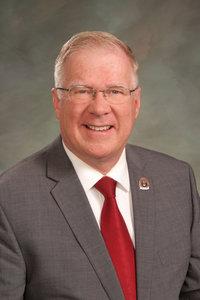
Photo of Kent Lambert
R Colorado Senate · District 9

Sen. Kent Lambert

Compare
Total votes
1,088
all sessions
Attendance
0%
254 missed
Near the chamber average
With party
94%
of cast votes
Near the chamber average
Bipartisan score
4%
crosses aisle rarely
Near the chamber average
Sponsored
91
bills & resolutions
Higher than 93% of chamber peers
Committees
0
assignments
91 bills and resolutions

Sponsored bills

Total
91
Primary
91
Co-sponsor
0
This page
91
matching current filters
Primary HB 18-1167
Signed into law · Colorado House · Lead sponsor
Supplemental Appropriation - Dept Of Revenue

Supplemental appropriations are made to the department of revenue. (Note: This summary applies to the reengrossed version of this bill as introduced in the second house.) Read More

Signed into law Mar 1, 2018 0 co-sponsors
Primary SB 18-040
In committee · Colorado Senate · Lead sponsor
Substance Use Disorder Harm Reduction

Opioid and Other Substance Use Disorders Interim Study Committee. The bill: Specifies that hospitals may be used as clean syringe exchange sites ( section 1 ); Provides civil immunity for participants of a clean syringe exchange program ( section 1 ); Creates a supervised injection facility pilot program in the city and county of Denver and provides civil and criminal immunity for the approved supervised injection facility ( sections 2 through 4 ); Allows school districts and nonpublic schools to develop a policy by which schools are allowed to obtain a supply of opiate antagonists and school employees are trained to administer opiate antagonists to individuals at risk of experiencing a drug overdose ( sections 5 through 11 ); and Requires the commission on criminal and juvenile justice to study certain topics related to sentencing for opioid-related offenses ( section 12 ).(Note: This summary applies to this bill as introduced.) Read More

In committee Feb 14, 2018 0 co-sponsors
Primary SB 18-029
In committee · Colorado Senate · Lead sponsor
Development of Marijuana Tracking Technology

The bill requires the institute of cannabis research at Colorado state university - Pueblo (institute) to develop marijuana tracking technology (technology). The technology must include an agent that is applied to a marijuana plant, marijuana product, industrial hemp, or industrial hemp product and then scanned by a device. The scan, at a minimum, would indicate whether the marijuana or hemp was cultivated, manufactured, or sold by a licensed marijuana business or registered hemp cultivator. The institute shall select a vendor to develop the technology. After the technology is developed, the state licensing authority must be satisfied that the technology provides an effective means of tracking marijuana. After the state licensing authority determines the technology is an effective means of tracking marijuana, it shall promulgate rules that require the technology to be used by licensed marijuana businesses, and the commissioner of the department of agriculture shall promulgate rules that require registered industrial hemp cultivators to use the technology. The technology that scans the marijuana must be made available to law enforcement and the department of revenue. The bill clarifies that the gray and black market marijuana enforcement grant program could award grants to law enforcement agencies to purchase the marijuana scanning technology. (Note: This summary applies to this bill as introduced.) , Read More

In committee Feb 7, 2018 0 co-sponsors
Primary SB 17-306
Signed into law · Colorado Senate · Lead sponsor
Direct Transfer High Cost Support Mechanism To Broadband Grant Recipients

The bill updates language regarding the use of money from the high cost support mechanism (HCSM) for broadband deployment grant applications approved by the broadband deployment board to have money transferred directly from the HCSM to approved broadband deployment grant applicants. The public utilities commission is directed to determine the amount of HCSM money available for broadband deployment and related administrative costs, and the bill requires that amount to be held in a separate account. (Note: This summary applies to the reengrossed version of this bill as introduced in the second house.)


Signed into law Jun 6, 2017 0 co-sponsors
Primary HB 17-1361
Signed into law · Colorado House · Lead sponsor
Evaluate State Information Technology Resources

Joint Budget Committee. The bill requires the state auditor to retain a qualified, independent third-party consulting firm (firm) to evaluate: The centralization of the management of state agency information technology resources in the office of information technology (office) as a result of legislation adopted by the general assembly in 2008; Whether the executive branch of state government has a strategic plan in place to guide its process for evaluating, prioritizing, and selecting information technology projects that require new or ongoing appropriations of state money; The opportunities the state has to interface with the public through information technology; The office's working relationship with state agencies and institutions that were not included in the centralization of state agency information technology resources in the 2008 legislation but that rely on the office to provide certain information technology services or resources; and Consumer satisfaction among state agencies with the management of state agency information technology resources and access to state government via information technology resources. The firm is required to provide the joint budget committee with an update regarding its progress in June 2018 and submit a report to the legislative audit committee, the joint technology committee, the joint budget committee, and the office by December 2018. The report is required to include recommendations to the office for industry best practice standards, recommendations for areas in which the office could work with the general assembly to improve the management of information technology resources and services, recommended future options for the state to solicit feedback from state residents regarding the public's opportunities to interface with state government, and policy discussions directed toward the general assembly. After receiving the report from the consulting firm, the joint budget committee, the joint technology committee, the office of information technology, and any other relevant office or department shall meet to discuss the implementation of the recommendations made in the report. (Note: This summary applies to the reengrossed version of this bill as introduced in the second house.)
Signed into law Jun 5, 2017 0 co-sponsors
Primary HB 17-1045
Signed into law · Colorado House · Lead sponsor
Extend Home Care Allowance Grant Program

The bill modifies the repeal date of the home care allowance grant program (program). The program will repeal when the revisor of statutes receives notice that there is a consumer-directed service delivery option available for homemaker, personal care, and medical support services for individuals who are receiving home-based and community-based services pursuant to the supported living services waiver. The bill requires the executive director of the department of human services and the executive director of the department of health care policy and financing to notify the revisor of statutes when the triggering event occurs. (Note: This summary applies to the reengrossed version of this bill as introduced in the second house.)

Signed into law Jun 5, 2017 0 co-sponsors
Primary SB 17-096
Signed into law · Colorado Senate · Lead sponsor
Reserve Peace Officer Academy Grant Program

The bill creates the reserve academy grant program to provide a one-time grant to a political subdivision of the state that is comprised of multiple participating jurisdictions and that is formed for the purpose of funding a reserve peace officer academy that will train and certify a shared reserve peace officer auxiliary group. The division of homeland security and emergency management (division) will administer the grant program. The division may accept gifts, grants, and donations to use towards the grant program. The division shall consider the following criteria in awarding the grant: Existing access to start-up capital; The capacity to serve communities statewide; and The ability to assist law enforcement agencies in times of need. The bill appropriates $814,834 to the department of public safety from the marijuana tax cash fund to implement the bill. $800,000 is for the grant award and $14,834 is for personal services to administer the grant program. (Note: This summary applies to the reengrossed version of this bill as introduced in the second house.)

Signed into law Jun 2, 2017 0 co-sponsors
Showing 51 to 60 of 91 bills
Previous 1 5 6 7 10 Next