The bill amends the "Colorado Consumer Protection Act" (act) to clarify that a plaintiff in an individual action may be awarded damages equal to the sum of $500 per violation. The bill also amends the act to clarify that, under the act, a class action may be brought and damages may awarded to the class. (Note: This summary applies to the reengrossed version of this bill as introduced in the second house.) Read More
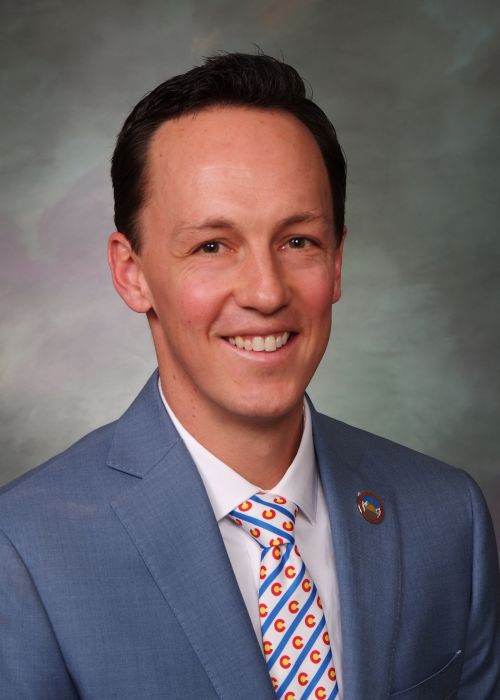
Sen. Dylan Roberts
Sponsored bills
Signals, signs, and markings - inoperable or malfunctioning signals - allowing a driver of a motorcycle to proceed past a malfunctioning traffic control signal. Under current law, when a driver approaches an intersection and faces a traffic control signal that is inoperative or that remains on steady red or steady yellow during several time cycles, the rules controlling entrance to a through street or highway from a stop street or highway apply until a police officer assumes control of traffic or until normal operation is resumed. If a traffic control signal at a place other than an intersection ceases to operate or malfunctions, drivers may proceed through the inoperative or malfunctioning signal only with caution, as if the signal were one of flashing yellow. The act states that when a motorcycle driver approaches an intersection and faces a traffic control signal that does not recognize the presence of the motorcycle, the provisions controlling entrance to a through street or highway from a stop sign or highway apply until a police officer assumes control of traffic or the traffic signal resumes normal operation. (Note: This summary applies to this bill as enacted.) Read More
Under current law, the Colorado water conservation board (board), subject to procedural requirements established to prevent injury to water rights or decreed conditional water rights, may use loaned water for instream flows if the loaned water is used for preserving the natural environment of a stream reach that is subject to a decreed instream flow water right held by the board. The bill expands the number of years within a 10-year period that a loan may be exercised from 3 years to 5 years, but for no more than 3 consecutive years, and allows a loan to be renewed for up to 2 additional 10-year periods. The bill also expands the board's ability to use loaned water for instream flows to allow loans to improve the natural environment to a reasonable degree pursuant to a decreed instream flow water right held by the board. In considering whether to accept the new type of loan authorized by the bill, the board must evaluate the proposed loan based on a biological analysis performed by the division of parks and wildlife. The board is required to promulgate rules regarding the necessary steps for reviewing and accepting such a loan. The state or division engineer's decision to approve or deny a proposed loan may be appealed to a water judge, who is required to hear the matter on an expedited basis and to review the evidence presented to the state or division engineer on a de novo basis. (Note: This summary applies to the reengrossed version of this bill as introduced in the second house.) Read More
Electricians - local inspection fees - limitations. The act repeals the prohibition against local governments and state institutions of higher education charging more than 15% more than the state charges to perform an inspection of electrical work, and instead subjects the inspection fee to a $120 cap that is adjusted annually for inflation with a potential additional 8% tiered charge based on the size or valuation of the inspected improvement. Specified provisions of the act are contingent upon House Bill 19-1172 becoming law. (Note: This summary applies to this bill as enacted.) Read More
Public hospitals - boards of trustees - membership - acquisition of real and personal property by lease. Under current law, not more than 4 of the 7 trustees of a public hospital board of trustees (hospital board) may be residents of the city or town in which the associated hospital is located. The act removes this restriction. Current law states that a hospital board may acquire real and personal property by lease only with the approval of the board of county commissioners. The act clarifies this requirement and creates an exception to it; that is, a hospital board that has designated its public hospital as an enterprise for purposes of section 20 of article X of the state constitution is not required to obtain such approval. (Note: This summary applies to this bill as enacted.) Read More
Hard rock mining - mined land reclamation board - reclamation plan - water quality treatment - financial assurance. Current law does not address reliance on perpetual water treatment as the means to minimize impacts to water quality in a reclamation plan for a mining operation. Section 1 of the act requires most reclamation plans to demonstrate, by substantial evidence, a reasonably foreseeable end date for any water quality treatment necessary to ensure compliance with applicable water quality standards. Current law allows a mining permittee to submit an audited financial statement as proof that the operator has sufficient funds to meet its reclamation liabilities in lieu of a bond or other financial assurance. Section 2 eliminates this self-bonding option and also requires that all reclamation bonds include financial assurances in an amount sufficient to protect water quality, including costs for any necessary treatment and monitoring costs. (Note: This summary applies to this bill as enacted.) Read More
Prerequisites for land acquisition - department of transportation. Previously, the law provided that when the department of transportation (CDOT) needs to acquire land in order to establish, open, relocate, widen, add mass transit to, or otherwise alter a portion of a state highway, it may only acquire the land after: The chief engineer of CDOT has provided a written report to the transportation commission that describes the project and all land to be acquired for the project, includes a map of the existing and future boundaries of the highway, and estimates the damages and benefits to each affected landowner; and The transportation commission has determined that, after providing 10 days written notice to the affected landowner of the date, time, and location of the commission meeting at which a resolution to authorize a proposed action and the filing of a petition in condemnation for land will be considered and providing the landowner with an opportunity to be heard at the meeting, the project will serve public interest or convenience and adopted a resolution authorizing the chief engineer to offer affected landowners appropriate compensation. The act authorizes CDOT, acting through the chief engineer, to acquire land in such circumstances by purchase or exchange without providing the report or obtaining transportation commission approval. If CDOT needs to acquire land in such circumstances through condemnation, it must provide the report and obtain transportation commission approval. (Note: This summary applies to this bill as enacted.) Read More

Child hearsay exception. The act amends the statutory exception to the hearsay rule to admit an out-of-court statement made by a child if certain conditions are satisfied in: Any criminal, delinquency, or civil proceeding in which the child (a person under 13 years of age) is alleged to have been a victim; or Any criminal, delinquency, or civil proceeding in which the child describes all or part of an offense of unlawful sexual behavior.(Note: This summary applies to this bill as enacted.) Read More

Pharmacists - chronic maintenance drugs - dispense without prescription. The act allows a pharmacist to dispense an emergency supply of a chronic maintenance drug to a patient without a prescription if: The pharmacist is unable to obtain authorization to refill the prescription from a health care provider; The pharmacist has a record of a prescription in the name of the patient who is requesting the emergency supply of the chronic maintenance drug, or, in the pharmacist's professional judgment, the refusal to dispense an emergency supply will endanger the health of the patient; The amount of the chronic maintenance drug dispensed does not exceed the amount of the most recent prescription or the standard quantity or unit of use package of the drug; The pharmacist has not dispensed an emergency supply of the chronic maintenance drug to the same patient in the previous 12-month period; and The prescriber of the drug has not indicated that no emergency refills are authorized. The act requires the state board of pharmacy to promulgate rules to establish standard procedures for dispensing chronic maintenance drugs. A pharmacist, the pharmacist's employer, and the original prescriber of the drug are not civilly liable for dispensing a chronic maintenance drug unless there is negligence, recklessness, or willful or wanton misconduct. Specified provisions of the act are contingent upon House Bill 19-1172 becoming law. (Note: This summary applies to this bill as enacted.) Read More
Capital development committee - appointments - chair and vice-chair elections. The act clarifies who makes the appointments of members from the senate and the house of representatives to serve on the capital development committee and clarifies that the chair and vice-chair elections are made at the first December meeting of the capital development committee held after the general election in each even-numbered year.(Note: This summary applies to this bill as enacted.) Read More