Maddy summarySenate Resolution 25-004 recognizes February 1, 2025, as World Hijab Day in Colorado. The resolution highlights the hijab's significance in Islamic tradition as a symbol of dignity and modesty, and acknowledges World Hijab Day's purpose of promoting religious tolerance and cultural understanding through public education. It does not create new laws or requirements but serves as a formal state acknowledgment of this annual observance. The resolution was unanimously passed by the Colorado Senate on January 31, 2025, without amendments.
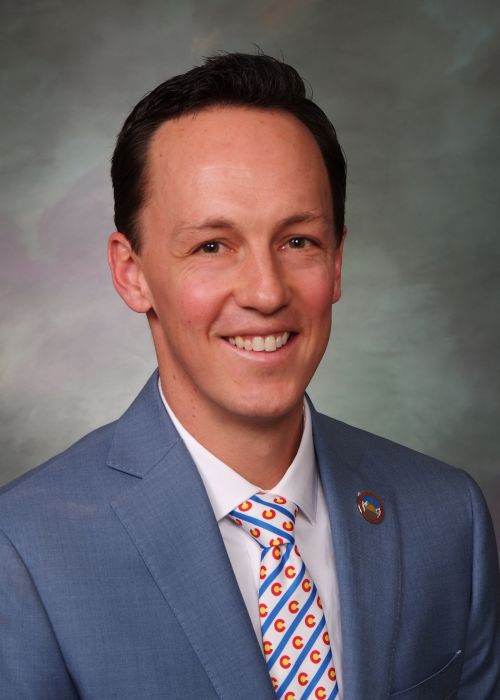
Sen. Dylan Roberts
Sponsored bills
Maddy summaryThis bill designates Monday, January 27, 2025, as "Colorado 4-H Day" to recognize the Colorado 4-H Youth Development program. It is a symbolic resolution honoring 4-H's work with youth aged 5-19, including its role in community engagement, leadership development, and STEM education through Colorado State University Extension. The resolution has no legal effect or new requirements - it simply encourages public acknowledgment of the program. (HJR 25-1006, passed by both chambers on January 27-30, 2025)
Maddy summaryThis bill (HJR 25-1007) is a commemorative resolution designating a specific segment of Interstate 25 in Colorado - southbound from mile marker 199.4 and northbound from mile marker 194.8 - as the "Firefighters Memorial Hwy in Memory of Chief Troy Jackson." It honors Troy Jackson, a 30-year firefighter with South Metro Fire Rescue who developed cancer prevention programs for first responders before passing in 2019. The resolution allows the Colorado Department of Transportation to accept donations for signage and coordinate with Arapahoe and Douglas counties for sign maintenance. As a naming resolution, it has no policy or funding changes beyond this memorial designation.
Water Resources and Agriculture Review Committee. The bill broadens the definition of "ranch" for purposes of property taxation to include a parcel of land used for grazing or raising livestock for the primary purpose of obtaining a monetary profit rather than a parcel of land used only for grazing livestock for the primary purpose of obtaining a monetary profit. The bill also eliminates the limited definition of "livestock" included in the definition of "ranch" and replaces it with the general definition of "livestock" used for property tax purposes that includes all animals.(Note: This summary applies to this bill as introduced.)
Maddy summarySJR 25-004 designates January 22 of each year as "Reproductive Rights and Justice Day" in Colorado. This symbolic resolution does not create new laws or policies but commemorates the anniversary of the Roe v. Wade decision (January 22, 1973) and acknowledges Colorado's legislative actions to protect reproductive rights, including the Reproductive Health Equity Act and the Safe Access to Protected Health Care Package. The designation serves as a formal observance without imposing legal obligations or altering existing rights.
Maddy summaryHJR 25-1005 is a ceremonial resolution encouraging Colorado communities to observe Martin Luther King Jr. Day on January 20, 2025 - the 41st anniversary of the state holiday. It does not create new laws or alter existing policies but urges cities, schools, counties, and local governments to hold commemorative events. The resolution honors Dr. King’s legacy, noting Colorado’s early adoption of the holiday in 1985 and its ongoing observance through events like the annual Marade. This is a non-binding call for community engagement, not a substantive legislative change.
The act requires a testing entity to grant an individual's request for a testing accommodation on a licensing exam without requiring the individual to undergo a diagnostic exam or psychological assessment if the individual has a recognized disability, provides proof of having received the testing accommodation on a past standardized exam or high-stakes test, provides a recommendation letter from the individual's treating medical professional supporting the requested accommodations, and requests the same testing accommodation that the individual previously received on a similar standardized exam or high-stakes test. The act allows an individual who is adversely affected or aggrieved by a testing entity's decision regarding the individual's request for a testing accommodation to bring a civil action against the testing entity. The act allows the attorney general to investigate violations of, and allows the attorney general to bring a civil action against, a testing entity for an alleged violation. APPROVED by Governor June 7, 2024 EFFECTIVE January 1, 2025(Note: This summary applies to this bill as enacted.)

The act requires telecommunications providers that operate in Colorado to remove, discontinue, or replace all critical telecommunications infrastructure that utilizes equipment from a federally banned entity. The act requires telecommunications providers to register with the division of homeland security and emergency management (division) within the department of public safety on or before January 15, 2025, and annually certify thereafter that the telecommunications provider is: Not operating critical telecommunications infrastructure that utilizes equipment from a federally banned entity; or Participating in the federal reimbursement program established by the federal "Secure and Trusted Communications Networks Act of 2019" and is in compliance with the reimbursement program. The act requires a telecommunications provider that operates critical telecommunications infrastructure that utilizes federally banned equipment to register with the division each year until all of the federally banned equipment has been removed or replaced. The act creates the secure telecommunications cash fund for the collection of registration fees that will be used to implement the program. The act also grants the director of the division rule-making authority to implement the requirements of the act. APPROVED by Governor June 7, 2024 EFFECTIVE June 7, 2024(Note: This summary applies to this bill as enacted.)

Currently, critical access hospitals must be licensed as general hospitals under state law. The act: Authorizes the department of public health and environment (department) to license critical access hospitals separately from general hospitals; On and after July 1, 2026, prohibits a person from operating a critical access hospital without a critical access hospital license; and Requires the state board of health to promulgate rules concerning the licensure of critical access hospitals. The act appropriates $45,722 from the general fund to the department for administration and operations management. From that appropriation, $12,285 is reappropriated to the office of the governor for use by the office of information technology to provide services to the department. APPROVED by Governor June 6, 2024 PORTIONS EFFECTIVE August 7, 2024 PORTIONS EFFECTIVE July 1, 2026(Note: This summary applies to this bill as enacted.)
The act authorizes the department of higher education to enter into a limited purpose fee-for-service contract with the board of regents of the university of Colorado for allocation to programs or institutions of higher education to expand an existing rural track program. If an allocation is made to a program or institution to expand an existing rural track program, the department of higher education shall utilize a formula developed and revised annually by the rural program office, in collaboration with the institutions, that is based on data that documents the program's or institution's fulfillment of certain requirements. The act requires the rural program office to submit a report to the general assembly each year that includes the allocation formula developed by the rural program office. The act creates the rural hospital cash fund and on July 1, 2024, requires the state treasurer to transfer $1,742,029 from the general fund to the rural hospital cash fund for the purpose of distributing money in equal amounts to rural hospitals. For the 2024-25 state fiscal year, the act appropriates $866,667 from the general fund to the department of higher education for the college opportunity fund program to be used for limited purpose fee-for-service contracts with institutions of higher education. APPROVED by Governor June 6, 2024 EFFECTIVE June 6, 2024(Note: This summary applies to this bill as enacted.)