

The act establishes a first and preferred opportunity for available employment for coal transition workers in coal transition communities (hiring preference). A business entity located in a coal transition community that is engaged in the business of constructing or operating railroads, utilities, energy generation facilities, or advanced manufacturing facilities (covered business) is required to comply with the hiring preference. A covered business does not include the state government or a local government. A covered business is required to make good faith efforts to provide a hiring preference to a coal transition worker who meets the qualifications for an employment position (qualified coal transition worker). A covered business may hire an individual who is not a qualified coal transition worker only if a qualified coal transition worker did not apply for employment with the covered business, each qualified coal transition worker declined a job offer from a covered business, or a qualified coal transition worker's qualifications did not meet the qualifications of other candidates for the same job. If a qualified coal transition worker applies for employment with a covered business, the covered business is required to report specified information annually to the just transition office. The executive director is required to adopt policies and procedures to implement the act. A hiring preference does not apply if a covered business places an existing employee in another employment position with the covered business or to the extent that a hiring preference conflicts with the terms of a collective bargaining agreement that applies to the relationship between a covered business and its employees. Currently, a public entity is not allowed to invest public funds in certain types of investments, such as equity instruments, instruments convertible to equity, or equity interests, or to deposit public funds with any person except certain depository institutions, which are primarily banks. The act authorizes a public entity to deposit or invest, either directly or through an investment firm or other third party authorized by the public entity, public funds from a payment or settlement that the public entity has received to offset the socioeconomic impacts to a community or government from the closure of a coal mine or coal power generating station in any investment permitted by an investment policy approved by the public entity.(Note: This summary applies to this bill as enacted.)
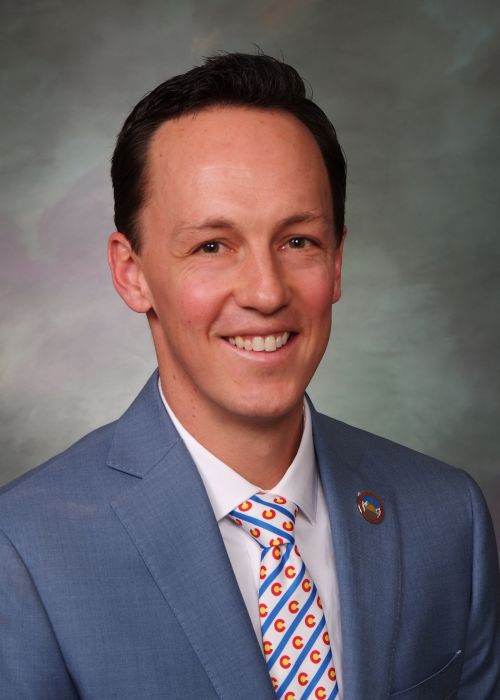
Sen. Dylan Roberts
Sponsored bills
Maddy summarySJR 4 designates September 20-26, 2026, as "Frontotemporal Degeneration (FTD) Awareness Week" in Colorado. This symbolic resolution recognizes FTD - a terminal, incurable neurodegenerative disease affecting speech, behavior, and motor skills - and aims to increase public awareness of the condition. It directly supports Coloradans living with FTD, their families, and advocacy groups like the Association for Frontotemporal Degeneration, which focuses on research and care. The bill has no funding or regulatory provisions, as it is purely a recognition measure.
Maddy summaryThis Senate Resolution (SR 3) designates March as "Arts Education Month" in Colorado. It does not create new laws or funding but symbolically recognizes the importance of arts education (including dance, music, theater, and visual arts) for students' development and academic success. The resolution aligns Colorado with national observances in March and acknowledges the state's lack of data on arts education access and the need to expand equitable opportunities. It is a non-binding recognition, sent to the Governor and State Board of Education, with no direct policy changes or requirements for schools.
Maddy summaryHJR 1018 designates the 61-mile stretch of State Highway 86 through Elbert County, Colorado, as the "Plains-to-Pines Scenic Corridor." The resolution authorizes the Colorado Department of Transportation (CDOT) to accept donations for signage, markers, and landscaping to promote this scenic route connecting the eastern plains to the Rocky Mountain foothills. It specifically enables CDOT to collaborate with Elbert County and the towns of Kiowa and Elizabeth for maintenance of these promotional elements. This is a commemorative designation without new regulatory requirements, focusing on tourism and regional identity.
Maddy summarySJR 14 is a symbolic resolution declaring February 28, 2026, as "Rare Disease Day" in Colorado. It recognizes over 500,000 Coloradans living with rare diseases - conditions affecting fewer than 200,000 people - and highlights challenges like limited treatments and high costs. The resolution encourages public awareness through events (like lighting Denver's City and County Building) and acknowledges the resilience of affected individuals. It does not create new laws, funding, or services, but formally supports the rare disease community through recognition.
Maddy summaryHJR 1019 designates February 20, 2026, as Caregiving Youth Day in Colorado, with an official observance on February 27, 2026. The resolution recognizes children and adolescents under 18 who provide care for family members with health needs (such as chronic illness, disability, or aging-related care) and encourages schools, healthcare providers, and community organizations to identify these young caregivers and offer appropriate support. It does not create new laws or funding but aims to increase awareness of this underserved population.
Maddy summarySJR 13 is a symbolic resolution recognizing February 26, 2026, as "Youth Mental Health Action Day" in Colorado. It does not create new laws or allocate funding but formally honors pediatric health-care providers working to support youth mental health. The resolution cites Colorado's high rates of youth mental health challenges (including suicide being a leading cause of death for children under 18) and emphasizes collaboration with providers, agencies, and communities. It commits the General Assembly to "promoting child and youth well-being" through existing mental health system efforts. This is a non-binding recognition, not a policy change.
Maddy summaryThis is a commemorative resolution, not a bill with policy changes. It designates February 20, 2026, as "Colorado FFA Day" to honor the Colorado Future Farmers of America (FFA) program. The resolution recognizes FFA's role in developing student leadership, career skills, and agricultural education across Colorado. It directly celebrates FFA members, educators, and supporters but does not create new laws or affect any legal obligations. The resolution was introduced in both chambers of the Colorado legislature in February 2026.
Maddy summarySJR 10 is a symbolic resolution celebrating Lunar New Year 2026 in Colorado, not a new law. It formally recognizes the cultural significance of Lunar New Year and honors Asian American contributions to the state, building on Colorado’s existing 2024 observed holiday (established by HB 23-1271). The resolution urges Coloradans to attend community events and acknowledges the holiday’s historical roots and global celebration by over two billion people. It has no direct policy impact or legal effect, as it serves purely ceremonial and commemorative purposes.
Maddy summarySJR 9 is a procedural resolution that officially designates February 4 of each year as "Missing Persons Day" in Colorado. It raises public awareness about the issue of missing persons, acknowledges the emotional and practical challenges faced by families, and supports existing efforts to locate missing individuals. The resolution does not create new laws or programs but encourages community engagement and highlights Colorado's commitment to addressing this issue. It directly affects all Coloradans, particularly families of missing persons, by providing a designated day for advocacy and support.