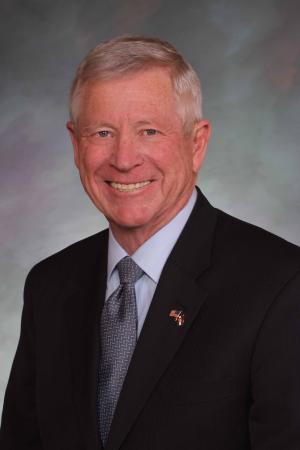
Photo of Bob Rankin
R Colorado Senate · District 5

Sen. Bob Rankin

Contact Email
Compare
Total votes
4,487
all sessions
Attendance
99%
57 missed
Among the lowest in the chamber
With party
88%
of cast votes
Bipartisan score
7%
crosses aisle rarely
Sponsored
196
bills & resolutions
Lower than 99% of chamber peers
Committees
0
assignments
196 bills and resolutions

Sponsored bills

Total
196
Primary
196
Co-sponsor
0
This page
196
matching current filters
Primary SB 21-209
Signed into law · Colorado Senate · Lead sponsor
Transfer To General Fund From Repealed Cash Funds

The economic gardening pilot project, which was administered by the office of economic development and international trade, was created in 2013 and repealed on July 1, 2017. At the time of the repeal, there was money remaining in the related economic gardening pilot project fund. Additionally, the public school energy efficiency fund was created in 2007 and repealed on July 1, 2017. At the time of the repeal, there was money remaining in the fund.On July 1, 2021, the act requires the state treasurer to transfer to the general fund the money from the repealed cash funds and any related interest and income.(Note: This summary applies to this bill as enacted.)

Signed into law Apr 30, 2021 0 co-sponsors
Primary SB 21-220
Signed into law · Colorado Senate · Lead sponsor
Reverse Transfers From Severance Tax Operational Fund

To avoid a fund deficit in the severance tax operational fund, the act reverses 5 transfers made from the fund to other cash funds after the fiscal year 2019-20. Specifically, the state treasurer is required to transfer the following amounts to the fund:$1,998,205 from the species conservation trust fund; $1,600,964 from the parks and wildlife aquatic nuisance species fund; $219,803 from the water efficiency grant program cash fund; $297,759 from the interbasin compact committee operation fund; and $3,996,410 from the water supply reserve fund.(Note: This summary applies to this bill as enacted.)

Signed into law Apr 30, 2021 0 co-sponsors
Primary SB 21-207
Signed into law · Colorado Senate · Lead sponsor
Public School Capital Construction Assistance Fund Transfer

On June 1, 2022, the state treasurer is required to transfer $100 million from the marijuana tax cash fund to the public school capital construction assistance fund (BEST fund).(Note: This summary applies to this bill as enacted.)

Signed into law Apr 30, 2021 0 co-sponsors
Primary SB 21-227
Signed into law · Colorado Senate · Lead sponsor
State Emergency Reserve

Under the Taxpayer's Bill of Rights and the implementing legislation, the state is required to maintain an emergency reserve to be used for declared emergencies (state emergency reserve). The state may use the state emergency reserve for declared emergencies only.The act designates the cash and capital asset that constitute the state emergency reserve for the 2021-22 fiscal year. It also creates the state emergency reserve cash fund (fund) to be some or all of the state emergency reserve. On June 30, 2021, the state treasurer is required to transfer $101 million from the general fund and $100 million from the controlled maintenance trust fund to the fund. If money from any fund that is designated as part of the state emergency reserve is expended for a declared emergency and the state subsequently receives reimbursement for the expenditure, then the bill requires the state treasurer to deposit the reimbursement into the fund that was the source for the expenditure.(Note: This summary applies to this bill as enacted.)

Signed into law Apr 29, 2021 0 co-sponsors
Primary SB 21-225
Signed into law · Colorado Senate · Lead sponsor
Repay Cash Funds For 2020 Transfers

In 2020, the general assembly enacted legislation to require the state treasurer to transfer money from the small communities water and wastewater grant fund and off-highway vehicle recreation fund to the general fund to offset the general fund revenue reduction related to the COVID-19 public health emergency.The act requires the state treasurer to repay those cash funds by transferring the following amounts from the general fund:$5 million to the small communities water and wastewater grant fund; and $5 million to the off-highway vehicle recreation fund.(Note: This summary applies to this bill as enacted.)

Signed into law Apr 29, 2021 0 co-sponsors
Primary SB 21-218
Signed into law · Colorado Senate · Lead sponsor
Colorado Department Of Labor And Employment Employment And Training Technology Fund

Under current law, revenue from an assessment on employers' unemployment insurance premiums, not to exceed $10 million per year and not to exceed cumulative revenue of $100 million, is allocated to the employment and training technology fund (technology fund) in the division of unemployment insurance (division) in the department of labor and employment to fund employment and training automation initiatives established by the director of the division. Any amount of revenues from the assessment that exceeds the $10 million annual cap or the $100 million cumulative revenue cap is allocated to the unemployment compensation fund. Additionally, if the balance in the unemployment compensation fund falls below $100 million, the balance in the technology fund is allocated to the unemployment compensation fund.The act:Eliminates the allocation of the technology fund balance to the unemployment compensation fund when the unemployment compensation fund balance falls below $100 million; Eliminates the $10 million cap on annual allocations to the technology fund and adds a new $7 million annual cap starting July 1, 2023; Adds a cap of $31 million on cumulative revenue to the technology fund until June 30, 2023; Transfers any amounts credited to and remaining in the technology fund between July 1, 2020, and the effective date of the act to the unemployment compensation fund; and Repeals the assessment for the technology fund on June 30, 2031.(Note: This summary applies to this bill as enacted.)

Signed into law Apr 27, 2021 0 co-sponsors
Primary HB 21-1210
In committee · Colorado House · Lead sponsor
Modifications To Qualified State Tuition Programs

The federal "Tax Cuts and Jobs Act", which became law in December 2017, added distributions for elementary or secondary tuition expenses as qualified distributions from a qualified state tuition program (529 account), thereby allowing, on the federal level, income tax-free distributions for elementary and secondary tuition expenses in addition to already authorized income tax-free distributions for higher education expenses. Similarly, the federal "Setting Every Community Up for Retirement Enhancement Act of 2019", which became law in December 2019, expands the qualified distributions from a 529 account to include repayment of qualified education loans and payments for registered apprenticeships. The bill creates the foundational learning experience savings program (FLEX savings program). The bill also specifies that distributions from FLEX savings program accounts are not counted as federal or state taxable income and that contributions to FLEX savings program accounts for qualified elementary or secondary tuition expenses may not be deducted from state taxable income. The accounts created under the FLEX savings program are defined by the following characteristics: Account owners may only use distributions from the accounts for qualified elementary or secondary tuition expenses; Anyone may contribute to the account, irrespective of their relationship to the account's designated beneficiary; An account owner may transfer money to the FLEX savings program accounts from a 529 account, if the total of all amounts transferred does not exceed $10,000 and is less than or equal to the lowest balance in the 529 account at any point during the previous 2 years; and Money in the account can be transferred to a different 529 account. The bill also allows for expenses for fees, books, supplies, and equipment required for the participation of a designated beneficiary in certain apprenticeship programs to be treated as "qualified higher education expenses" and subtracted from federal taxable income. The bill clarifies that "qualified higher education expenses" does not include repayment of qualified education loans. (Note: This summary applies to this bill as introduced.)

In committee Apr 7, 2021 0 co-sponsors
Primary SB 21-024
Signed into law · Colorado Senate · Lead sponsor
Welcome Home Vietnam Veterans Day

The act designates March 30 as "Welcome Home Vietnam Veterans Day", a commemorative state holiday, and allows for appropriate observance by the public and in all public schools in tribute to the service and sacrifice of Vietnam veterans.(Note: This summary applies to this bill as enacted.)

Signed into law Mar 30, 2021 0 co-sponsors
Primary SB 21-163
In committee · Colorado Senate · Lead sponsor
Cost-benefit Analysis For Rules Additional Requirements

Under current law, any person may ask the executive director of the department of regulatory agencies or the executive director's designee (executive director) to require a rule-making agency to conduct a cost-benefit analysis of a draft rule or draft amendment to a rule (proposed rule) for which the agency has filed a notice of proposed rule-making (notice). The bill extends the time period for which such request may be made from up to 5 days after the notice has been filed to up to 15 days before the scheduled rule-making hearing or, if the rule-making hearing is scheduled only 20 days after the notice was filed, up to 10 days after the notice was filed. The agency is required to complete the cost-benefit analysis at least 5 days before the scheduled rule-making hearing. The bill also specifies the following regarding a cost-benefit analysis: If the executive director determines that the proposed rule would likely have materially disparate effects on different regions of the state, the agency must include in the cost-benefit analysis a determination of the anticipated benefits, costs, and adverse effects of the proposed rule on different regions of the state; If the executive director determines that the proposed rule would have a negative economic or noneconomic impact, the executive director shall inform the public by either making a public presentation about the negative impact and any counterbalancing positive impact at the rule-making hearing or publishing a written report summarizing the impacts; The executive director, upon request of any party to the rule-making or member of the general assembly or upon the executive director's own motion, may require an agency to update a cost-benefit analysis to reflect material changes made to the proposed or adopted rule either before, during, or after the rule-making hearing; A member of the general assembly, no earlier than one year after a rule has been adopted, may request that the adopting agency conduct a cost-benefit analysis regarding the rule's implementation; and The public utilities commission, the department of natural resources, or the department of public health and environment, with regard to any cost-benefit analysis conducted by that agency, shall present the cost-benefit analysis at the rule-making hearing and allow public testimony at the hearing regarding the cost-benefit analysis. (Note: This summary applies to this bill as introduced.)


In committee Mar 24, 2021 0 co-sponsors
Primary SB 21-113
Signed into law · Colorado Senate · Lead sponsor
Firefighting Aircraft Wildfire Mgmt And Response

The act directs the state treasurer to transfer $30,800,000 from the general fund to the Colorado firefighting air corps fund to support the following purposes:The purchase by the division of fire prevention and control (division) in the department of public safety of a fire hawk helicopter (helicopter) configured for wildfire mitigation; and The leasing by the division of a type 1 helicopter or other available and appropriate aviation resource configured for wildfire mitigation in advance of the 2021 wildfire season and for the operational costs associated with the leased and purchased aviation resources. In addition to any other purpose for the use of money in the wildfire emergency preparedness fund (WEPF), the act permits the division of fire prevention and control in the department of public safety to use money in the WEPF to provide wildfire suppression assistance to county sheriffs, municipal fire departments, or fire protection districts throughout the state at no cost to such entities pursuant to annual guidelines published by the division in the wildfire preparedness plan.(Note: This summary applies to this bill as enacted.)

Signed into law Mar 21, 2021 0 co-sponsors
Showing 81 to 90 of 196 bills
Previous 1 … 8 9 10 … 20 Next