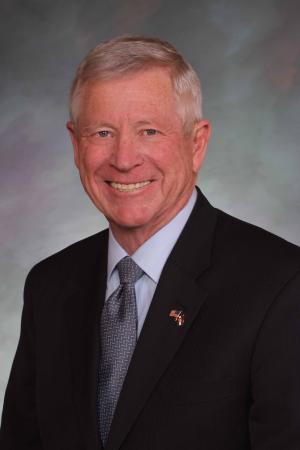
Photo of Bob Rankin
R Colorado Senate · District 5

Sen. Bob Rankin

Contact Email
Compare
Total votes
4,487
all sessions
Attendance
82%
918 missed
Lower than 100% of chamber peers
With party
89%
of cast votes
Lower than 100% of chamber peers
Bipartisan score
7%
crosses aisle rarely
Lower than 100% of chamber peers
Sponsored
196
bills & resolutions
Lower than 100% of chamber peers
Committees
0
assignments
196 bills and resolutions

Sponsored bills

Total
196
Primary
196
Co-sponsor
0
This page
196
matching current filters
Primary HB 21-1257
Signed into law · Colorado House · Lead sponsor
Recognition Of Veterans In Capitol Complex Parks

On and after May 31, 2021, the act changes the name of Lincoln park and Liberty park in the capitol complex to "Lincoln veterans' memorial park".The act makes an appropriation.(Note: This summary applies to this bill as enacted.)

Signed into law Jun 23, 2021 0 co-sponsors
Primary SB 21-166
Signed into law · Colorado Senate · Lead sponsor
Colorado Fire Commission Recommendations

The act implements recommendations of the 2020 Colorado Fire Commission Annual Report.The act updates 3 mutual aid statutes affecting the responsibilities of requesting and assisting fire control. Under current statutory provisions, all resources from an agency assisting in fire prevention are under the control of the requesting agency and liability is placed with the requesting agency. Under the changes made by the act, the assisting agency, working under the direction of the incident commander, retains operational control of its resources and, therefore, retains liability for the actions of its crews. The act incorporates the term "emergency responder" to categorize the different agencies assisting in fire prevention.The regional and statewide mutual aid system (RSMAS) is a regional and statewide system that provides for the coordinated initial response of emergency responders to emergency incidents. The act establishes the RSMAS to be administered by the division of fire prevention and control (division) in the department of public safety.The director of the division is required to establish, implement, and maintain the RSMAS. Among the duties of the director in administering the RSMAS is implementing the Colorado coordinated regional mutual aid system (CCRMAS). The CCRMAS establishes geographic areas within the state to be known as division of fire prevention and control (DFPC) districts. Each DFPC district has a regional mutual aid coordinator, whose duties include ensuring that a competent mutual aid plan exists in each DFPC district and who serves as the point of contact within the DFPC district and coordinates mutual aid requests for fire and EMS resources. The act specifies the duties of each regional mutual aid coordinator and of the director of the division with respect to administration of the RSMAS and CCRMAS overall.Unless an emergency responder has opted out of the RSMAS and CCRMAS, all emergency responders are part of the RSMAS and CCRMAS. An emergency responder is relieved from any duty to make its equipment and personnel available to the RSMAS and CCRMAS under circumstances specified in the act. An emergency responder that opts out of the RSMAS and CCRMAS is only eligible for reimbursement to the extent authorized in the rules promulgated by the director of the division.The RSMAS and CCRMAS do not affect any other mutual aid agreement that may be entered into by one or more emergency responders.The act mandates consultation between the director of the office of emergency management (OEM) and the director of the division of fire prevention and control with respect to the CCRMAS. The act requires the director of the OEM to ensure that resources in the CCRMAS are included in the all-hazards resource mobilization system. The director of the OEM is also required to coordinate with the state coordination center to ensure sufficient and effective implementation and integration of the state resources mobilization plan and state and local emergency operations plans.At the end of any state fiscal year commencing with the 2022 state fiscal year, the act requires the state treasurer to transfer any money in the aviation resources line of the annual general appropriation act for that same state fiscal year that would otherwise revert to the general fund into the wildfire preparedness fund (WPF). Money transferred by the state treasurer into the WPF must be used for the purpose of traditional mitigation efforts. As long as money transferred into the WPF is being expended for one of the purposes specified in the act, the division may allocate the money to any such purpose as will maximize the impact of such funding as the division may determine in its sole discretion.Not less than once every 3 years commencing January 15, 2025, the division is required to report to the joint budget committee concerning its expenditures from the transfers made into the WPF under the act.The act appropriates $1,108,800 from the general fund to the department of public safety for the 2021-22 state fiscal year for its implementation.(Note: This summary applies to this bill as enacted.)

Signed into law Jun 22, 2021 0 co-sponsors
Primary SB 21-292
Signed into law · Colorado Senate · Lead sponsor
Federal COVID Funding For Victim's Services

The federal government enacted the "American Rescue Plan Act of 2021" (federal act) to provide support to state, local, and tribal governments in responding to the impact of the COVID-19 public health emergency and to assist them in their efforts to contain the effects of the COVID-19 public health emergency on their communities, residents, and businesses.As part of the federal act, the state will receive $3,828,761,790 from the federal coronavirus state fiscal recovery fund to be used for specific purposes identified in the federal act. This act allocates a total of $15 million to be appropriated for victim's services programs and purposes related to populations that have been disproportionately negatively affected by the COVID-19 public health emergency, including those affected by domestic violence, sexual assault, and violence generally. The money will be appropriated from the economic recovery and relief cash fund using money from the federal coronavirus state fiscal recovery fund. All money appropriated through this act must conform with the eligible uses set forth in the federal act.This act appropriates money to the following entities:The forensic nurse examiner telehealth program; The state and local victims and witnesses assistance and law enforcement funds; The state crime victims compensation program; The address confidentiality program fund; and The Colorado domestic abuse program fund for the funding of domestic violence programs. For the 2021-22 state fiscal year, the act appropriates from the economic recovery and relief cash fund and of money the state receives from the federal coronavirus state fiscal recovery fund:$3,000,000 to the department of public safety for use by the division of criminal justice. for the forensic nurse examiners telehealth program; $1,500,000 to the department of public safety for use by the division of criminal justice for the state victim compensation program; $3,000,000 to the victims and witnesses assistance and law enforcement fund. The judicial department is responsible for the accounting related to this appropriation; $1,500,000 to the victims assistance and law enforcement fund. The department of public safety is responsible for the accounting related to this appropriation. $500,000 to the address confidentiality program fund. The department of personnel is responsible for the accounting related to this appropriation. $4,750,000 to the Colorado domestic abuse program fund. The department of human services is responsible for the accounting related to this appropriation. $750,000 to the judicial department for use by courts administration for family violence justice grants. The act also appropriates, from reappropriated funds in the victims assistance and law enforcement fund, $1,500,000 to the department of public safety for use by the division of criminal justice for the state victims assistance and law enforcement program. The act also appropriates, from reappropriated funds in the Colorado domestic abuse program fund, $4,750,000 to the department of human services for use by the office of self sufficiency for the domestic abuse program.(Note: This summary applies to this bill as enacted.)


Signed into law Jun 22, 2021 0 co-sponsors
Primary SB 21-151
Signed into law · Colorado Senate · Lead sponsor
Literacy Curriculum Transparency

The act amends the "Colorado READ Act" to require each local education provider to submit the following information to the department of education (department) and to require the department to post the information on its website:The core and supplemental reading curriculum, or a detailed description of the reading curriculum, by grade, used in each of the local education provider's schools; The core and supplemental reading instructional programs and intervention reading instruction, services, and other supports provided in each of the local education provider's schools; The number of students enrolled in kindergarten and first through third grades who have READ plans, as well as the number of students who have achieved reading competency; and The local education provider's budget and narrative explanation for the use of the "Colorado READ Act" intervention money. Each local education provider must provide a link on its website and on its schools' websites to the page on the department's website where the information is posted.For the 2021-22 budget year, $91,944 is appropriated from the early literacy fund to the department for the costs of implementing the act.(Note: This summary applies to this bill as enacted.)
Signed into law Jun 18, 2021 0 co-sponsors
Primary SB 21-265
Signed into law · Colorado Senate · Lead sponsor
Transfer From General Fund To State Highway Fund

On July 1, 2021, the state treasurer is required to transfer $124 million from the general fund to the state highway fund.(Note: This summary applies to this bill as enacted.)

Signed into law Jun 18, 2021 0 co-sponsors
Primary SB 21-281
Signed into law · Colorado Senate · Lead sponsor
State Severance Tax Trust Fund Allocation

Currently, 50% of state severance tax revenues are deposited into the severance tax trust fund, which is then typically split between the severance tax perpetual base fund (perpetual base fund) and the severance tax operational fund (operational fund). Money in the operational fund is currently used for core departmental programs and, if there are sufficient available revenues, for transfers to funds that support natural resources and energy grant programs (grant program transfers). The act repeals the grant program transfers, with some, but not all, of the recipient programs receiving alternative funding from severance tax revenues.Subject to annual appropriation, the Colorado water conservation board is authorized to direct the state treasurer to transfer money from the perpetual base fund to the water supply reserve fund, the interbasin compact committee operation fund, and the water efficiency grant program cash fund, all of which previously received grant program transfers. The general assembly is authorized to directly appropriate or transfer money into the perpetual base fund and the water supply reserve fund.If less than 100% of the money available in the operational fund is used for the current core departmental programs, then, the general assembly may appropriate money from the operational fund to the species conservation trust fund, the division of parks and wildlife aquatic nuisance species fund, and the conservation district grant fund, all of which previously received grant program transfers. The transfers from the operational fund are subject to the same limits that they had as grant program transfers. On June 30, 2021, and July 1, 2022, the state treasurer is required to transfer $9,456,005 from the general fund to the operational fund. The director of the office of state planning and budgeting and the executive directors of the departments of revenue, natural resources, education, and local affairs, or their designees, are required to review and analyze various elements of the state severance tax and submit written recommendations for any changes to the joint budget committee. Stakeholders will be involved in the process and may submit responsive comments to the recommendations.The act also requires metropolitan districts created after July 1, 2021, to annually pay the state an amount equal to the total of all severance tax ad valorem credits claimed for property taxes that are imposed by the metropolitan district. This money will be allocated like severance tax revenues.(Note: This summary applies to this bill as enacted.)

Signed into law Jun 18, 2021 0 co-sponsors
Primary SB 21-185
Signed into law · Colorado Senate · Lead sponsor
Supporting Educator Workforce In Colorado

Current law limits the content areas in which a person who holds an adjunct instructor authorization may teach. The act allows a school district or charter school to employ a person who holds an adjunct instructor authorization to teach in all content areas in order to address recruiting challenges and establish a diverse workforce.The act requires the department of education (department) to direct resources to publicize existing teacher preparation programs to facilitate entry into the teaching profession. The act also requires the department to provide technical support to school districts, boards of cooperative services, and charter schools to assist them in accessing the existing programs and in recruiting individuals to pursue teaching careers.The act requires the department of higher education, in collaboration with the department of education, the state board for community colleges and occupational education, and the deans of the schools of education and academic administrators in Colorado institutions of higher education, or their designees, to design a teaching career pathway for individuals to enter the teaching profession. The act outlines the components of the teaching career pathway program.The act creates the teacher recruitment education and preparation program (TREP program) in the department. Two of the main objectives of the TREP program are to increase the number of students entering the teaching profession and to create a more diverse teacher workforce to reflect the ethnic diversity of the state. A qualified TREP program participant may concurrently enroll in postsecondary courses in the 2 years directly following the year in which the participant was enrolled in the twelfth grade of a local education provider. The act outlines the selection criteria and requirements for the TREP program.The act creates the educator recruitment and retention program (ERR program) in the department to provide support to members of the armed forces, nonmilitary-affiliated educator candidates, and local education providers to recruit, select, train, and retain highly qualified educators across the state. The state board of education shall promulgate rules to implement the ERR program. The act outlines the eligibility criteria and program services.The act adds criteria for the commission on higher education to select eligible applicants for the educator loan forgiveness program.The act requires the university of Colorado health and sciences center to establish and operate an educator well-being and mental health program to provide support services for educators serving students in Colorado's public elementary and secondary schools.For the 2021-22 state fiscal year, $9,132,856 is appropriated from the general fund to the department of education to implement the act. For the 2021-22 state fiscal year, $942,542 is appropriated from the general fund to the department of higher education to implement the act. For the 2021-22 state fiscal year, $2,500,000 is appropriated from the general fund to the educator loan forgiveness fund. The department of higher education is responsible for the accounting related to the appropriation for the educator loan forgiveness fund.(Note: This summary applies to this bill as enacted.)

Signed into law Jun 16, 2021 0 co-sponsors
Primary HB 21-1234
Signed into law · Colorado House · Lead sponsor
Supplemental Education High-impact Tutoring Programs

The act creates the Colorado high-impact tutoring program (program) to provide grant funding to local education providers, as defined in the act to include school districts and charter schools and others, to create high-impact tutoring programs (tutoring programs) to address student learning loss and unfinished learning due to the presence of the COVID-19 pandemic in Colorado.A local education provider or group of providers may apply to the department of education (department) for a grant. To receive a grant, a local education provider shall apply to the department and shall demonstrate need, as determined by the department, which may include serving low-income or underserved students. The application must also include the local education provider's plan for its tutoring program (program plan), which must include the elements of a tutoring program and must detail how the local education provider will implement the program plan. The department shall review grant applications, and the commissioner of education (commissioner) shall award grants. In awarding grants, the commissioner shall consider the alignment of the local education provider's program plan with the requirements of the tutoring program, the number of students projected to be served, the needs of a rural local education provider for financial or technical support to implement a tutoring program, the cost of implementing the local education provider's tutoring program, the amount of available money for program grants, and any other criteria determined by the commissioner. The state board of education may promulgate rules necessary to implement the program.Each year in which a grant is awarded, the act requires a local education provider receiving a grant to report to the department information concerning the implementation of the tutoring program, including student outcomes. The department shall also report annually to the education committees of the general assembly summarizing local education providers' tutoring programs and student outcomes. The department is not required to implement the program if there is insufficient money to award program grants. The act is repealed July 1, 2026.The act appropriates $4,981,720 and 1.1 FTE to the department of education to implement the act.(Note: This summary applies to this bill as enacted.)

Signed into law Jun 16, 2021 0 co-sponsors
Primary SB 21-204
Signed into law · Colorado Senate · Lead sponsor
Rural Economic Development Initiative Grant Program Funding

The act appropriates $5 million to the department of local affairs (department) to use for the rural economic development initiative (REDI) grant program, and permits the department to use up to 3.75% of the appropriation for any direct and indirect administrative expenses related to the grants awarded from the appropriation.If the department determines that a rural community needs resources or assistance because it has been impacted by a significant economic event or an anticipated event that has been announced, the department may use all or a portion of the money appropriated for the REDI grant program for the purposes of the "Rural Economic Advancement of Colorado Towns (REACT) Act". The act repeals the sunset of the REACT Act.(Note: This summary applies to this bill as enacted.)

Signed into law Jun 15, 2021 0 co-sponsors
Primary SB 21-258
Signed into law · Colorado Senate · Lead sponsor
Wildfire Risk Mitigation

The act allows the forest service to issue forest restoration and wildfire risk mitigation grants for projects on federal lands, so long as the project maintains continuity across a landscape including federal lands and the area of federal lands does not exceed the combined area of the nonfederal lands involved in the project.The act increases the amount that the forest service may use for the direct and indirect costs in administering the forest restoration and wildfire risk mitigation grant program from 3% to 7% of any amounts appropriated in any fiscal year.The act allows for the technical advisory panel that evaluates the proposals for forest restoration and wildfire risk mitigation grants to scale up and down in size.The act expands the allowable uses of the forest restoration and wildfire risk mitigation grant program by allowing the grant program to fund capacity-building efforts to provide local governments, community groups, and collaborative forestry groups with the resources and staffing necessary to plan and implement forest restoration and wildfire risk mitigation projects, including community and partner outreach and engagement, identifying priority project areas, prescription planning, and acquiring community equipment for use by landowners.The act allows for the forest service to hire nontemporary additional field capacity to support the implementation and monitoring of fuels mitigation grant awards and wildfire risk mitigation program grant awards and to hire full-time, nontemporary staff for developing, revising, and implementing community wildfire protection plans and collaborative landscape level prioritization plans; developing and implementing risk mitigation and watershed restoration plans; strengthening the responsible use of prescribed fire; and supporting economically beneficial uses of woody biomass.The act also creates 2 funds. First, the act creates the wildfire mitigation capacity development fund. Money from the wildfire mitigation capacity development fund is continuously appropriated to the department of natural resources to support a number of wildfire related areas administered by the department. Second, the act creates the hazard mitigation fund to assist local jurisdictions in obtaining the matching funds required for certain federal hazard mitigation grants.Finally, the act requires the following immediate transfers:$5 million from the general fund to the healthy forests and vibrant communities fund; $2.5 million from the general fund to the wildfire risk mitigation revolving fund for loans issued by the wildfire risk mitigation loan program; $17.5 million from the general fund to the wildfire mitigation capacity development fund; $3 million from the wildfire preparedness fund to the hazard mitigation fund; and $600,000 from the wildfire preparedness fund and $1.2 million from the Colorado firefighting air corps fund to the wildfire emergency response fund for both the 2020-2021 fiscal year and the 2021-2022 fiscal year.(Note: This summary applies to this bill as enacted.)

Signed into law Jun 15, 2021 0 co-sponsors
Showing 61 to 70 of 196 bills
Previous 1 6 7 8 20 Next