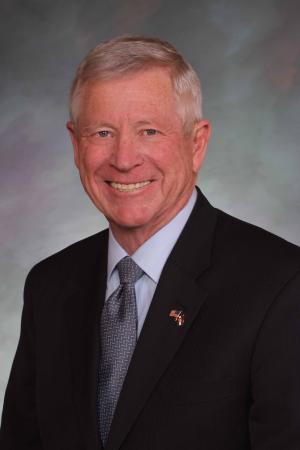
Photo of Bob Rankin
R Colorado Senate · District 5

Sen. Bob Rankin

Contact Email
Compare
Total votes
4,487
all sessions
Attendance
99%
57 missed
Among the lowest in the chamber
With party
88%
of cast votes
Bipartisan score
7%
crosses aisle rarely
Sponsored
196
bills & resolutions
Lower than 99% of chamber peers
Committees
0
assignments
196 bills and resolutions

Sponsored bills

Total
196
Primary
196
Co-sponsor
0
This page
196
matching current filters
Primary HB 20-1383
Signed into law · Colorado House · Lead sponsor
Reduce The General Fund Reserve

Under current law, the general fund reserve requirement is equal to 7.25% of the amount appropriated for expenditure from the general fund for the fiscal year. The act reduces the percentage used to determine the general fund reserve as follows: 3.07% for fiscal year 2019-20; and 2.86% for fiscal years 2020-21 and 2021-22.(Note: This summary applies to this bill as enacted.)

Signed into law Jun 30, 2020 0 co-sponsors
Primary HB 20-1377
Signed into law · Colorado House · Lead sponsor
Fund Controlled Maintenance Projects

Under current law, enacted by Senate Bill 17-267, the state executed the second of 4 tranches of lease-purchase agreements of up to $500 million in principal value each before the end of state fiscal year 2019-20 for the sole purpose of funding transportation projects. Due to a favorable interest rate environment, the state actually received more than $600 million of proceeds from the execution of this second tranche of lease-purchase agreements. The act requires the first $49 million of proceeds received in excess of $500 million to be credited to the capital construction fund and appropriated for controlled maintenance projects, including controlled maintenance projects that are capital renewal projects, instead of transportation projects. (Note: This summary applies to this bill as enacted.)

Signed into law Jun 30, 2020 0 co-sponsors
Primary HB 20-1369
Signed into law · Colorado House · Lead sponsor
Reduce Prosecution Training Appropriation

The general assembly is required to annually appropriate $350,000 to the department of law for allocation to the Colorado district attorneys' council for prosecution training. The act reduces the annual amount to $200,000 for fiscal year 2020-21. (Note: This summary applies to this bill as enacted.)

Signed into law Jun 30, 2020 0 co-sponsors
Primary HB 20-1363
Signed into law · Colorado House · Lead sponsor
Repeal Report On Increase Rate For Direct Support

Under current law, following the 2019-20 and 2020-21 fiscal years, service agencies serving persons with intellectual and developmental disabilities are required to report to the department of health care policy and financing how they used a funding increase intended to increase compensation for direct support professionals. The act repeals this reporting requirement. (Note: This summary applies to this bill as enacted.)

Signed into law Jun 30, 2020 0 co-sponsors
Primary HB 20-1382
Signed into law · Colorado House · Lead sponsor
Repeal Cash Funds With General Fund Reversions

The act repeals the technology advancement and emergency fund and the reversion of unspent general fund appropriations to the fund. Prior to the repeal, the state treasurer is required to transfer the unspent and unencumbered balance of the fund to the general fund. (Note: This summary applies to this bill as enacted.)

Signed into law Jun 30, 2020 0 co-sponsors
Primary HB 20-1399
Signed into law · Colorado House · Lead sponsor
Suspend Limited Gaming Tax Transfers To Cash Funds

The act suspends, for 2 years, the operation of statutory provisions allocating specific amounts of revenue derived from the tax on limited gaming activity to the following cash funds: The Colorado travel and tourism promotion fund, administered by the board of directors of the Colorado tourism office; The advanced industries acceleration cash fund, administered by the Colorado office of economic development; The local government limited gaming impact fund, including the limited gaming impact account and the gambling addiction account, administered by the departments of local affairs and human services and local governmental entities; The innovative higher education research fund, administered by the higher education competitive research authority; The creative industries cash fund, administered by the council on creative industries; and The Colorado office of film, television, and media operational account cash fund, administered by the Colorado office of film, television, and media. The act also changes allocations within the local government limited gaming impact fund by: Eliminating a temporary earmarking of funds in the gambling addiction account for: A study, by the department of local affairs, to define the documented expenses, costs, and other impacts incurred directly as a result of limited gaming; and The development, by the department of human services, of a statewide program to address gambling addiction; and Making money available from the limited gaming impact account, in addition to the gambling addiction account, to award grants for the provision of gambling addiction counseling to Colorado residents. Finally, the act adjusts current long bill appropriations to fund the programs listed above for the 2020-21 state fiscal year. (Note: This summary applies to this bill as enacted.)

Signed into law Jun 30, 2020 0 co-sponsors
Primary HB 20-1376
Signed into law · Colorado House · Lead sponsor
Modify Transportation Funding Mechanisms

Before the enactment of the act, existing law, enacted by Senate Bills 18-001 and 19-263, required that a ballot issue seeking approval for the issuance of transportation revenue anticipation notes (TRANs) be submitted to the voters of the state at the November 2020 general election. If the ballot issue had been approved, the requirement, enacted by Senate Bill 17-267, that the state execute 2 separate tranches of up to $500 million each of lease-purchase agreements in state fiscal years 2020-21 and 2021-22 for the purpose of funding transportation would have been repealed. Existing law, enacted by Senate Bill 19-239, also required department of transportation (CDOT) rule-making and reporting relating to motor vehicles used for certain types of commercial purposes. The act: Delays from the November 2020 general election to the November 2021 statewide election the requirement that a ballot issue seeking approval for the issuance of transportation revenue anticipation notes (TRANs) be submitted to the voters of the state; Amends the ballot issue to reduce the amount of TRANs authorized to be issued by $500 million to offset the additional $500 million of lease-purchase agreement transportation funding that becomes available because the approval of the ballot issue at the November 2020 general election will repeal only the state fiscal year 2021-22 and tranche of Senate Bill 17-267 lease-purchase agreements, rather than both the state fiscal year 2020-21 and 2021-22 tranches of such lease-purchase agreements; Eliminates 2 statutory transfers of $50 million each from the general fund to the state highway fund that are scheduled under current law to be made on June 30, 2021, and June 30, 2022; Reduces the amount of general fund money dedicated to make lease-purchase agreement payments due in state fiscal years 2020-21 and 2021-22 by $12 million per year by increasing the amount of such payment to be paid by the department of transportation from its other sources of legally available money by $12 million per year; Makes corresponding adjustments to the state fiscal year 2020-21 long bill appropriations to the department of treasury for lease-purchase agreements that decrease the general fund appropriation by $12 million and increase the cash funds appropriation from various cash funds under the control of the transportation commission by $12 million; and Repeals the CDOT rule-making and reporting requirements relating to motor vehicles used for certain types of commercial purposes.(Note: This summary applies to this bill as enacted.)

Signed into law Jun 30, 2020 0 co-sponsors
Primary HB 20-1381
Signed into law · Colorado House · Lead sponsor
Cash Fund Transfers General Fund

For the purpose of augmenting the revenue in the state general fund, the act requires the state treasurer to make specific transfers to the general fund. On June 30, 2020, the state treasurer is required to transfer the following amounts to the general fund: $3,176 from the employment verification fund, as it existed prior to its repeal in 2016; The unexpended and unencumbered balance from the fund state employee reserve fund; $7.9 million from the Fort Logan land sale account in the capital construction fund; $8,381,753 from the indirect costs excess recovery fund; $1,887,116 from the state supplemental security income stabilization fund; $1 million from the veterans assistance grant program cash fund; $167,463 from the Moffat tunnel cash fund; and $10 million from the multimodal transportation options fund. On July 1, 2020, the state treasurer is required to transfer: $45.5 million from the severance tax perpetual base fund to the general fund; and $43 million from the unclaimed property trust fund.(Note: This summary applies to this bill as enacted.)

Signed into law Jun 29, 2020 0 co-sponsors
Primary HB 20-1374
Signed into law · Colorado House · Lead sponsor
Repeal Waste Grease Program

The act: Repeals the state regulatory program concerning the registration, fees, record keeping, violations, and rules regarding waste grease; and Reduces the cash funds appropriation from the solid waste management fund made in the 2020-21 general appropriation act (long bill) by $100,890 and reduces the related FTE by 0.7 FTE.(Note: This summary applies to this bill as enacted.)

Signed into law Jun 29, 2020 0 co-sponsors
Primary HB 20-1366
Signed into law · Colorado House · Lead sponsor
Higher Education Funding Allocation Model

The act makes revisions to the higher education funding provisions creating a new higher education funding allocation model (new funding model). The new funding model begins in the 2021-22 state fiscal year and includes new provisions for calculating fee-for-service contracts for institutions and makes related changes to the calculation of state funding to support specialty education programs, area technical colleges, and local district colleges. Under the new funding model, fee-for-service contracts for institutions are based on 3 components: Ongoing additional funding, performance funding, and temporary additional funding. The Colorado commission on higher education (commission), in conjunction with the department of higher education (department) and in collaboration with the institutions, shall calculate and make funding recommendations to the joint budget committee for these components as part of the annual budget request process. Ongoing additional funding is base building and may be awarded to an institution to make progress toward the commission's master plan goals, which may include addressing base funding disparities or funding priorities not addressed through performance funding metrics. An institution may also receive ongoing additional funding through a formula set forth in the act to recognize an institution's additional costs associated with educating and providing services to first-generation undergraduate students. Performance funding is calculated based on an institution's change over time in performance on each performance funding metric compared to other institutions' change in performance and adjusted based on each institution's share of funding in the previous state fiscal year. The performance funding metrics include: Resident student full-time equivalent enrollment; Credential completion; Resident Pell-eligible student population share; Resident underrepresented minority student population share; Retention rate; One-hundred-percent-of-time graduation rate; One-hundred-fifty-percent-of-time graduation rate; and Resident first-generation undergraduate student population share. The joint budget committee determines the amount of funding allocated to each performance funding metric for a fiscal year after considering recommendations from the commission and department that are developed in collaboration with the institutions. Finally, temporary additional funding, which is not base building, may be awarded to an institution for a specified period of time to address commission master plan goals or other areas the commission identifies. Under current law and the new model, minimum funding for specialty education programs, local district colleges, and area technical colleges is based on their previous year's funding, increased or decreased by the average percentage change in state funding for all institutions (percentage change). However, the act modifies how the percentage change is calculated so that it does not include amounts awarded to institutions for ongoing additional funding or temporary additional funding in the applicable state fiscal year. The act requires the annual budget request that the commission and the department submit relating to the new funding model to include detailed information and funding recommendations. The act also requires the commission, in conjunction with the department and in collaboration with the institutions, to identify and make recommendations to the joint budget committee by July 1, 2022, concerning ways to better measure success for students who are not first-time, full-time students. This may include a recommendation for a statutory change to the calculation of one of the graduation rate performance funding metrics. The act repeals fiscal limits, reporting requirements, and budget provisions that do not apply to the new funding model. The act amends statutory references to reflect the creation of a new higher education funding model. (Note: This summary applies to this bill as enacted.)


Signed into law Jun 29, 2020 0 co-sponsors
Showing 101 to 110 of 196 bills
Previous 1 … 10 11 12 … 20 Next