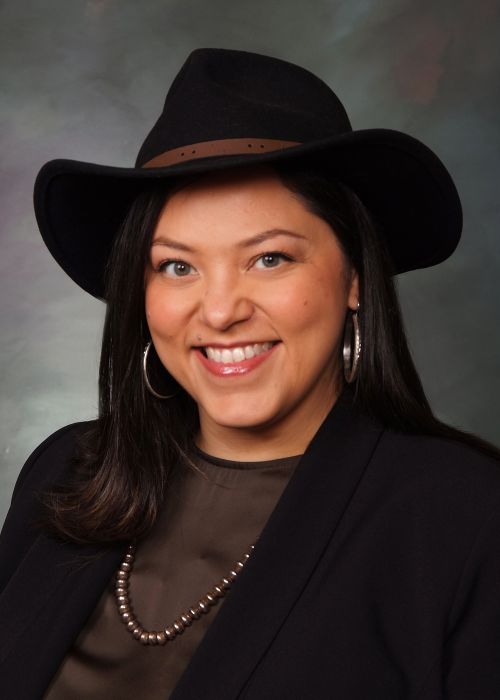
Photo of Julie Gonzales
D Colorado Senate · District 34

Sen. Julie Gonzales

Compare
Total votes
6,713
all sessions
Attendance
98%
136 missed
Lower than 92% of chamber peers
With party
98%
of cast votes
Higher than 77% of chamber peers
Bipartisan score
1%
crosses aisle rarely
Lower than 81% of chamber peers
Sponsored
710
bills & resolutions
Higher than 75% of chamber peers
Committees
3
assignments
710 bills and resolutions

Sponsored bills

Total
710
Primary
297
Co-sponsor
413
This page
710
matching current filters
Primary HB 20-1351
In committee · Colorado House · Lead sponsor
Local Government Authority Promote Affordable Housing Units

The bill clarifies that the existing authority of cities and counties (local governments) to plan for and regulate the use of land includes the authority to regulate development or redevelopment in order to promote the construction of new affordable housing units. The provisions of the state's rent control statute do not apply to any land use regulation that restricts rents on newly constructed or redeveloped housing units as long as the regulation provides a choice of options to the property owner or land developer and creates one or more alternatives to the construction of new affordable housing units on the building site.(Note: This summary applies to this bill as introduced.)

In committee May 27, 2020 0 co-sponsors
Primary HB 20-1081
Passed · Colorado House · Lead sponsor
Multilingual Ballot Access

The bill requires the secretary of state (secretary) and county clerk and recorders (county clerk) of certain counties to provide multilingual ballot access. The secretary is required to establish a multilingual ballot hotline (hotline) to provide access to qualified translators in each of the languages in which the most recent decennial census was offered, to assist electors in translating ballot language. The secretary is required to establish the hotline for use during the general election held in November 2020 November 2022 , and for every general election and statewide odd-year election thereafter. The secretary is also required to: Provide notice of the hotline to electors through election day; Ensure that the translators who provide translations for the multilingual hotline are qualified translators; and Promulgate rules as may be necessary to create and administer the hotline. The county clerk of any county that satisfies specified criteria is required to create, in coordination with the secretary, a minority language sample ballot (sample ballot) in any minority language spoken in the county that satisfies the following: The minority language is spoken by at least 2,000 citizens in the county age 18 years or older who speak English less than very well and who speak the minority language at home; or The minority language is spoken by at least 2.5% of citizens in the county age 18 years or older who speak English less than very well and who speak the minority language at home. The bill specifies the information that the county clerk is required to include on the that the sample ballot must include all of the same content that is on the English language ballot as well as and also specifies the format of the sample ballot. In addition, the bill requires that the sample ballots be available for the general election held in November 2020, and for each general election and statewide odd-year election thereafter. The county clerk of any county that satisfies specified criteria is required to provide, upon the request of an elector, an in-person minority language ballot (in-person ballot) in any minority language spoken in the county that satisfies the same criteria specified for sample ballots. An in-person ballot can be a ballot on demand, a ballot from a printed stock of ballots, or a ballot via an electronic voting device. The bill specifies the information that the county clerk is required to include on the that the in-person ballot must include all of the same content that is on the English language ballot and specifies that in-person ballots are required to be available for the general election held in November 2022, and for each general election and statewide odd-year election thereafter. The secretary is required to determine, pursuant to specified criteria, which counties in the state are required to provide multilingual ballot access by creating a sample ballot and providing an in-person ballot, and to notify the county clerk of any county that is required to provide such multilingual ballot access. The secretary is required to provide each county clerk that is required to provide multilingual ballot access with a translation in the applicable minority language or languages of all federal and statewide candidates for election, all statewide ballot questions, and all statewide questions regarding the retention of judges content that is certified to the county clerks by the secretary of state for use by the county clerk in creating the multilingual ballot access . For the 2020-21 state fiscal year, $72,112 is appropriated to the department of state from the department of state cash fund for the implementation of the multilingual ballot access requirements. (Note: Italicized words indicate new material added to the original summary; dashes through words indicate deletions from the original summary.) (Note: This summary applies to the reengrossed version of this bill as introduced in the second house.)


Passed May 27, 2020 0 co-sponsors
Primary SB 20-108
Passed · Colorado Senate · Lead sponsor
Landlord Prohibitions Tenant Citizenship Status

The bill creates the "Immigrant Tenant Protection Act" (Act), which prohibits a landlord from: Demanding, requesting, or collecting information regarding or relating to the immigration or citizenship status of a tenant; Disclosing or threatening to disclose information regarding or relating to the immigration or citizenship status of a tenant to any person, entity, or immigration or law enforcement agency; Harassing, intimidating, or retaliating against a tenant for exercising the tenant's rights or opposing prohibited conduct; Interfering with a tenant's rights, including influencing or attempting to influence a tenant to surrender possession of a dwelling unit or to not seek to occupy a dwelling unit based solely or in part on the immigration or citizenship status of the tenant; Refusing to enter into a lease agreement or approve a subtenancy, or to otherwise preclude a tenant from occupying a dwelling unit, based solely or in part on the immigration or citizenship status of the tenant; and Bringing an action to recover possession of a dwelling unit based solely or in part on the immigration or citizenship status of a tenant. The Act is enforceable through a private right of action. (Note: This summary applies to the reengrossed version of this bill as introduced in the second house.)
Passed May 27, 2020 0 co-sponsors
Primary HB 20-1294
Passed · Colorado House · Lead sponsor
Replace Illegal Alien With Undocumented Immigrant

The bill replaces the term "illegal alien" with "undocumented immigrant" "unauthorized worker" as it relates to public contracts for services. (Note: Italicized words indicate new material added to the original summary; dashes through words indicate deletions from the original summary.) (Note: This summary applies to the reengrossed version of this bill as introduced in the second house.)

Passed May 27, 2020 0 co-sponsors
Primary HB 20-1348
In committee · Colorado House · Lead sponsor
Additional Liability Under Respondeat Superior

A recent Colorado supreme court case held that in a civil action when an employer admits liability for the tortious actions of its employee, the plaintiff cannot assert additional claims against the employer arising out of the same incident. The bill allows a plaintiff to bring such claims against an employer. (Note: This summary applies to this bill as introduced.)

In committee May 26, 2020 0 co-sponsors
Primary SB 20-203
In committee · Colorado Senate · Lead sponsor
Repeal Metered-dose Inhalers As Vaporized Delivery

Under current law, the state licensing authority is required to treat a metered-dose inhaler the same as a vaporized delivery device for purposes of regulation and testing. The bill repeals this provision. (Note: This summary applies to this bill as introduced.)

In committee May 26, 2020 0 co-sponsors
Primary SB 20-192
In committee · Colorado Senate · Lead sponsor
Staffing Agency Requirements For Employees

The bill requires a staffing agency that places temporary and part-time employees with work-site employers to provide the employees specific information concerning the terms and conditions of employment. The information must be provided in writing before the end of the first pay period. The bill requires the staffing agency to post a notice in its workplace that includes the name and telephone number of the division of labor standards and statistics (division) in the department of labor and employment and a description of employees' rights to the receipt of the required terms and conditions of employment. A staffing agency and a work-site employer are prohibited from charging an employee: A fee for certain work-related expenses or deducting expenses from the employee's wages without authorization from the employee; The cost of required specific transportation services; or More than the actual cost of optional transportation. The bill prohibits a staffing agency from knowingly issuing, distributing, circulating, or providing false, fraudulent, or misleading information to an employee or applicant for employment and from refusing to refund fees or costs owed to the employee. The bill requires each staffing agency to annually register and pay a fee to the division. Each staffing agency is required to submit information to the division in a form and manner required by the division. The division is required to maintain a list of the registration status of each staffing agency on its website. Employers who use staffing agencies are required to verify whether the staffing agency is registered with the division. The division may assess a fine for a violation and may revoke or suspend the registration of a staffing agency for any violation. The division is authorized to promulgate rules, including rules that state the information that a staffing agency is required to submit to the division and that establish circumstances where a staffing agency's registration may be revoked or suspended. (Note: This summary applies to this bill as introduced.)

In committee May 26, 2020 0 co-sponsors
Primary SB 20-193
In committee · Colorado Senate · Lead sponsor
Creation Of The Financial Empowerment Office

The bill creates the financial empowerment office (office) and the director of the office (director) in the department of law to grow the financial resilience and well-being of Coloradans through specified community-derived goals and strategies. The director is appointed by the Colorado attorney general and may hire staff as necessary to perform the duties and functions of the office. The office also consists of a manager who is appointed by the director. The office is authorized to partner with governmental bodies, community organizations, financial institutions, local service providers, and philanthropic organizations to achieve the purposes of the office. The office is also authorized to develop: Methods to increase access to safe and affordable financial products; Tools and resources that advance, increase, and improve Colorado residents' financial management; and Community-informed policies and systems that dismantle systemic barriers to building ownership and wealth for all, especially low-income communities and communities of color. The financial empowerment office is required to: Support the organization of community coalitions to define and lead financial resilience strategies; Align, support, and build ties to build financial education and well-being in communities across the state; Establish a statewide coalition to assist the director in increasing access to safe and affordable banking products that help improve the financial stability of Colorado residents; Work with stakeholders to increase access to low-cost, credit-building loans and financial products; Work with state authorities and other stakeholders to expand access to safe and affordable banking products with low fees and easy account access; Develop technical assistance to launch or expand local financial coaching and counseling efforts; Raise money to support coaching, safe and affordable banking, and potential loan funds; Collaborate with the office of the state treasurer on the creation and management of a loan fund to support small credit-building loans; and Track community feedback on consumer financial abuses and coordinate with the enforcement teams at various state agencies, connect consumers with existing resources, and educate the public on their related consumer rights. The office is also required to submit an annual report to the general assembly regarding the activities of the office and the state of affordable banking access in Colorado. (Note: This summary applies to this bill as introduced.)

In committee May 26, 2020 0 co-sponsors
Primary SB 20-180
In committee · Colorado Senate · Lead sponsor
Dyslexia Education In Criminal And Juvenile Justice System

Each offender who is sentenced to the department of corrections is required to undergo a diagnostic examination and evaluation. The bill requires those diagnostic services to include screening for indicators of dyslexia. The bill requires the correctional education program to provide scientifically based or evidence-based reading instruction to offenders who may have dyslexia. The department of corrections is required to enter into an agreement with a literacy consultant to assist the implementation of the dyslexia screening and educational programs. The bill requires the department of human services to implement a dyslexia screening program for juveniles held in detention facilities and to administer scientifically based or evidence-based reading instruction to juveniles committed to the department who may have dyslexia. The department of human services is required to enter into an agreement with a literacy consultant to assist the implementation of the dyslexia screening and educational programs. (Note: This summary applies to this bill as introduced.)

In committee May 26, 2020 0 co-sponsors
Primary HB 20-1267
Passed · Colorado House · Lead sponsor
Transparency Of Telecommunications Providers Correctional Facilities

The bill requires penal telecommunication service providers (providers) who that contract with a government entity to provide telecommunication services (services) to jails and other correctional facilities (jails) to maintain data and records (data) related to the services provided to jails. The bill requires providers to submit the data and a report on the services provided to the public utilities commission (commission) on a quarterly basis. An underlying carrier that contracts with a provider to provide the actual services to jails is not required to maintain or produce such data or reports. The commission is required to publish the data and report on its website in a format accessible by the public. Current law exempts providers and the services provided from oversight by the commission. The bill grants the commission authority over providers and the services provided. (Note: Italicized words indicate new material added to the original summary; dashes through words indicate deletions from the original summary.) (Note: This summary applies to the reengrossed version of this bill as introduced in the second house.)

Passed May 26, 2020 0 co-sponsors
Showing 661 to 670 of 710 bills
Previous 1 … 66 67 68 … 71 Next