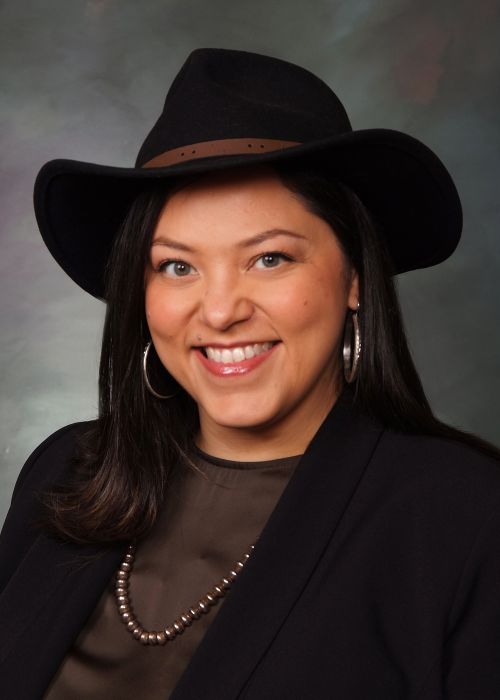
Photo of Julie Gonzales
D Colorado Senate · District 34

Sen. Julie Gonzales

Compare
Total votes
6,713
all sessions
Attendance
98%
136 missed
Lower than 92% of chamber peers
With party
98%
of cast votes
Higher than 77% of chamber peers
Bipartisan score
1%
crosses aisle rarely
Lower than 81% of chamber peers
Sponsored
710
bills & resolutions
Higher than 75% of chamber peers
Committees
3
assignments
710 bills and resolutions

Sponsored bills

Total
710
Primary
297
Co-sponsor
413
This page
710
matching current filters
Co-sponsor HB 25-1318
Signed into law · Colorado House · Co-sponsor
Species Conservation Trust Fund Projects

For state fiscal year 2025-26, the act appropriates $5,000,000 from the species conservation trust fund in the state treasury for various wildlife conservation programs directed at conserving candidate native species that have been listed as threatened or endangered under state or federal law or are species that are likely to become candidate species, as determined by the United States fish and wildlife service, as follows: $2,480,000 for the upper Colorado river endangered fish recovery program; $20,000 for selenium management, research, monitoring, evaluation, and control; $1,250,000 for native terrestrial wildlife conservation; and $1,250,000 for native aquatic wildlife conservation.(Note: This summary applies to this bill as enacted.)

Signed into law May 30, 2025 1 co-sponsor
Co-sponsor SB 25-298
Signed into law · Colorado Senate · Co-sponsor
Remove Term Homosexuality from Criminal Code

The act removes the term "homosexuality" from the definition of sexual conduct in the sexually explicit materials harmful to children part of the "Colorado Criminal Code". (Note: This summary applies to this bill as enacted.)

Signed into law May 30, 2025 1 co-sponsor
Co-sponsor HB 25-1186
Signed into law · Colorado House · Co-sponsor
Work-Based Learning Experiences in Higher Education

The act creates the work-based learning consortium pilot program (pilot program) in the department of higher education (department). The purpose of the 3-year pilot program is to: Demonstrate the value of work-based learning in postsecondary curricula by studying the impact of industry-sponsored projects on course objectives and learning outcomes; Promote the adoption of work-based learning in higher education by working with faculty at institutions of higher education (institutions) that participate in the pilot program (participating institutions) to embed project-based learning opportunities into credit-bearing programs; Provide broader access to collegiate work-based learning for students; Measure the impact of work-based learning on participating students; and Learn how institutions can increase the value of postsecondary education through career exposure and preparedness. Pending the receipt of sufficient funds, the department shall convene a consortium (consortium) of representatives from participating institutions, the commission on higher education (commission), the department of labor and employment, the department of education, and a subject matter expert with experience implementing work-based learning. The consortium shall: Work with each participating institution's faculty to embed industry-sponsored projects in course curriculum that meet the work-based learning quality standards; Work with the department to determine the impact of industry-sponsored projects; Work with a third-party platform to connect faculty from participating institutions to employers for the purpose of developing high-quality, project-based learning opportunities for classroom instruction; Advise the commission on strategies to improve student access to high-quality, work-based learning opportunities for students based on participating faculty members' experience embedding industry-sponsored projects into curriculum; Develop best practices for institutions to expand access to work-based learning in the classroom through industry-sponsored projects; and Develop findings and recommendations. Subject to available appropriations, at the end of the pilot program, the act requires the consortium to complete and submit a report to the education committees of the house of representatives and the senate, or their successor committees. The report must include: A description of the consortium's findings and recommendations; Details on the consortium's impacts on participating institutions and the effects of creating additional work-based learning activities on students, faculty, and employers; and Recommendations for statutory changes, financial resources, department policy changes, and policy changes in institutions that are necessary to improve successful work-based learning opportunities for students in institutions. The department may seek, accept, and expend gifts, grants, or donations from private or public sources for the pilot program. The department shall transmit all gifts, grants, or donations to the state treasurer, who shall credit the money to the higher education work-based learning consortium fund (fund). If, by June 30, 2028, the money in the fund has never reached or exceeded $2 million dollars, the state treasurer shall return each grantor's or donor's gift, grant, or donation. On or before November 1, 2026, the commission shall recommend a list of terms used by institutions related to work-based learning to the Colorado workforce development council for inclusion in the talent development glossary (glossary). The purpose of the list of terms is to: Augment the glossary so that collegiate work-based learning activities are accurately reflected in statewide efforts to promote work-based learning; and Demonstrate to institutions relevant opportunities to participate in statewide efforts to promote work-based learning. On or before July 1, 2026, the commission shall work with institutions, the Colorado workforce development council, the department of education, the consortium, nonprofit organizations, industry associations, and businesses to develop recommendations on how to best embed work-based learning opportunities into current degree pathways. On or before December 31, 2026, the department shall work with institutions to identify which work-based learning activities are measurable and how to best report work-based learning activities. Institutions that are eligible for the work-study program may use work-study program money to cover the costs of work-based learning credits for students who are required to complete credit-bearing work-based learning requirements to graduate from an institution. The office of economic development (office) administers the universal high school scholarship program (program). The act allows the office to spend unexpended or unencumbered money appropriated in the 2023-24 state fiscal year through the 2025-26 state fiscal year without further appropriation. The act requires that expenditures for the administrative costs of the program not exceed $1.5 million. The act extends the date for the state treasurer to transfer all unexpended and unencumbered money in the universal high school scholarship cash fund from December 30, 2026, to June 30, 2027. (Note: This summary applies to this bill as enacted.)


Signed into law May 30, 2025 1 co-sponsor
Primary HB 25-1301
Signed into law · Colorado House · Lead sponsor
Authorizing Voice Court Reporter to Give Oath

Current law does not allow a voice court reporter to administer an oath or affirmation. The act adds voice reporters to the list of professionals who may administer an oath or affirmation. (Note: This summary applies to this bill as enacted.)
Signed into law May 30, 2025 0 co-sponsors
Co-sponsor SB 25-285
Signed into law · Colorado Senate · Co-sponsor
Updating Food Establishment Inspection Fees

The act updates the ongoing schedule of annual fees imposed on retail food establishments, which fees are imposed to cover the cost of required health and safety inspections under current law. (Note: This summary applies to this bill as enacted.)

Signed into law May 30, 2025 1 co-sponsor
Primary SB 25-158
Signed into law · Colorado Senate · Lead sponsor
State Agency Procurement & Disposal Certain Items

The act creates state procurement practices for firearms and items regulated pursuant to the federal "National Firearms Act" ("NFA"). The act applies to all contracts the state sources, enters into, awards, amends, renews, or extends on or after January 1, 2026, for procuring firearms or items regulated pursuant to the "NFA". During a governmental body's contracting process, sourcing method process, or upon request during the term of a contract, a contractor or bidder shall comply with certain requirements, make certain disclosures, and provide certain documentation to confirm that the contractor or bidder engages in safe business practices. The attorney general may assist the department of personnel (department) in developing processes and procedures to implement the procurement practices. The department may adopt rules to implement this act. (Note: This summary applies to this bill as enacted.)

Signed into law May 30, 2025 0 co-sponsors
Co-sponsor SB 25-278
Signed into law · Colorado Senate · Co-sponsor
Epinephrine Administration in Schools

The act changes the term "epinephrine auto-injector" to "emergency-use epinephrine" in order to encompass alternatives to injecting epinephrine as a means to treat anaphylaxis in school settings. (Note: This summary applies to this bill as enacted.)

Signed into law May 30, 2025 1 co-sponsor
Co-sponsor SB 25-118
Signed into law · Colorado Senate · Co-sponsor
Health Insurance Prenatal Care No Cost Sharing

The act requires that, for health insurance policies providing maternity coverage, policies issued or renewed on or after January 1, 2027, must include prenatal care coverage without cost sharing for up to 3 office visits. (Note: This summary applies to this bill as enacted.)

Signed into law May 29, 2025 1 co-sponsor
Co-sponsor SB 25-186
Signed into law · Colorado Senate · Co-sponsor
Sunset Workers' Compensation Providers Accreditation Program

The act implements the recommendations of the department of regulatory agencies in its 2024 sunset review of the workers' compensation accreditation of health-care providers program (program), including extending the program for 11 years to September 1, 2036, and authorizing any health-care professional regulated by the division of professions and occupations and listed in the utilization standards established by the director of the division of workers' compensation (division) who provides treatment in the workers' compensation system to obtain level I accreditation from the division. (Note: This summary applies to this bill as enacted.)

Signed into law May 29, 2025 1 co-sponsor
Co-sponsor HB 25-1026
Vetoed · Colorado House · Co-sponsor
Repeal Copayment for Department of Corrections Inmate Health Care

Current law requires the department of corrections (department) to assess a copayment for inmate-initiated visits to providers of medical, dental, mental health, and optometric care services. Current law permits a waiver or reduction of the copayment under a range of circumstances. The department's current administrative regulations assess fees when an inmate fails to attend or refuses a scheduled health-care appointment. The act eliminates the copayment and prohibits the department from assessing a fee when an inmate fails to attend or refuses a health-care appointment. The department is required to report during its 2026 "SMART Act" hearing on the number of times in the previous year that an inmate failed to attend a scheduled health-care appointment or requested an appointment when the request was not relevant to an actual medical condition. The act reduces appropriations to the department by a net of $165,682, which includes an increase of $157,179 appropriated from the general fund and a decrease of $322,861 from cash funds. VETOED by Governor 5/29/2025(Note: This summary applies to this bill as enacted.)

Vetoed May 29, 2025 1 co-sponsor
Showing 301 to 310 of 710 bills
Previous 1 … 30 31 32 … 71 Next