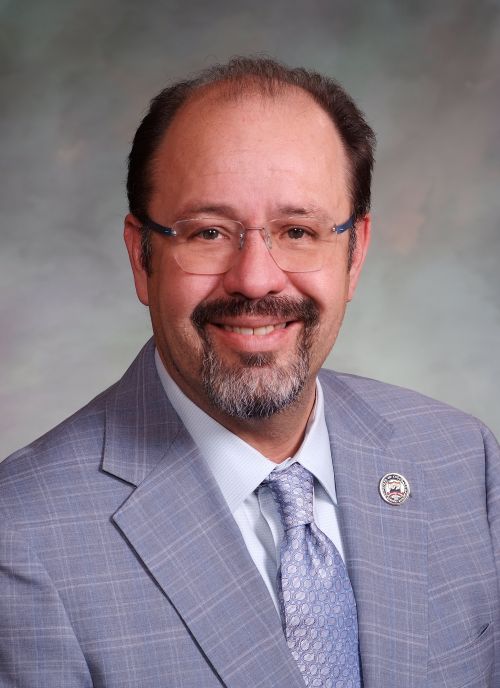
Photo of Robert Rodriguez
D Colorado Senate · District 32

Sen. Robert Rodriguez

Compare
Total votes
4,527
all sessions
Attendance
95%
214 missed
Near the chamber average
With party
98%
of cast votes
Higher than 91% of chamber peers
Bipartisan score
1%
crosses aisle rarely
Lower than 98% of chamber peers
Sponsored
436
bills & resolutions
Near the chamber average
Committees
4
assignments
436 bills and resolutions

Sponsored bills

Total
436
Primary
227
Co-sponsor
209
This page
436
matching current filters
Primary SB 19-215
Signed into law · Colorado Senate · Lead sponsor
Parents Encouraging Parents Conference

Parents encouraging parents conference - appropriation. The act creates parents encouraging parents conferences for parents of children with disabilities. The department of education shall provide for the conferences and related lodging and food for attendees. The act requires a specified conference curriculum. For the 2019-20 state fiscal year, the act appropriates $68,000 from the general fund to the department of education. (Note: This summary applies to this bill as enacted.) Read More

Signed into law May 29, 2019 0 co-sponsors
Primary HB 19-1306
Signed into law · Colorado House · Lead sponsor
Monitoring Colorado Call Center Job Losses

Department of labor and employment - Colorado call center jobs - workforce data. The department of labor and employment is required to include, as part of its annual presentation to its legislative committee of reference at a hearing held pursuant to the "State Measurement for Accountable, Responsive, and Transparent (SMART) Government Act", data that it currently collects regarding the call center work force, including tracking call center jobs and wage analysis of customer service employees.(Note: This summary applies to this bill as enacted.) Read More

Signed into law May 28, 2019 0 co-sponsors
Primary SB 19-170
Signed into law · Colorado Senate · Lead sponsor
Inquiry Into College Applicant Criminal History

State institutions of higher education - application for admission - criminal or educational disciplinary history inquiry. A state institution of higher education (institution) is prohibited from inquiring, prior to admission, about an applicant's criminal history or disciplinary history at an elementary, secondary, or postsecondary institution (disciplinary history); except that the institution may inquire into the following: An applicant's prior convictions or disciplinary history for stalking, sexual assault, and domestic violence; An applicant's convictions within 5 years before submitting the application for assault, kidnapping, voluntary manslaughter, or murder; and Any pending criminal charges against the applicant. An institution that accepts a form of application that may be used to apply to other institutions is prohibited from considering any criminal or disciplinary history information provided on that application that the institution is prohibited from inquiring into on its own application. An institution that accepts a form of application that is designed by a national application service, tailored for admission to a specific degree program, and used in other states may consider criminal history information provided on that application. An institution's review of an otherwise qualified applicant's disclosed criminal history or disciplinary history must be made in a reasonable amount of time. The institution shall provide an appeals process for an otherwise qualified applicant denied admission based on the applicant's criminal or disciplinary history. An institution is required to post its policies regarding inquiries into an applicant's criminal and disciplinary history on its website and file such policies with the Colorado commission on higher education (commission). An institution shall notify the commission at least 30 days before making any changes to such policies. An institution is permitted to inquire into an admitted student's criminal history when obtaining information pertaining to participation in campus life or student housing. (Note: This summary applies to this bill as enacted.) Read More

Signed into law May 28, 2019 0 co-sponsors
Primary HB 19-1025
Signed into law · Colorado House · Lead sponsor
Limits On Job Applicant Criminal History Inquiries

Hiring practices - limitations on criminal history inquiries - exceptions - enforcement - appropriation. Effective September 1, 2019, for employers with 11 or more employees, and effective September 1, 2021, for all employers, employers are prohibited from: Advertising that a person with a criminal history may not apply for a position; Placing a statement in an employment application that a person with a criminal history may not apply for a position; or Inquiring about an applicant's criminal history on an initial application. An employer may obtain a job applicant's publicly available criminal background report at any time. An employer is exempt from the restrictions on advertising and initial employment applications when: The law prohibits a person who has a particular criminal history from being employed in a particular job; The employer is participating in a program to encourage employment of people with criminal histories; or The employer is required by law to conduct a criminal history record check for the particular position. The department of labor and employment (department) is charged with enforcing the requirements of the act and may issue warnings and orders of compliance for violations and, for second or subsequent violations, impose civil penalties. A violation of the restrictions does not create a private cause of action, and the act does not create a protected class under employment anti-discrimination laws. The department is directed to adopt rules regarding procedures for handling complaints against employers. The department is appropriated $38,113 from the employment support fund and 0.6 FTE to implement the act. (Note: This summary applies to this bill as enacted.) Read More

Signed into law May 28, 2019 0 co-sponsors
Primary HB 19-1232
Signed into law · Colorado House · Lead sponsor
Aligning Indian Child Welfare Act Requirements

Child custody - Indian child - Align requirements with federal Indian Child Welfare Act. In 2016, the bureau of Indian affairs in the United States department of the interior published updated guidelines for implementing the federal "Indian Child Welfare Act". The act updates the current statute to align the compliance requirements with federal law.(Note: This summary applies to this bill as enacted.) Read More

Signed into law May 28, 2019 0 co-sponsors
Primary HB 19-1283
Signed into law · Colorado House · Lead sponsor
Disclosure Of Insurance Liability Coverage

Automobile insurance policy disclosures - liability - appropriation. The act requires an insurer that provides or may provide commercial automobile or personal automobile liability insurance coverage that pays all or a portion of a pending or prospective claim to provide to a claimant via mail, facsimile, or electronic delivery, within 30 calendar days after receiving a written request from the claimant, a statement setting forth the following information with regard to each known policy of insurance of the named insured, including excess or umbrella insurance: The name of the insurer; The name of each insured party, as the name appears on the declarations page of the policy; The limits of the liability coverage; and A copy of the policy. An insured party, upon written request of a claimant or a claimant's attorney, shall disclose to the claimant or claimant's attorney the name and coverage of each known insurer of the insured party. An insurer that violates the disclosure requirement is liable to the requesting claimant for damages in an amount of $100 per day, beginning on and including the 31st day following the receipt of the claimant's written request. The penalty accrues until the insurer provides the information required. An insurer that fails to make a required disclosure is also responsible for attorney fees and costs incurred by a claimant in enforcing the penalty. The claimant and any attorney of the claimant shall not disclose the disclosed information to any party; except that the claimant and an attorney of the claimant may discuss the information with the claimant's insurer. The act appropriates $12,599 to the department of regulatory agencies from the division of insurance cash fund to implement the act. (Note: This summary applies to this bill as enacted.) Read More

Signed into law May 22, 2019 0 co-sponsors
Primary SB 19-165
Signed into law · Colorado Senate · Lead sponsor
Increase Parole Board Membership

State board of parole - membership - appropriation. The act increases the state board of parole's (board) membership by 2, for a total of 9 members. The 2 additional members must have experience in a field relevant to the work of the board. $293,774 is appropriated to the department of corrections to implement this act. (Note: This summary applies to this bill as enacted.) Read More

Signed into law May 20, 2019 0 co-sponsors
Primary HB 19-1267
Signed into law · Colorado House · Lead sponsor
Penalties For Failure To Pay Wages

Theft - wages - failure to pay wages - paying less than the minimum wage. The act defines wage theft as theft, which is a felony when the theft is of an amount greater than $2,000. The act adds refusing to pay wages or compensation with the intent to coerce a person who is owed wages as conduct that constitutes wage theft. The act removes the exemption from criminal penalties for an employer who is unable to pay wages or compensation because of a chapter 7 bankruptcy action or other court action resulting in the employer having limited control over his or her assets. The act defines "employee" as any person who performs labor or services for the benefit of an employer and provides factors that are relevant for determining whether a person is an employee. The act defines "employer" as having the same meaning as set forth in the federal "Fair Labor Standards Act" and specifically includes foreign labor contractors and migratory field labor contractors or crew leaders in the definition. The act defines intentionally paying a wage less than the minimum wage as theft, which is a felony when the theft is of an amount greater than $2,000. (Note: This summary applies to this bill as enacted.) Read More

Signed into law May 16, 2019 0 co-sponsors
Primary SB 19-234
Signed into law · Colorado Senate · Lead sponsor
Sunset Professional Review Committees

Professional review committees - knowledge of reporting data - requirement to update information - rules - original source documents - committee membership - requirement to notify medical and nursing board - continuation under sunset law. The act implements the recommendations of the department of regulatory agencies' sunset review and report on the functions of professional review committees as follows: Repeals references to the committee on anticompetitive conduct because the committee no longer exists and replaces the term "utilization and quality control peer review organization" with "quality improvement organization" to be consistent with federal law; Clarifies that governing boards reporting data, and the data reported, to the division of professions and occupations in the department of regulatory agencies or a regulatory board may be known to staff of the division; Requires governing boards to annually update their information with the division; and Requires the division to promulgate rules to determine the information a governing board is required to report and to establish a process to remove governing boards from the registry. The act also: Defines "original source document", exempts such documents from the definition of "records", and specifies when the documents may be subject to subpoena, discovery, or use in a civil action; Encourages each professional review committee of a hospital to appoint a consumer to serve on the committee; and Repeals language requiring, in certain situations, a professional review committee for individuals licensed under the "Colorado Medical Practice Act" or the "Nurse Practice Act" to notify the medical board or nursing board, as applicable. The automatic termination date of the functions of professional review committees is extended until September 1, 2030, pursuant to the provisions of the sunset law. Specified provisions of the act are contingent upon House Bill 19-1172 becoming law. (Note: This summary applies to this bill as enacted.) Read More

Signed into law May 16, 2019 0 co-sponsors
Primary SB 19-005
Signed into law · Colorado Senate · Lead sponsor
Import Prescription Drugs From Canada

Prescription drugs - Canadian prescription drug importation program - federal approval - eligible importers and suppliers - eligible prescription drugs - distribution requirements - reports - rules - appropriations. The act creates the "Canadian Prescription Drug Importation Program" (program) in the department of health care policy and financing (department). On or before September 1, 2020, the department shall submit a request to the United States secretary of health and human services for approval of the program. The department shall begin operating the program not later than 6 months after receiving such approval. The department may expend money for the purpose of requesting approval of the program, but the department cannot spend any other money to implement the program until the department receives approval of the program. Upon receiving approval of the program, the department shall contract with 1 or more vendors to provide services under the program. Each vendor, in consultation with the department and any other vendors, shall establish a wholesale prescription drug importation list (importation list) that identifies the prescription drugs that have the highest potential for cost savings to the state. Each vendor shall revise the list at least annually and at the direction of the department. The department shall review the importation list at least every 3 months to ensure that it continues to meet the requirements of the program. The department may direct a vendor to revise the list, as necessary. Each vendor shall: Identify, in consultation with the department, Canadian suppliers who are in full compliance with relevant Canadian federal and provincial laws and regulations and who have agreed to export prescription drugs identified on the importation list; Verify that such Canadian suppliers meet the requirements of the program and will export prescription drugs at prices that provide cost savings to the state; Contract with such eligible Canadian suppliers, or facilitate contracts between eligible importers and Canadian suppliers, to import prescription drugs under the program; Assist the department in developing and administering a distribution program within the program; Assist the department with the preparation of an annual report and provide any information requested by the department for the report; Ensure the safety and quality of drugs imported under the program; Maintain a list of all eligible importers that participate in the program; Ensure compliance with the federal "Drug Quality and Security Act" by all Canadian suppliers, eligible importers, distributors, and other participants in the program; Provide an annual financial audit of its operations to the department; Provide to the department quarterly financial reports specific to the program, which reports must include information concerning the performance of the vendor's subcontractors and vendors; Submit evidence of a surety bond in an amount of at least $25,000 with any bid or initial contract negotiation documents and maintain documentation of evidence of the surety bond with the department throughout the contract term; and Maintain the information and documentation submitted to the department for at least 7 years. The act imposes certain requirements for drugs that are imported under the program, and the act prohibits certain drugs from being imported under the program. The act states that the following entities are eligible importers under the program: A pharmacist or wholesaler employed by or under contract with a medicaid pharmacy, for dispensing to the pharmacy's medicaid recipients; A pharmacist or wholesaler employed by or under contract with the department of corrections, for dispensing to inmates in the custody of the department of corrections; Commercial plans, as defined by rules promulgated by the medical services board and as approved by the federal government; and A licensed Colorado pharmacist or wholesaler approved by the department. An eligible importer may import a prescription drug from a Canadian supplier if: The drug meets federal food and drug administration standards and is not a controlled substance, biological product, infused or intravenously injected drug, a drug that is inhaled during surgery, or a parenteral drug deemed a threat to public health; and Importing the drug is expected to generate cost savings and would not violate federal patent laws. The act requires the department to designate an office or division that must be a licensed pharmaceutical wholesaler or that shall contract with a licensed pharmaceutical wholesaler. The designated office shall: Set a maximum profit margin so that a wholesaler, distributor, pharmacy, or other licensed provider participating in the program maintains a profit margin that is no greater than the profit margin that the wholesaler, distributor, pharmacy, or other licensed provider would have earned on the equivalent nonimported drug; Exclude generic products if the importation of the products would violate United States patent laws applicable to United States-branded products; Comply with certain federal requirements concerning drug quality and security; and Determine a method for covering the administrative costs of the program. Each participating eligible importer and Canadian supplier shall submit to the vendor specified information about each drug to be acquired by the importer or to be supplied by the Canadian supplier under the program. The department shall immediately suspend the importation of a specific drug or the importation of drugs by a specific eligible importer if it discovers that any drug or activity is in violation of the act or any federal or state law or regulation. The department may revoke the suspension if, after conducting an investigation, it determines that the public is adequately protected from counterfeit or unsafe drugs being imported into this state. The executive director of the department shall promulgate rules as necessary for the administration of the program. The department shall approve a method of financing the administrative costs of the program, which method may include imposing a fee on each prescription pharmaceutical product sold through the program or any other appropriate method determined by the department to finance administrative costs. The department shall not require a fee in an amount that the department determines would significantly reduce consumer savings. On or before December 1, 2021, and on or before December 1 each year thereafter, the department shall submit a report to the governor, the president of the senate, and the speaker of the house of representatives concerning the operation of the program during the previous fiscal year. For the 2019-20 fiscal year, the act appropriates $1,041,802 to the department to implement the act, $134,719 of which is reappropriated to the department of law to provide legal services to the department. (Note: This summary applies to this bill as enacted.) Read More


Signed into law May 16, 2019 0 co-sponsors
Showing 421 to 430 of 436 bills