

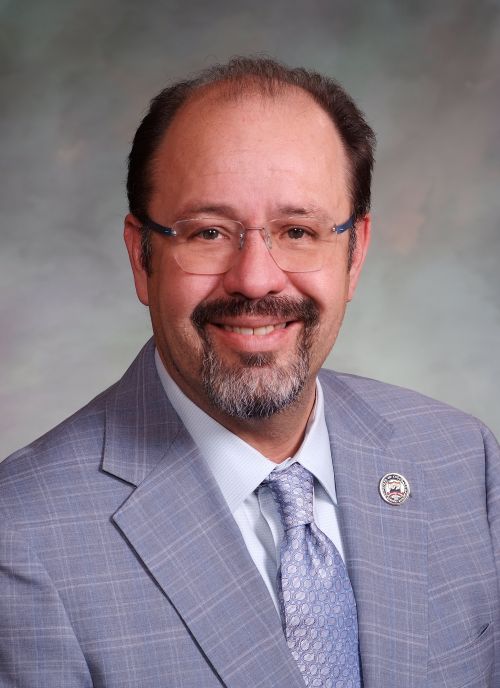
Photo of Robert Rodriguez
D Colorado Senate · District 32

Sen. Robert Rodriguez

Compare
Total votes
5,536
all sessions
Attendance
94%
378 missed
With party
98%
of cast votes
Higher than 91% of chamber peers
Bipartisan score
1%
crosses aisle rarely
Lower than 98% of chamber peers
Sponsored
436
bills & resolutions
Near the chamber average
Committees
4
assignments
436 bills and resolutions

Sponsored bills

Total
436
Primary
227
Co-sponsor
209
This page
436
matching current filters
Co-sponsor SB 25-023
Signed into law · Colorado Senate · Co-sponsor
Local Government Audit Exemption Thresholds

The act allows a local government to seek from the state auditor an exemption from the annual audit of its financial statements if the local government's total fiscal year revenues and expenditures are each less than or equal to $200,000, instead of less than $100,000 as was previously the case. The act also allows a local government to seek from the state auditor an exemption from the annual audit of its financial statements if either the local government's total fiscal year revenues or expenditures are at least $200,000 and not more than $1,000,000, instead of at least $100,000 and not more than $750,000 as was previously the case. (Note: This summary applies to this bill as enacted.)

Signed into law Apr 7, 2025 1 co-sponsor
Co-sponsor SJR 25-008
Passed · Colorado Senate · Co-sponsor
Buy Colorado Day

Maddy summarySJR 25-008 designates March 3, 2025, as "Buy Colorado Day" (also called "303 Day") and March 3-10, 2025, as "Buy Colorado Week" to encourage Coloradans to support local businesses. The resolution urges residents to spend money at homegrown Colorado brands and enterprises, highlighting the state's diverse business community including restaurants, breweries, agricultural producers, and retailers. This symbolic measure has no legal force and serves as a recognition of Colorado's economic contributions, not a new policy or requirement. It directly affects all Coloradans by promoting a voluntary shift in consumer behavior toward local spending.

Passed Apr 4, 2025 1 co-sponsor
Co-sponsor SJR 25-018
Passed · Colorado Senate · Co-sponsor
Sexual Assault Awareness Month Denim Day 2025

Maddy summarySJR 25-018 recognizes April 2025 as Sexual Assault Awareness Month and designates April 30, 2025, as Colorado Denim Day. The resolution symbolically supports the annual Denim Day observance, which began in Colorado in 2013, to raise awareness about sexual violence and honor the work of organizations like the Colorado Coalition Against Sexual Assault (CCASA). It highlights ongoing challenges such as evidence kit backlogs and the need for survivor support services, without creating new laws or funding. This is a ceremonial resolution, not a policy change, aligning Colorado with the global Denim Day movement that uses wearing jeans to protest attitudes condoning sexual assault.

Passed Apr 4, 2025 1 co-sponsor
Co-sponsor SJR 25-014
Passed · Colorado Senate · Co-sponsor
Single Parent Day

Maddy summaryThis symbolic resolution designates March 21 as "Single Parent Day in Colorado" to recognize single parents' efforts in raising children. It directly honors single parents across the state, referencing U.S. Census data showing over 10 million single-parent households nationwide. The resolution continues Colorado's recognition of the day, aligning with President Reagan's 1984 national declaration. It has no policy or funding provisions - it is purely a commemorative gesture without legal or financial impact.

Passed Apr 2, 2025 1 co-sponsor
Co-sponsor SR 25-008
Passed · Colorado Senate · Co-sponsor
Transgender Day of Visibility

Maddy summarySenate Resolution 25-008 designates March 31 of each year as "Transgender Day of Visibility" in Colorado. The resolution commits the Colorado Senate to defending transgender rights in health care, education, employment, housing, and civic participation while acknowledging Colorado's historical role in providing gender-affirming care. It also expresses solidarity with transgender people and other marginalized groups facing rights challenges. This symbolic resolution does not create new laws or funding but serves as a formal public affirmation of support for transgender Coloradans.

Passed Mar 31, 2025 1 co-sponsor
Primary HB 25-1015
Signed into law · Colorado House · Lead sponsor
Ability to Pay Bond Online Clarifications

Current law requires that bond can be posted online. The act makes clarifying changes to the bond statutes to ensure that bond can be posted online. (Note: This summary applies to this bill as enacted.)

Signed into law Mar 31, 2025 0 co-sponsors
Co-sponsor HB 25-1016
Signed into law · Colorado House · Co-sponsor
Occupational Therapist Prescribe Medical Equipment

The act authorizes an occupational therapist to directly recommend or prescribe durable medical equipment to a patient without requesting the prescription from a licensed physician and requires that the occupational therapist consult with the patient concerning payment options. (Note: This summary applies to this bill as enacted.)

Signed into law Mar 31, 2025 1 co-sponsor
Co-sponsor HB 25-1040
Signed into law · Colorado House · Co-sponsor
Adding Nuclear Energy as a Clean Energy Resource

The statutory definition of "clean energy" determines which energy projects are eligible for clean energy project financing at the county and city and county level. The statutory definition of "clean energy resource" determines which energy resources may be used by a qualifying retail utility to meet the 2050 clean energy target. The act updates the 2 statutory definitions to include nuclear energy; except that, for property valuations made for tax purposes, the act exempts from the definition of "clean energy resource" nuclear energy. (Note: This summary applies to this bill as enacted.)

Signed into law Mar 31, 2025 1 co-sponsor
Co-sponsor HB 25-1077
Signed into law · Colorado House · Co-sponsor
Backflow Prevention Devices Requirements

Backflow is the reverse flow of water, fluid, or gas caused by back pressure or back siphonage. Under current law, individuals who are engaged in the business of installing, removing, inspecting, testing, or repairing backflow prevention devices are subject to the licensure requirements for plumbers, except when the individuals are installing or testing a stand-alone fire suppression sprinkler system. The act exempts individuals engaged in the business of inspecting, testing, or repairing backflow prevention devices from licensure requirements but retains the licensure requirements for individuals engaged in the installation or removal of the devices; except that individuals who install or replace a backflow prevention device on a stand-alone fire suppression system remain exempted from the licensure requirements. The act requires that, on and after July 1, 2025, a licensed plumber who installs, tests, inspects, repairs, or reinstalls a backflow prevention device and a certified cross-connection control technician or a licensed plumber with a cross-connection control technician certification who tests or repairs a backflow prevention device must affix a tag on the backflow prevention device that contains certain information about the licensed plumber, the certified cross-connection control technician, or the licensed plumber with a cross-connection control technician certification, as applicable, and the service that was provided. (Note: This summary applies to this bill as enacted.)

Signed into law Mar 28, 2025 1 co-sponsor
Co-sponsor SB 25-042
Signed into law · Colorado Senate · Co-sponsor
Behavioral Health Crisis Response Recommendations

No later than June 30, 2026, the act requires the department of public safety (DPS), in collaboration with the behavioral health administration (BHA), to consult with stakeholders to identify: Existing resources and model programs that communities throughout Colorado utilize when responding to behavioral health crises, including, but not limited to, co-responder programs, alternative response programs, and mobile crisis response programs, and the reimbursement shortages and gaps within the continuum of care for behavioral health crisis response; and The reimbursement shortages and gaps within the continuum of care for behavioral health crisis response, and reimbursement and funding options that are available at the state and federal levels to address the shortages and gaps, including funding for treatment in place. The act requires DPS to compile a list of the existing resources and model programs, and report reimbursement shortages and gaps identified by the stakeholder group and develop recommendations for addressing the shortages and gaps. The act requires DPS to make the resources, model programs, and recommendations publicly available on DPS's website. On or before January 1, 2027, the act requires the BHA, in collaboration with the department of health care policy and financing (HCPF), to provide information to the general assembly regarding the reimbursement shortages and gaps within the continuum of care for behavioral health crisis response and the reimbursement and funding options at the state and federal level that are available to address the shortages and gaps, including funding for treatment in place. The act requires HCPF to reimburse an institution for mental diseases for providing inpatient mental health treatment to a member for up to 60 days or to the extent permitted by federal law. Current law requires each person detained for an emergency mental health hold to receive an evaluation as soon as possible after the person is presented to a facility, and the evaluation may, but is not required to, include an assessment to determine if the person continues to meet the criteria for an emergency mental health hold and requires further mental health care in a facility designated by the commissioner. The act requires the evaluation to include the assessment determination. The act requires a hospital that is subject to the federal "Emergency Medical Treatment and Labor Act" to only discharge a person placed on an emergency mental health hold if the person no longer meets the criteria for an emergency mental health hold; except that a hospital may transfer the person to another hospital if the hospital is unable to provide the appropriate medical or behavioral health care to the person and the receiving hospital agrees to the transfer. (Note: This summary applies to this bill as enacted.)

Signed into law Mar 26, 2025 1 co-sponsor
Showing 211 to 220 of 436 bills
Previous 1 21 22 23 44 Next