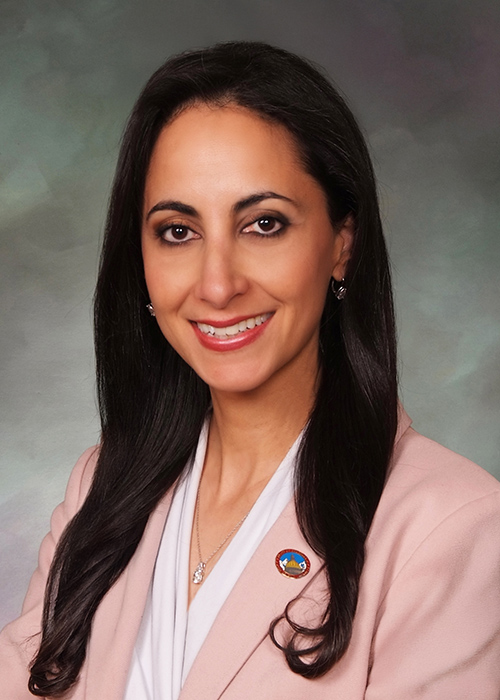
Photo of Iman Jodeh
D Colorado Senate · District 29 On the 2026 ballot

Sen. Iman Jodeh

Compare
Total votes
4,870
all sessions
Attendance
92%
370 missed
With party
99%
of cast votes
Higher than 75% of chamber peers
Bipartisan score
1%
crosses aisle rarely
Lower than 81% of chamber peers
Sponsored
631
bills & resolutions
Higher than 83% of chamber peers
Committees
2
assignments
631 bills and resolutions

Sponsored bills

Total
631
Primary
101
Co-sponsor
530
This page
631
matching current filters
Co-sponsor SJM 3
Passed · Colorado Senate · Co-sponsor
Memorializing Senator MaryAnne Tebedo

Maddy summaryThis bill memorializes former Senator MaryAnne Tebedo, honoring her life and contributions to Colorado public service. The legislation formally recognizes her decades of work in politics, including her roles as a campaign staffer, state representative, and state senator, as well as her efforts in passing funeral contract laws and her work as a mediator. It expresses the General Assembly's gratitude for her public service and extends sympathy to her surviving family members. Copies of the memorial will be sent to her children as a gesture of respect.

Passed May 20, 2026 1 co-sponsor
Primary SB 135
Passed · Colorado Senate · Lead sponsor
State Public K-12 Education Funding

The act requires the secretary of state to refer a ballot issue at the November 2026 general election to seek voter approval for the state, beginning in the 2026-27 state fiscal year, to retain and spend an amount of state revenue equal to the amount of state public K-12 education funding in excess of the limitation on state fiscal year spending and to increase state public K-12 education funding by up to 2% per year for 10 years.     The act directs legislative council staff to determine the amount of state public K-12 education funding and describes how legislative council staff will make that determination.     The act creates a positive factor to increase state public K-12 education funding. The amount of the positive factor compounds annually for 10 years. The positive factor for the 2026-27 budget year is 2% of the program foundation calculated for the 2025-26 budget year. For the 2027-28 through 2034-35 budget years, it is the sum of 2% of the prior year's program foundation plus the prior year's positive factor. For the 2035-36 budget year and beyond, it is the sum of 2% of the 2034-35 program foundation plus the 2034-35 positive factor.     A district's share of the positive factor is calculated proportionally based on the district's total program under the new school finance formula relative to the statewide total program.     A district may only use its positive factor funding for increasing teacher pay, improving teacher retention, lowering class sizes, and increasing access to career and technical courses.     For the 2026-27 state fiscal year, the children's account consists of an amount of money equal to the amount of state revenues that the state retains for a given fiscal year pursuant to voter approval of the act. For state fiscal years commencing on or after July 1, 2027, the account consists of that same amount minus an amount equal to the total dollar amount of warrants issued by the state treasurer to reimburse local governments for property tax exemptions. Money in the account must first be spent to pay districts their positive factor, then any remaining funds are appropriated for disability services and school services and to increase annual contact hours, and finally to programs prioritizing child care and full-day preschool.     The act directs the state auditor to conduct and publish a report on excess state revenues for each state fiscal year that the state retains and spends state revenues in excess of the limitation on state fiscal year spending. That report must include descriptions of:The amount of state revenues that the state retained and spent that would otherwise have been in excess of the limitation on state fiscal year spending; andHow the state expended the state revenues that the state retained and spent that would otherwise have been in excess of the limitation on state fiscal year spending.     Beginning August 1, 2027, the act requires each local education provider to post, online for free public access in a format that can be downloaded and sorted, its actual expenditures of any positive factor received.     Lastly, the act updates provisions regarding the expanded earned income tax credit, the family affordability tax credit, and the affordable housing financing fund to ensure that voter approval of the act does not adversely impact those programs.(Note: This summary applies to this bill as enacted.)


Passed May 20, 2026 0 co-sponsors
Co-sponsor SJM 2
Passed · Colorado Senate · Co-sponsor
Memorialize Former Senator Lewis H. Entz

Maddy summarySJM 2 is a memorial resolution honoring former Colorado State Senator Lewis H. Entz, who died in December 2025 at age 94. The bill formally recognizes his decades of service in the Colorado legislature (1969-2005), including eight terms in the House and five in the Senate, with focus on agriculture, water policy, and veterans' affairs. It expresses the legislature’s tribute to his public service and extends condolences to his family. As a procedural resolution, it does not enact policy changes or affect any legislation. The resolution was introduced in the Senate on February 25, 2026.

Passed May 20, 2026 1 co-sponsor
Co-sponsor SB 158
Signed into law · Colorado Senate · Co-sponsor
Youthful Offender Early Parole Procedure

The act adds the state board of parole as an entity that may approve an application for early parole for an offender who has successfully completed a specialized program as provided in current law. The offender must have been convicted of a certain predicate felony and committed the felony when they were younger than 21 years old.     The state board of parole can approve or deny the application if the governor has not acted on the application within 60 days after receiving the board's recommendation. If the governor acts on the application within 60 days, the governor's decision is final. If the governor does not act on the application, the state board of parole's decision is final.     Under current law, there is a specialized program for juveniles and young adults convicted as adults that must include components that allow an offender to experience placement with more independence in daily life. The act requires the specialized program to include programming that requires an offender to acknowledge the impact of crime on victims and the ongoing trauma that crime survivors experience, as well as the offender's own trauma.(Note: This summary applies to this bill as enacted.)
Signed into law May 19, 2026 1 co-sponsor
Co-sponsor SB 159
Signed into law · Colorado Senate · Co-sponsor
Inmate Earned Time Formula for Sentence to Department of Corrections

An inmate who is serving a sentence to the department of corrections (DOC) for certain lower level criminal offenses, has not incurred a penal discipline violation within a specified time period, and is program compliant is currently eligible to earn 12 days of earned time per month. The act increases eligibility to 14 days per month.     An inmate who is serving a sentence for, or who has been previously convicted of, certain higher level criminal offenses, including a felony offense listed in the 'Victim Rights Act', is currently eligible to earn 10 days of earned time per month. The act increases eligibility to 12 days per month.     An inmate who completes a milestone or phase of a behavioral health program in an area related to recovery from a condition that contributed to the inmate's underlying offense may be awarded up to 150 days of earned time.     The DOC is directed to enact policy changes to incentivize inmates to pursue activities that award earned time.     The act creates a working group to make recommendations for a capacity management plan (plan) for the DOC with input from impacted groups. The plan must be informed by strategies to assess prison programming and clinical care, inmate release processes, services for successful release outcomes, prison population management, and prison capacity changes. Members of the house of representatives judiciary committee, the senate judiciary committee, and the joint budget committee may submit in writing to the chair of the working group a request to prioritize specific issues or provide other relevant information. The working group shall submit an interim and a final report to the general assembly, the DOC's certified employee organization, and the governor's office.(Note: This summary applies to this bill as enacted.)

Signed into law May 19, 2026 1 co-sponsor
Co-sponsor SB 143
Signed into law · Colorado Senate · Co-sponsor
Rename Colorado Youth Advisory Council Review Committee

The act renames the Representative Hugh McKean Colorado youth advisory council review committee as the Representative Hugh McKean and Senator Faith Winter Colorado youth advisory council review committee.(Note: This summary applies to this bill as enacted.)

Signed into law May 19, 2026 1 co-sponsor
Co-sponsor SB 95
Signed into law · Colorado Senate · Co-sponsor
Measures to Support Victim-Survivors of Crimes

The act requires a licensee, nurse, or certified midwife who performs a medical forensic examination to inform the victim-survivor about how to determine when the testing related to the examination is complete and how to obtain the results and records.     The act subjects a cause of action against a person arising from any protected statement by a victim-survivor to a special motion to dismiss unless the court determines that the plaintiff has established that there is a reasonable likelihood that the plaintiff will prevail on the claim.     The act makes a predispute arbitration agreement and predispute joint-action waiver void and unenforceable upon request of an individual who alleges conduct that results in a sexual harassment dispute or a sexual misconduct dispute or upon request of a named representative of a joint action, class action, or collective action that results in a sexual harassment dispute or a sexual misconduct dispute.     The act requires a judge to allow a forensic scientist to testify remotely in a criminal proceeding if a party requests and both parties consent to the remote testimony.     The act authorizes the court to order that the testimony of a victim-survivor of domestic violence, unlawful sexual behavior, stalking, human trafficking for involuntary servitude, or human trafficking for sexual servitude be taken in a room other than the courtroom and be televised by closed-circuit television in the courtroom under certain circumstances.     The act requires peace officer annual in-service training programs to include a 2-hour training to improve a peace officer's understanding of the impact of trauma on victim-survivors of crimes and the optimal way for a peace officer to respond to victim-survivors who are experiencing trauma and includes trauma-informed investigation and response training as a permissible use of peace officer training and support fund money.     The act renames the Colorado sexual assault forensic medical evidence review board as the Colorado sexual assault response review board and adds 4 members to the board.(Note: This summary applies to this bill as enacted.)

Signed into law May 19, 2026 1 co-sponsor
Co-sponsor SJR 25
Passed · Colorado Senate · Co-sponsor
Colorado Mining Association's 150th Anniversary

Maddy summaryThis bill is a Senate Joint Resolution that formally recognizes the Colorado Mining Association for its 150th anniversary in 2026. It highlights the organization's historical significance and its role in supporting Colorado's mining industry, which contributes billions to the state's economy and supports tens of thousands of jobs. The resolution acknowledges the association's partnerships with state and federal agencies in promoting safety, environmental stewardship, and responsible mineral development. This measure does not change any laws or policies but serves as an official acknowledgment of the association's contributions to Colorado's history and economy.

Passed May 13, 2026 1 co-sponsor
Co-sponsor SB 43
Passed · Colorado Senate · Co-sponsor
Record Keeping & Regulation of Sale of Firearm Barrel

The bill requires a firearm barrel to be sold or transferred in person by a federally licensed firearm dealer. A person who is not a federally licensed firearm dealer shall not possess a firearm barrel with the intent to sell or transfer, or with the intent to offer to sell or transfer, the firearm barrel. Unlawful sale of a firearm barrel and unlawful possession with intent to sell a firearm barrel are each an unclassified misdemeanor.A person must be 18 years old or older and legally allowed to purchase a firearm under state and federal law to purchase a firearm barrel, subject to certain exceptions.The bill requires a federally licensed firearm dealer to record a sale or transfer of a firearm barrel for at least 5 years.The bill requires the Colorado bureau of investigation to create a form for federally licensed firearm dealers to record a sale or transfer of a firearm barrel.(Note: This summary applies to the reengrossed version of this bill as introduced in the second house.)

Passed May 13, 2026 1 co-sponsor
Co-sponsor SB 48
Passed · Colorado Senate · Co-sponsor
Remove Exception to Marry with Judicial Approval

Current law requires an individual to be at least 18 years old in order to obtain a marriage license; except that a minor who is 16 or 17 years old may obtain a marriage license with judicial approval. The bill repeals this exception, therefore requiring that an individual be at least 18 years old to obtain a marriage license.(Note: This summary applies to the reengrossed version of this bill as introduced in the second house.)

Passed May 13, 2026 1 co-sponsor
Showing 131 to 140 of 631 bills
Previous 1 13 14 15 64 Next